


Clipping versus coiling for aneurysmal subarachnoid hemorrhage: a systematic review and meta-analysis of prospective studies
- PMID: 34870768
- PMCID: PMC8976818
- DOI: 10.1007/s10143-021-01704-0
Clipping versus coiling for aneurysmal subarachnoid hemorrhage: a systematic review and meta-analysis of prospective studies
Abstract
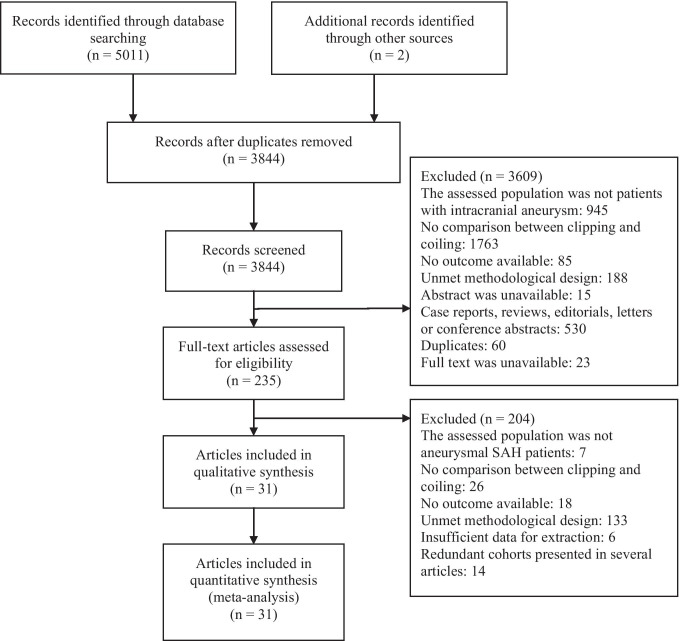
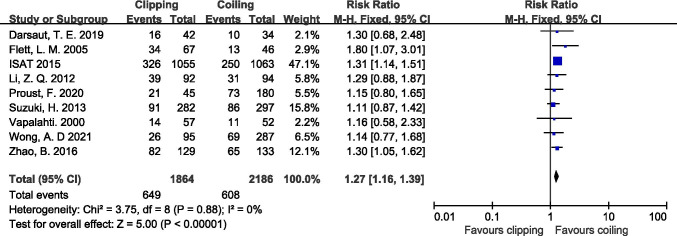
Neurosurgical clipping and endovascular coiling are both standard therapies to prevent rebleeding after aneurysmal subarachnoid hemorrhage (aSAH). However, controversy still exists about which is the optimal treatment. This meta-analysis aims to assess the effectiveness and safety of two treatments with high-quality evidence. Web of Science, Cochrane Library, EMBASE, Pubmed, Sinomed, China National Knowledge Infrastructure, and Wanfang Data databases were systematically searched on August 5, 2021. Randomized controlled trials (RCTs) and prospective cohort studies that evaluated the effectiveness and safety of clipping versus coiling in aSAH patients at discharge or within 1-year follow-up period were eligible. No restriction was set on the publication date. Meta-analyses were conducted to calculate the pooled estimates and 95% confidence intervals (CI) of relative risk (RR). Eight RCTs and 20 prospective cohort studies were identified. Compared to coiling, clipping was associated with a lower rebleeding rate at discharge (RR: 0.52, 95% CI: 0.29--0.94) and a higher aneurysmal occlusion rate (RR: 1.33, 95% CI: 1.19-1.48) at 1-year follow-up. In contrast, coiling reduced the vasospasm rate at discharge (RR: 1.45, 95% CI: 1.23-1.71) and 1-year poor outcome rate (RR: 1.27, 95% CI: 1.16-1.39). Subgroup analyses presented that among patients with a poor neurological condition at admission, no statistically significant outcome difference existed between the two treatments. The overall prognosis was better among patients who received coiling, but this advantage was not significant among patients with a poor neurological condition at admission. Therefore, the selection of treatment modality for aSAH patients should be considered comprehensively.
Keywords: Aneurysmal subarachnoid hemorrhage; Effectiveness; Endovascular coiling; Meta-analysis; Neurosurgical clipping; Safety.
© 2021. The Author(s).
Conflict of interest statement
The authors declare no competing interests.
Figures


References
Publication types
MeSH terms
LinkOut - more resources
Full Text Sources
Medical
