


Left ventricular systolic dysfunction predicted by artificial intelligence using the electrocardiogram in Chagas disease patients-The SaMi-Trop cohort
- PMID: 34871321
- PMCID: PMC8675930
- DOI: 10.1371/journal.pntd.0009974
Left ventricular systolic dysfunction predicted by artificial intelligence using the electrocardiogram in Chagas disease patients-The SaMi-Trop cohort
Erratum in
-
Correction: Left ventricular systolic dysfunction predicted by artificial intelligence using the electrocardiogram in Chagas disease patients-the SaMi-Trop cohort.PLoS Negl Trop Dis. 2022 May 25;16(5):e0010488. doi: 10.1371/journal.pntd.0010488. eCollection 2022 May. PLoS Negl Trop Dis. 2022. PMID: 35613089 Free PMC article.
Abstract
Background: Left ventricular systolic dysfunction (LVSD) in Chagas disease (ChD) is relatively common and its treatment using low-cost drugs can improve symptoms and reduce mortality. Recently, an artificial intelligence (AI)-enabled ECG algorithm showed excellent accuracy to detect LVSD in a general population, but its accuracy in ChD has not been tested.
Objective: To analyze the ability of AI to recognize LVSD in patients with ChD, defined as a left ventricular ejection fraction determined by the Echocardiogram ≤ 40%.
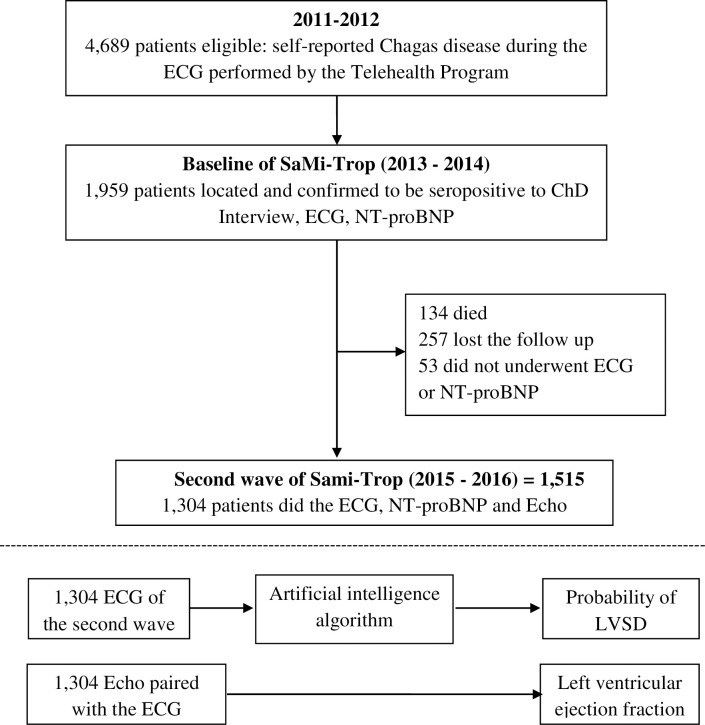
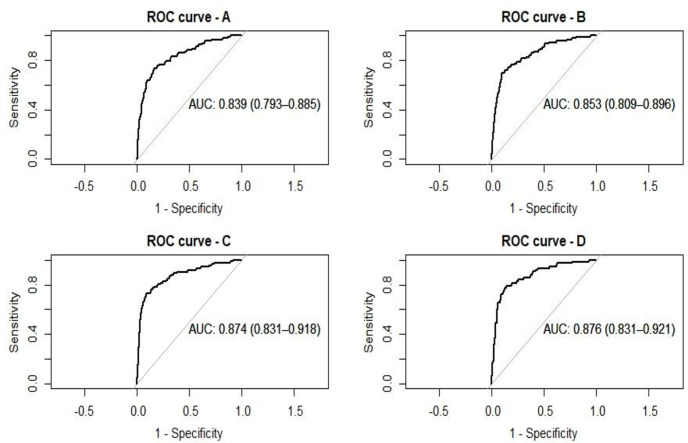
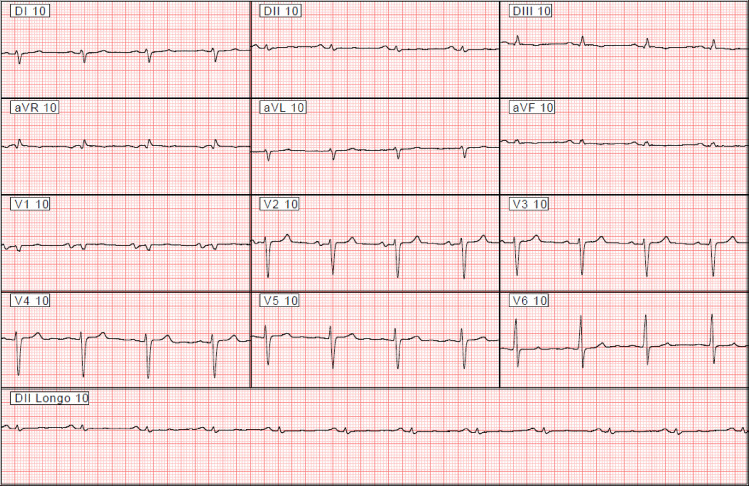
Methodology/principal findings: This is a cross-sectional study of ECG obtained from a large cohort of patients with ChD named São Paulo-Minas Gerais Tropical Medicine Research Center (SaMi-Trop) Study. The digital ECGs of the participants were submitted to the analysis of the trained machine to detect LVSD. The diagnostic performance of the AI-enabled ECG to detect LVSD was tested using an echocardiogram as the gold standard to detect LVSD, defined as an ejection fraction <40%. The model was enriched with NT-proBNP plasma levels, male sex, and QRS ≥ 120ms. Among the 1,304 participants of this study, 67% were women, median age of 60; there were 93 (7.1%) individuals with LVSD. Most patients had major ECG abnormalities (59.5%). The AI algorithm identified LVSD among ChD patients with an odds ratio of 63.3 (95% CI 32.3-128.9), a sensitivity of 73%, a specificity of 83%, an overall accuracy of 83%, and a negative predictive value of 97%; the AUC was 0.839. The model adjusted for the male sex and QRS ≥ 120ms improved the AUC to 0.859. The model adjusted for the male sex and elevated NT-proBNP had a higher accuracy of 0.89 and an AUC of 0.874.
Conclusion: The AI analysis of the ECG of Chagas disease patients can be transformed into a powerful tool for the recognition of LVSD.
Conflict of interest statement
I have read the journal’s policy and some authors of this manuscript have the following competing interests: Mayo Clinic has licensed the underlying technology to EKO, a maker of digital stethoscopes with embedded ECG electrodes. Mayo Clinic may receive financial benefit from the use of this technology, but at no point will Mayo Clinic benefit financially from its use for the care of patients at Mayo Clinic. F.L.J. and Z.I.A. may also receive financial benefit from this agreement. There is a patent filing covering some of the technology described in this manuscript (USPO application WO2019070978A1).
Figures
References
-
- Chagas C, Villela E. Cardiac form of American Trypanosomiasis. Memorias do Instituto Oswaldo Cruz. 1922;14(1):5–61.
-
- Ribeiro AL, Marcolino MS, Prineas RJ, Lima-Costa MF. Electrocardiographic abnormalities in elderly Chagas disease patients: 10-year follow-up of the Bambui Cohort Study of Aging. Journal of the American Heart Association. 2014;3(1):e000632. Epub 2014/02/11. doi: 10.1161/JAHA.113.000632 - DOI - PMC - PubMed
MeSH terms
Grants and funding
LinkOut - more resources
Full Text Sources
Medical
Research Materials
