. 2022 Jan 28;129(2):161-170.
doi: 10.1093/aob/mcab141.

Stomatal closure during water deficit is controlled by below-ground hydraulics

Affiliations

Stomatal closure during water deficit is controlled by below-ground hydraulics

Mohanned Abdalla et al. Ann Bot. .

Abstract

Background and aims: Stomatal closure allows plants to promptly respond to water shortage. Although the coordination between stomatal regulation, leaf and xylem hydraulics has been extensively investigated, the impact of below-ground hydraulics on stomatal regulation remains unknown.

Methods: We used a novel root pressure chamber to measure, during soil drying, the relation between transpiration rate (E) and leaf xylem water pressure (ψleaf-x) in tomato shoots grafted onto two contrasting rootstocks, a long and a short one. In parallel, we also measured the E(ψleaf-x) relation without pressurization. A soil-plant hydraulic model was used to reproduce the measurements. We hypothesize that (1) stomata close when the E(ψleaf-x) relation becomes non-linear and (2) non-linearity occurs at higher soil water contents and lower transpiration rates in short-rooted plants.

Key results: The E(ψleaf-x) relation was linear in wet conditions and became non-linear as the soil dried. Changing below-ground traits (i.e. root system) significantly affected the E(ψleaf-x) relation during soil drying. Plants with shorter root systems required larger gradients in soil water pressure to sustain the same transpiration rate and exhibited an earlier non-linearity and stomatal closure.

Conclusions: We conclude that, during soil drying, stomatal regulation is controlled by below-ground hydraulics in a predictable way. The model suggests that the loss of hydraulic conductivity occurred in soil. These results prove that stomatal regulation is intimately tied to root and soil hydraulic conductances.

Keywords: Solanum lycopersicum; hydraulic limitations; hydraulic signal; modelling; root system; water stress.


Figures

Fig. 1.
Fig. 1.
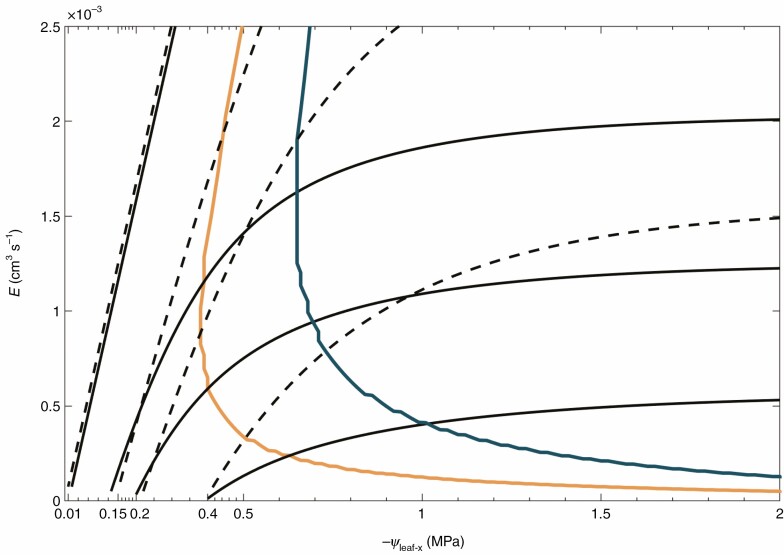
Hypothesis: reduction in root length causes an earlier drop in soil hydraulic conductance and an earlier stomatal closure. Relation between transpiration (E) and leaf xylem pressure (ψleaf-x) as simulated by a model of water flow across the soil, the root system and along the xylem, including the non-linearity of their hydraulic conductances (Carminati and Javaux, 2020). The model hypothesizes that stomata close at the onset of hydraulic limitation (stress onset line, SOL), which is defined as the point at which the slope of E(ψleaf-x) reaches 50 % of its maximum (see Materials and methods and Supplementary Data Table S2). E(ψleaf-x) relations were simulated at soil matric potentials of −0.01, −0.15 −0.2 and −0.4 MPa. Plants with a short root system (solid black lines and orange SOL) require larger gradients in soil matric potential around their roots, which results in a marked non-linearity in E(ψleaf-x) compared with plants with a long root system (dashed lines and blue SOL). Consequently, stomatal closure occurs at less negative ψleaf-x for plants with short root systems (orange line for the short and blue line for the long root system).
Fig. 2.
Fig. 2.
Measured relation between transpiration (E) and leaf xylem pressure (ψleaf-x) in tomato plants grafted onto (A) a short root system and (B) a long root system during soil drying (θ: soil water content [cm3 cm−3], N = 6).
Fig. 3.
Fig. 3.
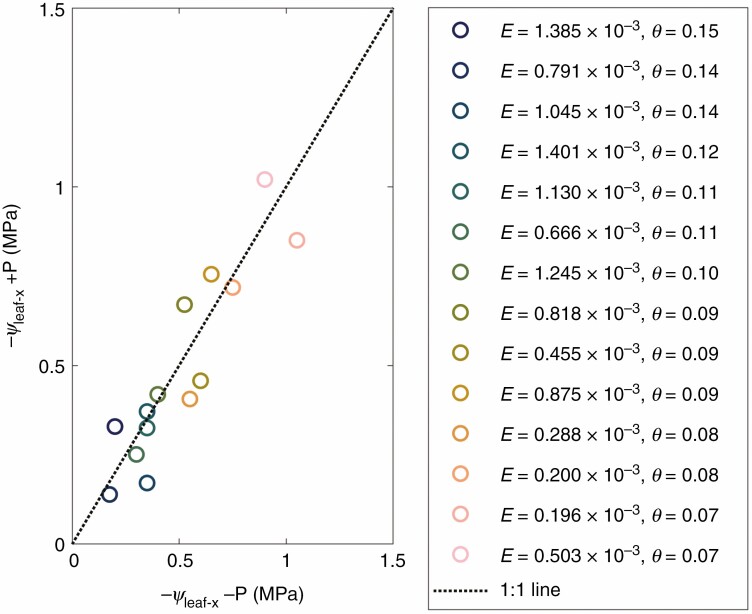
Leaf xylem pressure (ψleaf-x) in pressurized (+P) and unpressurized (−P) tomato plants at the same soil water content (θ [cm3 cm−3]) and transpiration rate (E [cm3 s−1]). The ψleaf-x of pressurized plants was measured by the RPCS, while ψleaf-x of unpressurized plants was measured with a Scholander leaf pressure chamber (N = 6). The ψleaf-x of pressurized and unpressurized plants, for the same values of E and θ, matched well (r2 = 0.81).
Fig. 4.
Fig. 4.
Relation between transpiration rate (E) and leaf xylem pressure (ψleaf-x) (A, C) as well as predawn leaf xylem pressure (ψleaf-x-PD) as proxy of soil matric potential (ψsoil) (B, D), for the short (A, B) and long (C, D) root systems. The measurements (open symbols) were well reproduced by the model (black lines) at different soil water contents (different colours). The relation shifted from linear to non-linear during soil drying. The red line marks the onset of non-linearity (SOL). The red squares in (A–D) are the measured transpiration rates during soil drying in unpressurized plants (short root system, r2 = 0.74, 0.72; long root system, r2 = 0.82, 0.78 from leaf and soil views, respectively). (E) Onset of hydraulic limitation (SOL) for long-rooted (blue line) and short-rooted plants (orange line) match well the reduction in transpiration (blue and orange open symbols, respectively). The reduction in transpiration of long- and short-rooted plants was significantly different (P < 0.001; Supplementary Data Fig. S4), with the shorter root system reducing transpiration at less negative ψleaf-x. (F) Canopy conductance (gc) as a function of ψleaf-x for the short-rooted (orange open symbols) and long-rooted plants (blue open symbols). The slope and the intercept of the linear fit were used for the analysis of covariance, which showed a significant difference in stomatal closure between the two root systems (P < 0.01).
Fig. 5.
Fig. 5.
(A) Model predictions of the leaf xylem osmotic potential matched the direct measurements of leaf osmotic potential in both root systems (as indicated in the key) during soil drying. (B) Active root length (L) as a function of soil matric potential (ψsoil) for short-rooted and long-rooted plants (as indicated in the key). Longer-rooted plants had more active roots, especially in the dry range of ψsoil. (C) The difference between root fresh and dry weight was divided by dry weight to obtain root shrinkage. Root water content decreased exponentially as soil matric potential declined.
Fig. 6.
Fig. 6.
Relation between transpiration rate (E) and leaf xylem pressure (ψleaf~-x) for one exemplary measurement cycle (θ = 0.1045). Different model simulations were compared regarding their explanatory values. The measurements were well captured by a single soil isoline fitted to all data points (as indicated in the key) using the steady-state soil–plant hydraulic model. To understand the effect of decreasing soil water content during the measurement cycle, we plotted the soil isolines at the initial (θi = 0.1045) and final (θj = 0.0874) soil water content of the measurement cycle using the steady-state model but with different fitting parameters (L and Kroot) compared with the single soil isoline. The simulated trajectories with and without root capacitance were very close, indicating that root capacitance had a minor contribution to the E(ψleaf~-x) relation. Both trajectories reproduced the measurements very well.

References

    1. Abdalla M, Carminati A, Cai G, Javaux M, Ahmed MA. 2021. Stomatal closure of tomato under drought is driven by an increase in soil-root hydraulic resistance. Plant, Cell & Environment 44: 425–431. - PubMed
    1. Albuquerque C, Scoffoni C, Brodersen CR, Buckley TN, Sack L, McElrone AJ. 2020. Coordinated decline of leaf hydraulic and stomatal conductances under drought is not linked to leaf xylem embolism for different grapevine cultivars. Journal of Experimental Botany 71: 7286–7300. - PubMed

    1. Anderegg WRL, Wolf A, Arango-Velez A, et al. 2017. Plant water potential improves prediction of empirical stomatal models. PLoS ONE 12: e0185481. - PMC - PubMed
    1. Bartlett MK, Klein T, Jansen S, Choat B, Sack L. 2016. The correlations and sequence of plant stomatal, hydraulic, and wilting responses to drought. Proceedings of the National Academy of Sciences of the USA 113: 13098–13103. - PMC - PubMed
    1. Bourbia I, Pritzkow C, Brodribb TJ. 2021. Herb and conifer roots show similar high sensitivity to water deficit. Plant Physiology 186: 1908–1918. - PMC - PubMed

Publication types