. 2021 Dec 6;4(1):1362.
doi: 10.1038/s42003-021-02870-z.

Diversification of ergot alkaloids and heritable fungal symbionts in morning glories

Affiliations

Diversification of ergot alkaloids and heritable fungal symbionts in morning glories

Wesley T Beaulieu et al. Commun Biol. .

Abstract

Heritable microorganisms play critical roles in life cycles of many macro-organisms but their prevalence and functional roles are unknown for most plants. Bioactive ergot alkaloids produced by heritable Periglandula fungi occur in some morning glories (Convolvulaceae), similar to ergot alkaloids in grasses infected with related fungi. Ergot alkaloids have been of longstanding interest given their toxic effects, psychoactive properties, and medical applications. Here we show that ergot alkaloids are concentrated in four morning glory clades exhibiting differences in alkaloid profiles and are more prevalent in species with larger seeds than those with smaller seeds. Further, we found a phylogenetically-independent, positive correlation between seed mass and alkaloid concentrations in symbiotic species. Our findings suggest that heritable symbiosis has diversified among particular clades by vertical transmission through seeds combined with host speciation, and that ergot alkaloids are particularly beneficial to species with larger seeds. Our results are consistent with the defensive symbiosis hypothesis where bioactive ergot alkaloids from Periglandula symbionts protect seeds and seedlings from natural enemies, and provide a framework for exploring microbial chemistry in other plant-microbe interactions.


Conflict of interest statement

The authors declare no competing interests.

Figures
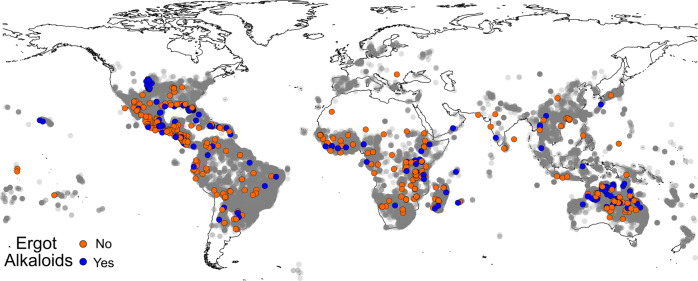
Fig. 1
Fig. 1. Geography of samples.
Global distribution of samples tested for EAs (n = 723). Gray circles represent herbarium specimens from Argyreia, Ipomoea, Stictocardia, and Turbina (now Ipomoea) species from the Global Biodiversity Information Facility to illustrate the geographical distribution of the tribe Ipomoeeae with higher concentrations of sample in darker areas.
Fig. 2
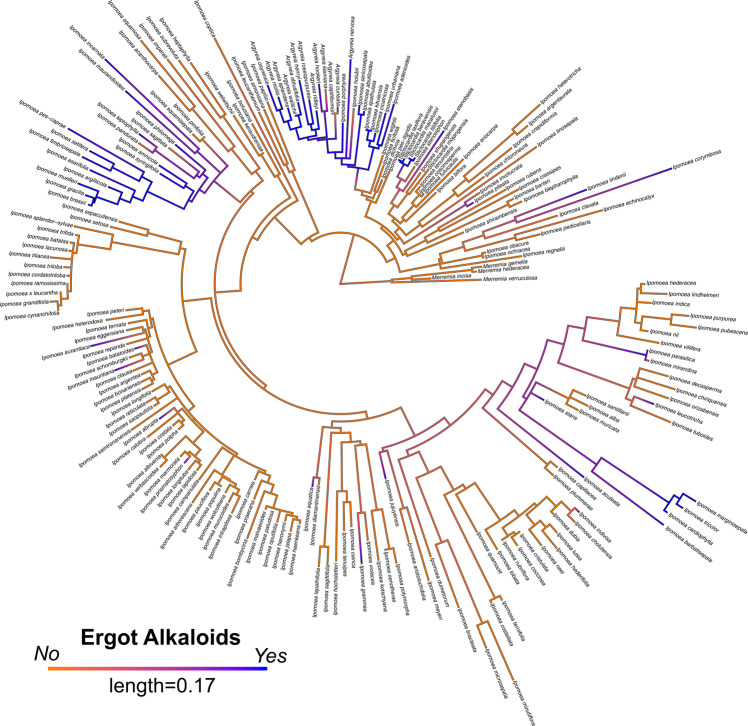
Fig. 2. ITS phylogeny of morning glories.
Maximum likelihood ITS phylogeny of morning glories (n = 206) with ancestral state reconstruction of EA presence by density map based on 1000 stochastic character maps. Branch color represents the probability of the character state. Length of the legend equals units of substitution per site.
Fig. 3
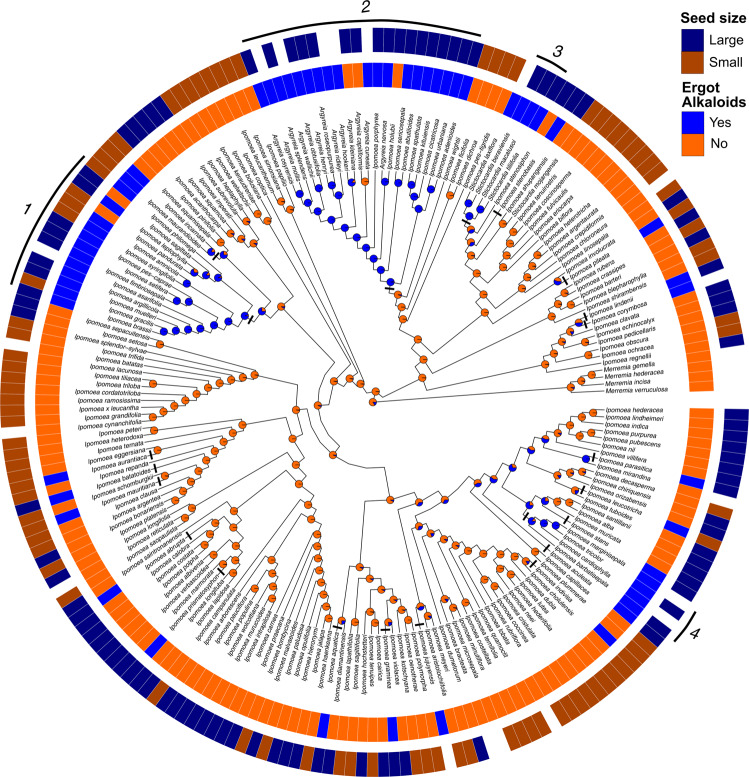
Fig. 3. Ancestral state reconstruction of EA presence.
Phylogenetic distribution of EA presence and seed mass. Species lacking seed mass data are represented by blank spaces. Pie charts at nodes indicate the relative likelihoods of the alkaloid ancestral character state. Black bars represent the origins of symbiosis. Lines and numbers indicate major clades of EA+ species: (1) Pes-caprae, (2) ATP, (3) Stictocardia, (4) Tricolores.
Fig. 4
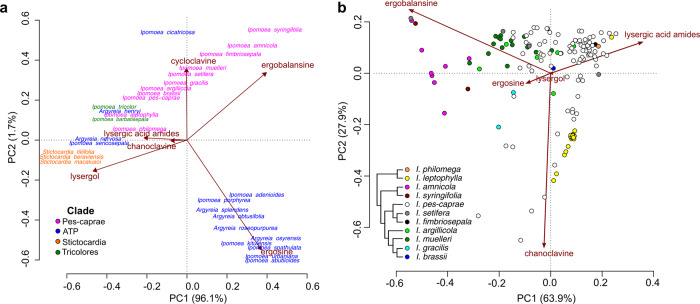
Fig. 4. Clustering of alkaloid profiles in EA+ species.
a Phylogenetic PCA of EA+ species colored by the four major clades. EA values are averaged for each species. b PCA of EA+ species in the Pes-caprae clade.
Fig. 5
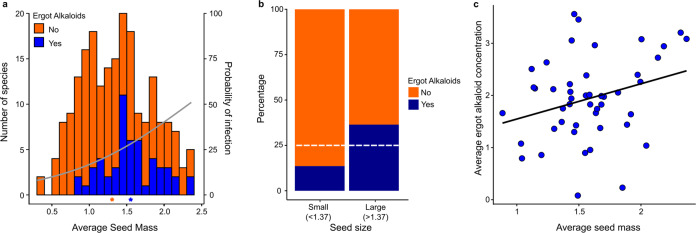
Fig. 5. Relationship of seed mass and EA concentrations.
Seed mass and EA concentrations are log10-transformed. a Number of species with (n = 53) or without (n = 157) EAs by mean seed mass. Stars along the x-axis indicate the mean seed mass of each group. Binomial regression line shows the probability of infection based on mean seed mass. b Proportion of small and large-seeded species with or without EAs. Dashed lines represent the expected number of EA+ species if the proportion of EA+ species is equivalent across seed mass. c Phylogenetic regression of seed mass and EA concentration in EA+ species.

References

    1. Smith, D. C. & Douglas, A. E. The biology of symbiosis. (Edward Arnold Ltd., 1987).
    1. Engl T, et al. Evolutionary stability of antibiotic protection in a defensive symbiosis. Proc. Natl Acad. Sci. USA. 2018;115:E2020–E2029. - PMC - PubMed
    1. Zan, J. et al. A microbial factory for defensive kahalalides in a tripartite marine symbiosis. Science10.1126/science.aaw6732 (2019). - PMC - PubMed
    1. Clay K, Schardl C. Evolutionary origins and ecological consequences of endophyte symbiosis with grasses. Am. Nat. 2002;160:S99–S127. - PubMed
    1. Eich, E. Solanaceae and Convolvulaceae: Secondary Metabolites. (Springer-Verlag Berlin Heidelberg, 2008).

Publication types

Substances