. 2021 Dec 24;84(12):3138-3146.
doi: 10.1021/acs.jnatprod.1c00938. Epub 2021 Dec 7.

Barrettides: A Peptide Family Specifically Produced by the Deep-Sea Sponge Geodia barretti

Affiliations

Barrettides: A Peptide Family Specifically Produced by the Deep-Sea Sponge Geodia barretti

Karin Steffen et al. J Nat Prod. .

Abstract

Natural product discovery by isolation and structure elucidation is a laborious task often requiring ample quantities of biological starting material and frequently resulting in the rediscovery of previously known compounds. However, peptides are a compound class amenable to an alternative genomic, transcriptomic, and in silico discovery route by similarity searches of known peptide sequences against sequencing data. Based on the sequences of barrettides A and B, we identified five new barrettide sequences (barrettides C-G) predicted from the North Atlantic deep-sea demosponge Geodia barretti (Geodiidae). We synthesized, folded, and investigated one of the newly described barrettides, barrettide C (NVVPCFCVEDETSGAKTCIPDNCDASRGTNP, disulfide connectivity I-IV, II-III). Co-elution experiments of synthetic and sponge-derived barrettide C confirmed its native conformation. NMR spectroscopy and the anti-biofouling activity on larval settlement of the bay barnacle Amphibalanus improvisus (IC50 0.64 μM) show that barrettide C is highly similar to barrettides A and B in both structure and function. Several lines of evidence suggest that barrettides are produced by the sponge itself and not one of its microbial symbionts.


Conflict of interest statement

The authors declare no competing financial interest.

Figures
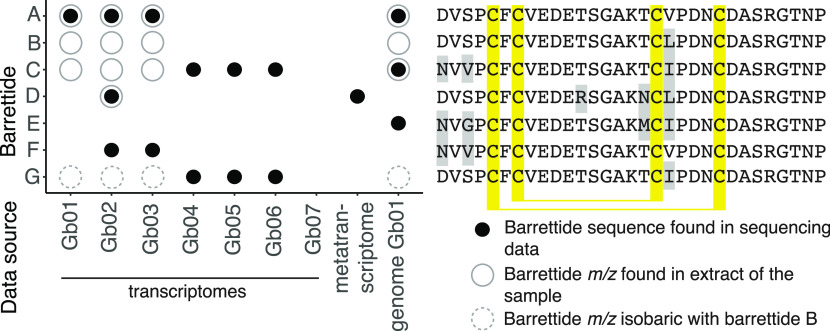
Figure 1
Figure 1
Identification of barrettides across different G. barretti samples. Full black circles: barrettide sequence found in respective sequencing data, open gray circles: barrettide m/z found in metabolic profile of the same sample. Dashed gray circles: m/z isobaric with barrettide B. The corresponding amino acid sequences are shown to the right, and amino acid differences to barrettide A are highlighted with gray shading. Gb07 did not yield any hits due to the quality filtering process removing most of the assembled transcripts.
Figure 2
Figure 2
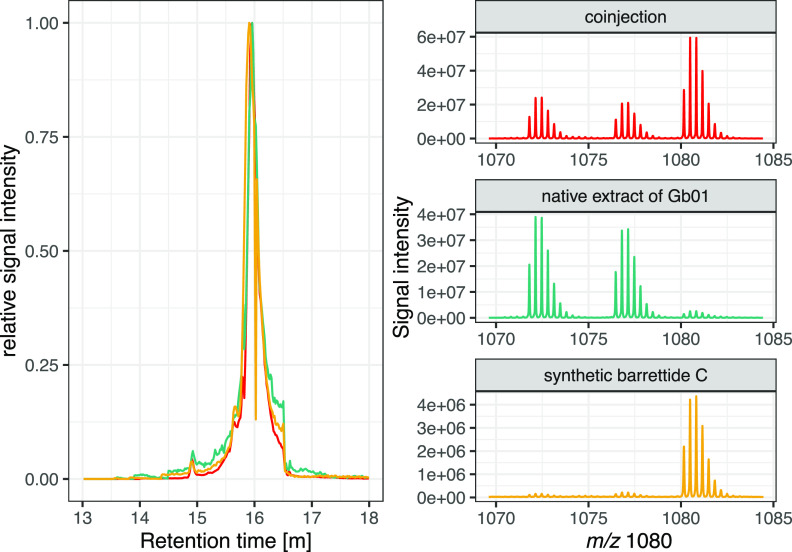
Left: Selected ion mass chromatograms for the m/z 1080 [M + 3H]3+ of barrettide C. The synthetic peptide (yellow) has the same retention time (tR) as the m/z observed in the native chemical profile (turquoise). Likewise, the native chemical extract spiked with synthetic barrettide C (red) only shows one peak at the same tR. Right: Isotopic patterns show a signal increase in the spiked native extract both in absolute terms and relative to the intensities of barrettide A ([M + 3H]3+ 1071) and B ([M + 3H]3+ 1076).
Figure 3
Figure 3
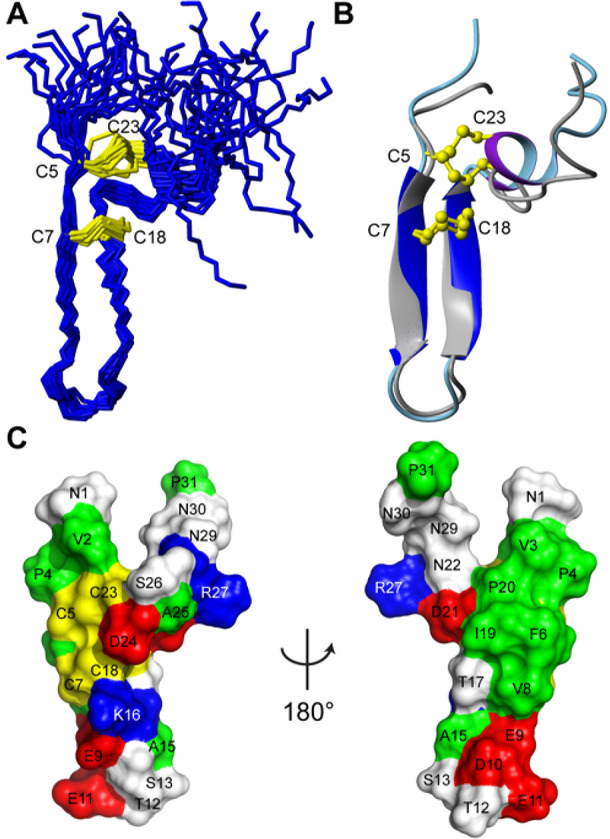
Solution NMR structure of barrettide C and comparison to barrettide A. (A) Superimposed structural ensemble of barrettide C in stick format, with disulfide bonds in yellow. (B) Superimposition of barrettide C (dark blue β-sheet, light blue backbone, and purple α-helix) and barrettide A (gray β-sheet and backbone) in ribbon format with ball-and-stick disulfide bonds in yellow. This superimposition highlights the conserved β-hairpin structure of the barrettides. (C) Surface representation of barrettide C. Colors are used to denote residue side chain properties: negatively charged (red), positively charged (blue), hydrophobic (green), disulfide (yellow), and polar (white). Individual amino acids are also labeled for orientation.
Figure 4
Figure 4
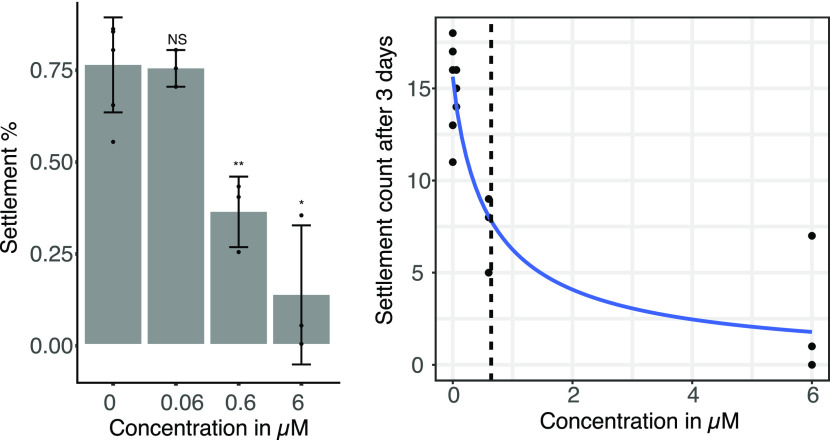
(Left) Larval settlement after 3 days of incubation with barrettide C. No mortality was observed. The experiments were performed in triplicate with n = 20 (±2) larvae per assay. Statistical evaluation was performed using a χ2 test comparing treatments to control. (Right) Dose–response curve of barnacle larval settlement after 3 days of incubation with barrettide C. The IC50 is indicated as a dashed line.

References

    1. Leal M. C.; Puga J.; Serôdio J.; Gomes N. C. M.; Calado R. Trends in the Discovery of New Marine Natural Products from Invertebrates over the Last Two Decades – Where and What Are We Bioprospecting?. PLoS One 2012, 7, e30580 10.1371/journal.pone.0030580. - DOI - PMC - PubMed
    1. Kornprobst J.-M.Porifera (Sponges). Encyclopedia of Marine Natural Products, 2nd ed.; Wiley-VCH: Weinheim, 2014; Vol. 2, pp 607–1086, OCLC: 931543490.
    1. Galitz A.; Nakao Y.; Schupp P. J.; Wörheide G.; Erpenbeck D. A Soft Spot for Chemistry–Current Taxonomic and Evolutionary Implications of Sponge Secondary Metabolite Distribution. Mar. Drugs 2021, 19, 448. 10.3390/md19080448. - DOI - PMC - PubMed
    1. Unson M. D.; Holland N. D.; Faulkner D. J. A brominated secondary metabolite synthesized by the cyanobacterial symbiont of a marine sponge and accumulation of the crystalline metabolite in the sponge tissue. Mar. Biol. 1994, 119, 1–11. 10.1007/BF00350100. - DOI
    1. Wilson M. C.; et al. An environmental bacterial taxon with a large and distinct metabolic repertoire. Nature 2014, 506, 58–62. 10.1038/nature12959. - DOI - PubMed

Publication types