


Dementia Caregiver Experiences and Recommendations for Using the Behavioral and Environmental Sensing and Intervention System at Home: Usability and Acceptability Study
- PMID: 34874886
- PMCID: PMC8691404
- DOI: 10.2196/30353
Dementia Caregiver Experiences and Recommendations for Using the Behavioral and Environmental Sensing and Intervention System at Home: Usability and Acceptability Study
Abstract
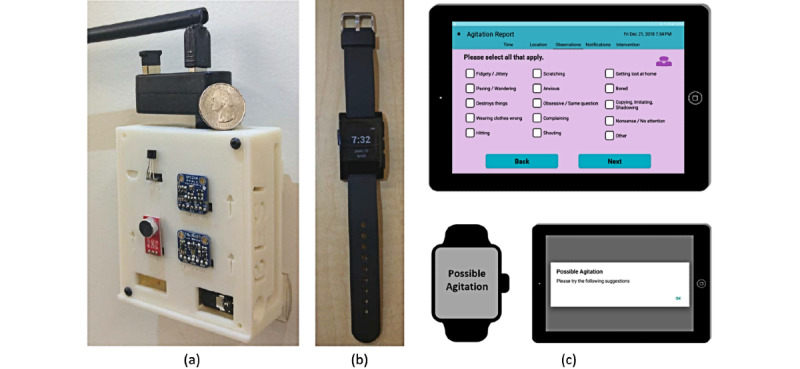
Background: Caregiver burden associated with dementia-related agitation is one of the most common reasons for a community-dwelling person living with dementia to transition to a care facility. The Behavioral and Environmental Sensing and Intervention (BESI) for the Dementia Caregiver Empowerment system uses sensing technology, smartwatches, tablets, and data analytics to detect and predict agitation in persons living with dementia and to provide just-in-time notifications and dyad-specific intervention recommendations to caregivers. The BESI system has shown that there is a valid relationship between dementia-related agitation and environmental factors and that caregivers prefer a home-based monitoring system.
Objective: The aim of this study is to obtain input from caregivers of persons living with dementia on the value, usability, and acceptability of the BESI system in the home setting and obtain their insights and recommendations for the next stage of system development.
Methods: A descriptive qualitative design with thematic analysis was used to analyze 10 semistructured interviews with caregivers. The interviews comprised 16 questions, with an 80% (128/160) response rate.
Results: Postdeployment caregiver feedback about the BESI system and the overall experience were generally positive. Caregivers acknowledged the acceptability of the system by noting the ease of use and saw the system as a fit for them. Functionality issues such as timeliness in agitation notification and simplicity in the selection of agitation descriptors on the tablet interface were identified, and caregivers indicated a desire for more word options to describe agitation behaviors. Agitation intervention suggestions were well received by the caregivers, and the resulting decrease in the number and severity of agitation events helped confirm that the BESI system has good value and acceptability. Thematic analysis suggested several subjective experiences and yielded the themes of usefulness and helpfulness.
Conclusions: This study determined preferences for assessing caregiver strain and burden, explored caregiver acceptance of the technology system (in-home sensors, actigraph or smart watch technology, and tablet devices), discerned caregiver insights on the burden and stress of caring for persons living with dementia experiencing agitation in dementia, and solicited caregiver input and recommendations for system changes. The themes of usefulness and helpfulness support the use of caregiver knowledge and experience to inform further development of the technology.
Keywords: agitation; caregiver; dementia; dyad; home-based; just-in-time notifications; qualitative; sensors; smart health; wearable technology.
©Martha Smith Anderson, Azziza Bankole, Nutta Homdee, Brook A Mitchell, Grace E Byfield, John Lach. Originally published in JMIR Aging (https://aging.jmir.org), 06.12.2021.
Conflict of interest statement
Conflicts of Interest: None declared.
Figures
References
-
- van der Linde RM, Dening T, Stephan BC, Prina AM, Evans E, Brayne C. Longitudinal course of behavioural and psychological symptoms of dementia: systematic review. Br J Psychiatry. 2016 Nov 02;209(5):366–77. doi: 10.1192/bjp.bp.114.148403. http://europepmc.org/abstract/MED/27491532 S0007125000245376 - DOI - PMC - PubMed
-
- Guisado-Fernández E, Giunti G, Mackey LM, Blake C, Caulfield BM. Factors influencing the adoption of smart health technologies for people with dementia and their informal caregivers: scoping review and design framework. JMIR Aging. 2019 Apr 30;2(1):e12192. doi: 10.2196/12192. https://aging.jmir.org/2019/1/e12192/ v2i1e12192 - DOI - PMC - PubMed
-
- Anderson MS, Homdee N, Bankole A, Alam R, Mitchell B, Hayes J, Byfield G, Lach J. Behavioral interventions for Alzheimer’s management using technology: home-based monitoring. Curr Geri Rep. 2020 Mar 21;9(2):90–100. doi: 10.1007/s13670-020-00312-y. - DOI
-
- Désormeaux-Moreau M, Michel C, Vallières M, Racine M, Poulin-Paquet M, Lacasse D, Gionet P, Genereux M, Lachiheb W, Provencher V. Mobile apps to support family caregivers of people with Alzheimer disease and related dementias in managing disruptive behaviors: qualitative study with users embedded in a scoping review. JMIR Aging. 2021 Apr 16;4(2):e21808. doi: 10.2196/21808. https://aging.jmir.org/2021/2/e21808/ v4i2e21808 - DOI - PMC - PubMed
-
- Joo E, Kononova A, Kanthawala S, Peng W, Cotten S. Smartphone users' persuasion knowledge in the context of consumer mHealth apps: qualitative study. JMIR Mhealth Uhealth. 2021 Apr 13;9(4):e16518. doi: 10.2196/16518. https://mhealth.jmir.org/2021/4/e16518/ v9i4e16518 - DOI - PMC - PubMed
LinkOut - more resources
Full Text Sources
