


Impact of a Mobile Telerehabilitation Solution on Metabolic Health Outcomes and Rehabilitation Adherence in Patients With Obesity: Randomized Controlled Trial
- PMID: 34874887
- PMCID: PMC8691412
- DOI: 10.2196/28242
Impact of a Mobile Telerehabilitation Solution on Metabolic Health Outcomes and Rehabilitation Adherence in Patients With Obesity: Randomized Controlled Trial
Abstract
Background: Obesity is a major public health issue. Combining exercise training, nutrition, and therapeutic education in metabolic rehabilitation (MR) is recommended for obesity management. However, evidence from randomized controlled studies is lacking. In addition, MR is associated with poor patient adherence. Mobile health devices improve access to MR components.
Objective: The aim of this study is to compare the changes in body composition, anthropometric parameters, exercise capacity, and quality of life (QOL) within 12 weeks of patients in the telerehabilitation (TR) program to those of usual care patients with obesity.
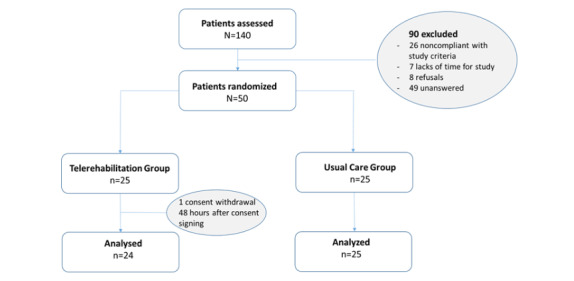
Methods: This was a parallel-design randomized controlled study. In total, 50 patients with obesity (BMI>30 kg/m²) were included in a TR group (TRG) or a usual care group (UCG) for 12 weeks. Patients underwent biometric impedance analyses, metabolic exercise tests, actimetry, and QOL and satisfaction questionnaires. The primary outcome was the change in fat mass at 12 weeks from baseline. Secondary outcomes were changes in body weight, metabolic parameters, exercise capacity, QOL, patients' adhesion, and satisfaction.
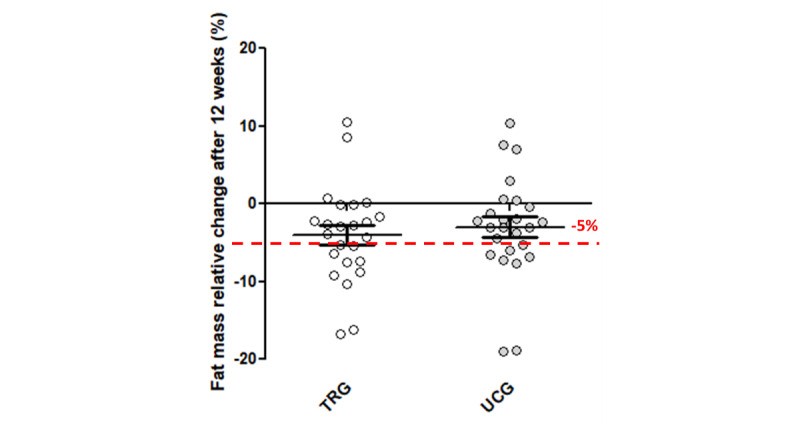
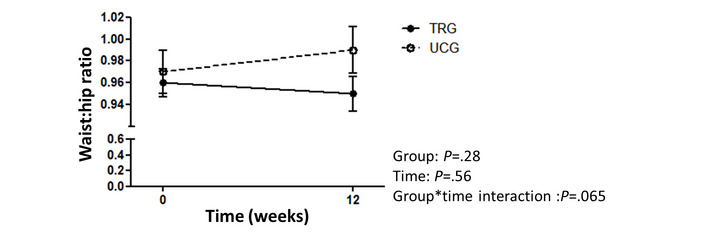
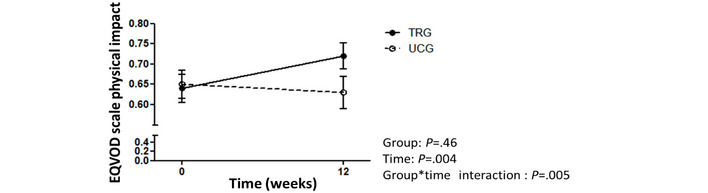
Results: A total of 49 patients completed the study. No significant group × time interaction was found for fat mass (TRG: mean 1.7 kg, SD 2.6 kg; UCG: mean 1.2 kg, SD 2.4 kg; P=.48). Compared with the UCG, TRG patients tended to significantly improve their waist to hip ratios (TRG: -0.01 kg, SD 0.04; UCG: +0.01 kg, SD 0.06; P=.07) and improved QOL physical impact (TRG: +21.8, SD 43.6; UCG: -1.2, SD 15.4; P=.005). Significant time effects were observed for body composition, 6-minute walk test distance, exercise metabolism, sedentary time, and QOL. Adherence (95%) and satisfaction in the TRG were good.
Conclusions: In adults with obesity, the TR program was not superior to usual care for improving body composition. However, TR was able to deliver full multidisciplinary rehabilitation to patients with obesity and improve some health outcomes. Given the patients' adherence and satisfaction, pragmatic programs should consider mobile health devices to improve access to MR. Further studies are warranted to further establish the benefits that TR has over usual care.
Trial registration: ClinicalTrials.gov NCT03396666; http://clinicaltrials.gov/ct2/show/NCT03396666.
Keywords: mHealth; mobile phone; obesity; rehabilitation; telerehabilitation.
©François Bughin, Gaspard Bui, Bronia Ayoub, Leo Blervaque, Didier Saey, Antoine Avignon, Jean Frédéric Brun, Nicolas Molinari, Pascal Pomies, Jacques Mercier, Fares Gouzi, Maurice Hayot. Originally published in JMIR mHealth and uHealth (https://mhealth.jmir.org), 06.12.2021.
Conflict of interest statement
Conflicts of Interest: None declared.
Figures
References
-
- NCD Risk Factor Collaboration (NCD-RisC) Worldwide trends in body-mass index, underweight, overweight, and obesity from 1975 to 2016: a pooled analysis of 2416 population-based measurement studies in 128·9 million children, adolescents, and adults. Lancet. 2017 Dec 16;390(10113):2627–42. doi: 10.1016/S0140-6736(17)32129-3. https://linkinghub.elsevier.com/retrieve/pii/S0140-6736(17)32129-3 S0140-6736(17)32129-3 - DOI - PMC - PubMed
-
- Global BMI Mortality Collaboration. Di Angelantonio E, Bhupathiraju S, Wormser D, Gao P, Kaptoge S, Berrington de Gonzalez A, Cairns B, Huxley R, Jackson C, Joshy G, Lewington S, Manson J, Murphy N, Patel A, Samet J, Woodward M, Zheng W, Zhou M, Bansal N, Barricarte A, Carter B, Cerhan J, Smith G, Fang X, Franco O, Green J, Halsey J, Hildebrand J, Jung K, Korda R, McLerran D, Moore S, O'Keeffe L, Paige E, Ramond A, Reeves G, Rolland B, Sacerdote C, Sattar N, Sofianopoulou E, Stevens J, Thun M, Ueshima H, Yang L, Yun Y, Willeit P, Banks E, Beral V, Chen Z, Gapstur S, Gunter M, Hartge P, Jee S, Lam T, Peto R, Potter J, Willett W, Thompson S, Danesh J, Hu F. Body-mass index and all-cause mortality: individual-participant-data meta-analysis of 239 prospective studies in four continents. Lancet. 2016 Dec 20;388(10046):776–86. doi: 10.1016/S01406736(16)30175-1. doi: 10.1016/S0140-6736(16)30175-1.S0140-6736(16)30175-1 - DOI - PMC - PubMed
-
- Pouliot MC, Després JP, Lemieux S, Moorjani S, Bouchard C, Tremblay A, Nadeau A, Lupien PJ. Waist circumference and abdominal sagittal diameter: best simple anthropometric indexes of abdominal visceral adipose tissue accumulation and related cardiovascular risk in men and women. Am J Cardiol. 1994 Mar 01;73(7):460–8. doi: 10.1016/0002-9149(94)90676-9.0002-9149(94)90676-9 - DOI - PubMed
Publication types
MeSH terms
Associated data
LinkOut - more resources
Full Text Sources
Medical
