


How do gender disparities in entrepreneurial aspirations emerge in Pakistan? An approach to mediation and multi-group analysis
- PMID: 34874979
- PMCID: PMC8651106
- DOI: 10.1371/journal.pone.0260437
How do gender disparities in entrepreneurial aspirations emerge in Pakistan? An approach to mediation and multi-group analysis
Abstract
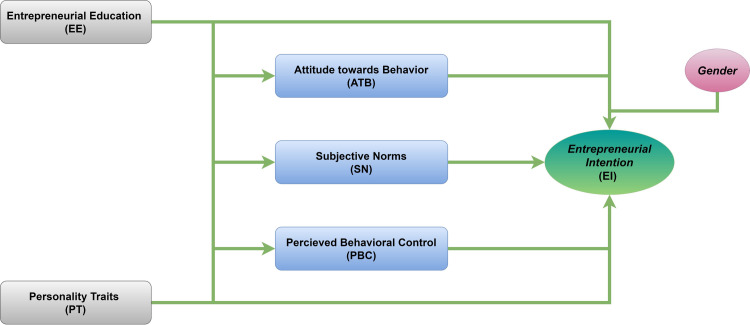
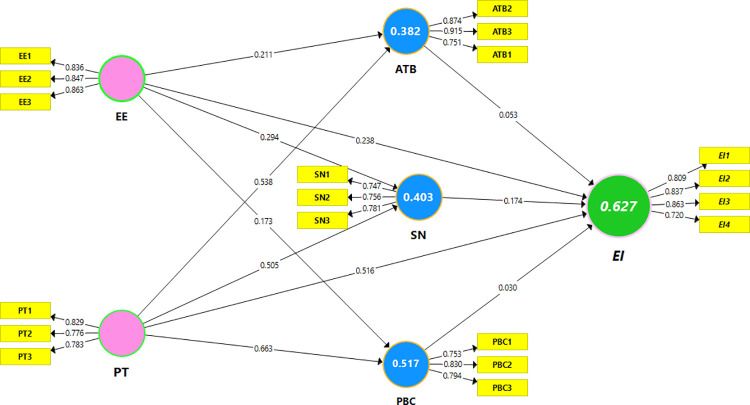
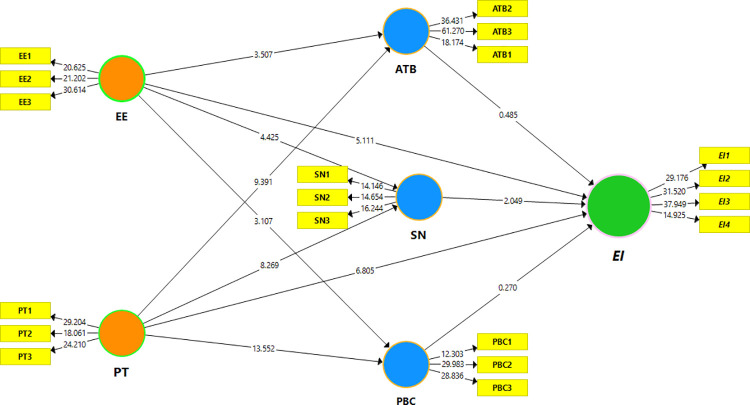
This cross-sectional study sought to identify gender differences in individual behavioral attitudes, personal traits, and entrepreneurial education based on planned behavior theory. The Smart partial least squares (PLS) structural equation model and PLS path modeling were used. A survey design was used to collect data from 309 samples using quantitative measures. The model was tested for validity and reliability and showed variance (full, R2 = 58.9% and split, R2 = 62.7% and R2 = 52.7%) in male and female model predictive power, respectively. Subjective norms (SN), personality traits (PT), and entrepreneurial education (EE) significantly impacted the male sample's intention. Females' intentions toward entrepreneurship was less affected by attitude toward behavior (ATB), subjective norms (SN), perceived behavioral control (PBC), and entrepreneurship education (EE). Further, attitudes, social norms, and behavioral controls as mediation variables indicate a significant and positive role of male and female intentions. These findings imply that behavioral beliefs (ATB, PBC, and SN) influence entrepreneurial intention-action translation. The results significantly supported the designed hypotheses and shed light on individual personality traits (PT) and entrepreneurship education (EE) underpinning enterprise intention. The study determined that EE and PT are the strongest predictors of intention, thus highlighting the role of these motives in the entrepreneurial process. This study contributes to the growing body of knowledge on youth entrepreneurs, expands our understanding of entrepreneurship as a practical career choice, and offers a novel account differentiating male and female PT. The drive to evaluate the effects of entrepreneurial intention among budding disparities in Pakistan requires a more profound knowledge of the aspects that endorse entrepreneurship as a choice of profession and enhances youth incentive abilities to engage in entrepreneurial activities based on exploitation.
Conflict of interest statement
The authors have declared that no competing interests exist.
Figures
References
-
- Mahfud T, Triyono MB, Sudira P, Mulyani Y. The influence of social capital and entrepreneurial attitude orientation on entrepreneurial intentions: the mediating role of psychological capital. Eur Res Manag Bus Econ. 2020;26. doi: 10.1016/j.iedeen.2019.12.005 - DOI
-
- Sargani GR, Zhou D, Raza MH, Wei Y. Sustainable entrepreneurship in the agriculture sector: The nexus of the triple bottom line measurement approach. Sustain. 2020;12. doi: 10.3390/SU12083275 - DOI
-
- Sargani GR, Deyi Z, Magsi H, Noonari S, Joyo A, Muhammad S, et al. An Empirical Study of Attitude Towards Entrepreneurial Intention among Pakistan and China Agricultural Graduates in Agribusiness. Int J Bus Manag Technol. 2018;2: 21–34. Available: www.theijbmt.com
-
- Roomi MA, Parrott G. Barriers to Development and Progression of Women Entrepreneurs in Pakistan. J Entrep. 2008;17: 59–72. doi: 10.1177/097135570701700105 - DOI
MeSH terms
LinkOut - more resources
Full Text Sources
