


Modelling and identification of characteristic kinematic features preceding freezing of gait with convolutional neural networks and layer-wise relevance propagation
- PMID: 34876110
- PMCID: PMC8650332
- DOI: 10.1186/s12911-021-01699-0
Modelling and identification of characteristic kinematic features preceding freezing of gait with convolutional neural networks and layer-wise relevance propagation
Abstract
Background: Although deep neural networks (DNNs) are showing state of the art performance in clinical gait analysis, they are considered to be black-box algorithms. In other words, there is a lack of direct understanding of a DNN's ability to identify relevant features, hindering clinical acceptance. Interpretability methods have been developed to ameliorate this concern by providing a way to explain DNN predictions.
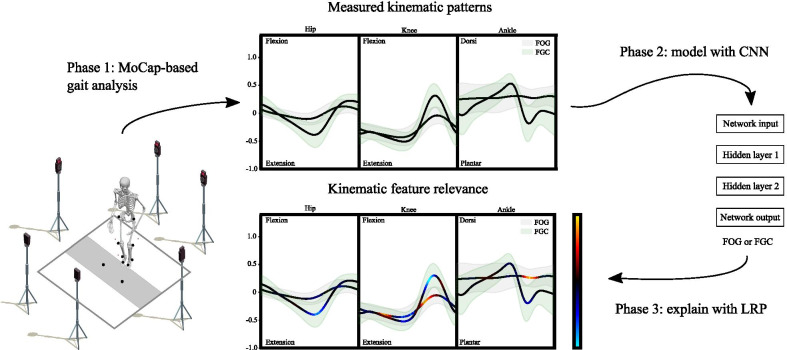
Methods: This paper proposes the use of an interpretability method to explain DNN decisions for classifying the movement that precedes freezing of gait (FOG), one of the most debilitating symptoms of Parkinson's disease (PD). The proposed two-stage pipeline consists of (1) a convolutional neural network (CNN) to model the reduction of movement present before a FOG episode, and (2) layer-wise relevance propagation (LRP) to visualize the underlying features that the CNN perceives as important to model the pathology. The CNN was trained with the sagittal plane kinematics from a motion capture dataset of fourteen PD patients with FOG. The robustness of the model predictions and learned features was further assessed on fourteen PD patients without FOG and fourteen age-matched healthy controls.
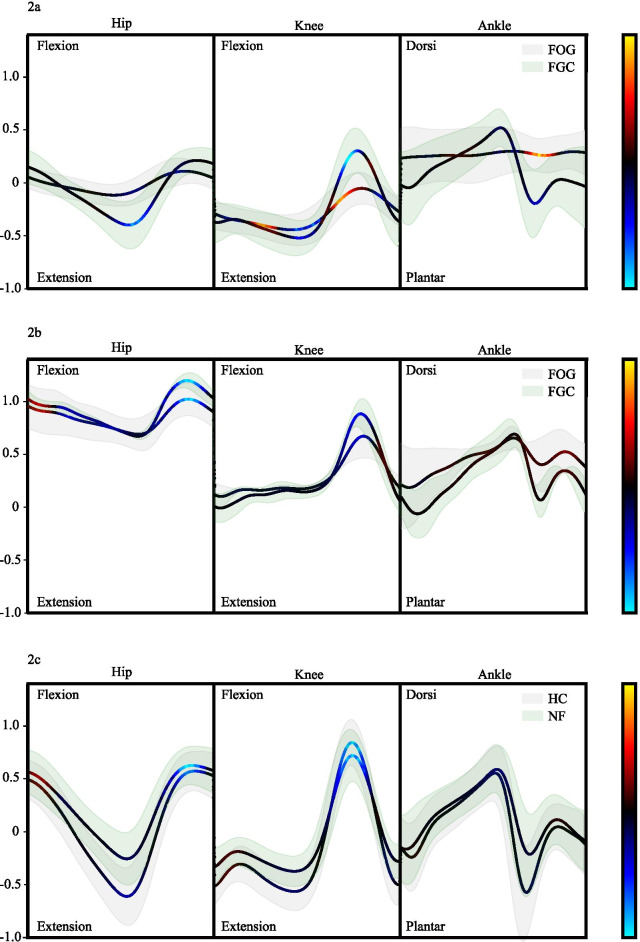
Results: The CNN proved highly accurate in modelling the movement that precedes FOG, with 86.8% of the strides being correctly identified. However, the CNN model was unable to model the movement for one of the seven patients that froze during the protocol. The LRP interpretability case study shows that (1) the kinematic features perceived as most relevant by the CNN are the reduced peak knee flexion and the fixed ankle dorsiflexion during the swing phase, (2) very little relevance for FOG is observed in the PD patients without FOG and the healthy control subjects, and (3) the poor predictive performance of one subject is attributed to the patient's unique and severely flexed gait signature.
Conclusions: The proposed pipeline can aid clinicians in explaining DNN decisions in clinical gait analysis and aid machine learning practitioners in assessing the generalization of their models by ensuring that the predictions are based on meaningful kinematic features.
Keywords: Convolutional neural networks; Explainable artificial intelligence; Freezing of gait; Gait analysis; Parkinson’s disease.
© 2021. The Author(s).
Conflict of interest statement
The authors declare that there is no competing interests regarding the publication of this article.
Figures
References
-
- Rudzińska M, Bukowczan S, Stożek J, Zajdel K, Mirek E, Chwala W, Wójcik-Pedziwiatr M, Banaszkiewicz K, Szczudlik A. Causes and consequences of falls in Parkinson disease patients in a prospective study. Neurol Neurochir Pol. 2013;47(5):423–430. - PubMed
-
- Perez-Lloret S, Negre-Pages L, Damier P, Delval A, Derkinderen P, Destée A, Meissner WG, Schelosky L, Tison F, Rascol O. Prevalence, determinants, and effect on quality of life of freezing of gait in Parkinson disease. JAMA Neurol. 2014;71(7):884–890. - PubMed
-
- Hely MA, Reid WGJ, Adena MA, Halliday GM, Morris JGL. The Sydney multicenter study of Parkinson’s disease: the inevitability of dementia at 20 years. Mov Disord. 2008;23(6):837–844. - PubMed
MeSH terms
LinkOut - more resources
Full Text Sources
Medical
Miscellaneous
