


Hemostasis testing in patients with liver dysfunction: Advantages and caveats
- PMID: 34876789
- PMCID: PMC8611202
- DOI: 10.3748/wjg.v27.i42.7285
Hemostasis testing in patients with liver dysfunction: Advantages and caveats
Abstract
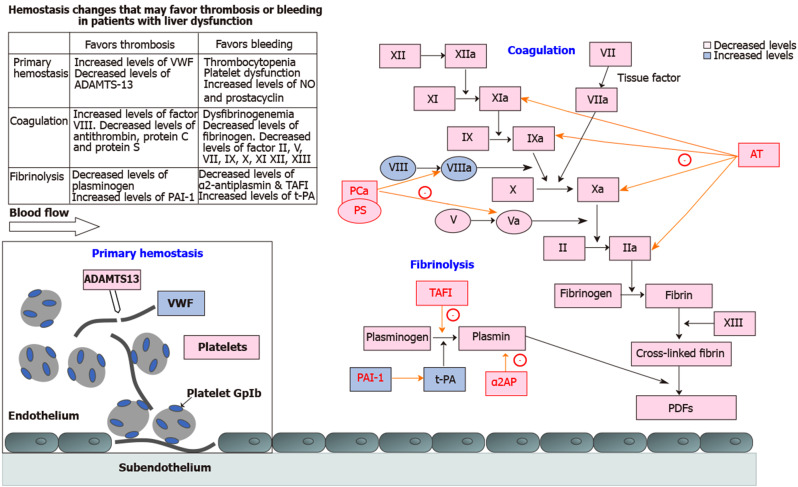
Due to concomitant changes in pro- and anti-coagulant mechanisms, patients with liver dysfunction have a "rebalanced hemostasis", which can easily be tipped toward either a hypo- or a hypercoagulable phenotype. Clinicians are often faced with the question whether patients with chronic liver disease undergoing invasive procedures or surgery and those having active bleeding require correction of the hemostasis abnormalities. Conventional coagulation screening tests, such as the prothrombin time/international normalized ratio and the activated partial thromboplastin time have been demonstrated to have numerous limitations in these patients and do not predict the risk of bleeding prior to high-risk procedures. The introduction of global coagulation assays, such as viscoelastic testing (VET), has been an important step forward in the assessment of the overall hemostasis profile. A growing body of evidence now suggests that the use of VET might be of significant clinical utility to prevent unnecessary infusion of blood products and to improve outcomes in numerous settings. The present review discusses the advantages and caveats of both conventional and global coagulation assays to assess the risk of bleeding in patients with chronic liver disease as well as the current role of transfusion and hemostatic agents to prevent or manage bleeding.
Keywords: Bleeding risk; Conventional tests; Hemostasis; Hemostatic agents; Thrombin generation; Viscoelastic tests.
©The Author(s) 2021. Published by Baishideng Publishing Group Inc. All rights reserved.
Conflict of interest statement
Conflict-of-interest statement: Authors declare that they have no competing interests.
Figures
References
-
- Tripodi A, Mannucci PM. The coagulopathy of chronic liver disease. N Engl J Med. 2011;365:147–156. - PubMed
-
- Lisman T, Porte RJ. Rebalanced hemostasis in patients with liver disease: evidence and clinical consequences. Blood. 2010;116:878–885. - PubMed
-
- Kujovich JL. Coagulopathy in liver disease: a balancing act. Hematology Am Soc Hematol Educ Program. 2015;2015:243–249. - PubMed
-
- Wolber EM, Jelkmann W. Thrombopoietin: the novel hepatic hormone. News Physiol Sci. 2002;17:6–10. - PubMed
-
- Roberts LN, Bernal W. Incidence of Bleeding and Thrombosis in Patients with Liver Disease. Semin Thromb Hemost. 2020;46:656–664. - PubMed
Publication types
MeSH terms
LinkOut - more resources
Full Text Sources
Medical
