


Tracking the amino acid changes of spike proteins across diverse host species of severe acute respiratory syndrome coronavirus 2
- PMID: 34877480
- PMCID: PMC8638202
- DOI: 10.1016/j.isci.2021.103560
Tracking the amino acid changes of spike proteins across diverse host species of severe acute respiratory syndrome coronavirus 2
Abstract
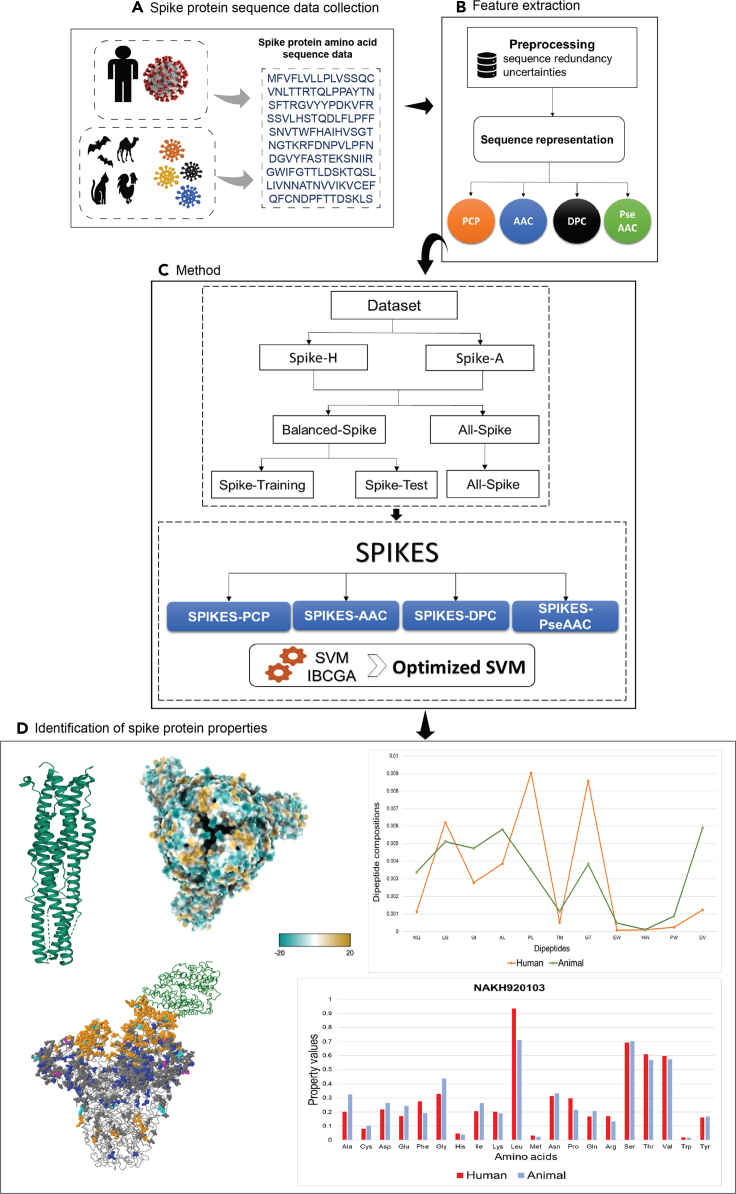
Knowledge of the host-specific properties of the spike protein is of crucial importance to understand the adaptability of severe acute respiratory syndrome coronavirus-2 (SARS-CoV-2) to infect multiple species and alter transmissibility, particularly in humans. Here, we propose a spike protein predictor SPIKES incorporating with an inheritable bi-objective combinatorial genetic algorithm to identify the biochemical properties of spike proteins and determine their specificity to human hosts. SPIKES identified 20 informative physicochemical properties of the spike protein, including information measures for alpha helix and relative mutability, and amino acid and dipeptide compositions, which have shown compositional difference at the amino acid sequence level between human and diverse animal coronaviruses. We suggest that alterations of these amino acids between human and animal coronaviruses may provide insights into the development and transmission of SARS-CoV-2 in human and other species and support the discovery of targeted antiviral therapies.
Keywords: Association analysis; Bioinformatics; Virology.
© 2021 The Authors.
Conflict of interest statement
The authors declare that they have no competing interests.
Figures



References
-
- Arora N., Banerjee A.K., Narasu M.L. The role of artificial intelligence in tackling COVID-19. Future Virol. 2020 doi: 10.2217/fvl-2020-0130. - DOI
-
- Benjamini Y., Krieger A.M., Yekutieli D. Adaptive linear step-up procedures that control the false discovery rate. Biometrika. 2006;93:491–507.
LinkOut - more resources
Full Text Sources
Miscellaneous
