


Trends in binge drinking prevalence among older U.S. men and women, 2015 to 2019
- PMID: 34877662
- PMCID: PMC8904280
- DOI: 10.1111/jgs.17573
Trends in binge drinking prevalence among older U.S. men and women, 2015 to 2019
Abstract
Background: Recent literature suggests that the gap in prevalence of binge drinking between men and women is closing, but little is known about sex-specific differences in trends and correlates of binge drinking among older Americans.
Methods: A total of 18,794 adults, aged 65 years and older were surveyed in the 2015-2019 National Survey on Drug Use and Health. We estimated trends in prevalence of past-month binge drinking (≥5 drinks on the same occasion for men and ≥4 drinks for women), stratified by sex. Correlates of binge drinking were estimated for men and women separately, focusing on demographic characteristics, chronic diseases, past-month tobacco and cannabis use, depression, and emergency department use. Multivariable generalized linear models using Poisson and log link were used to examine associations stratified by sex.
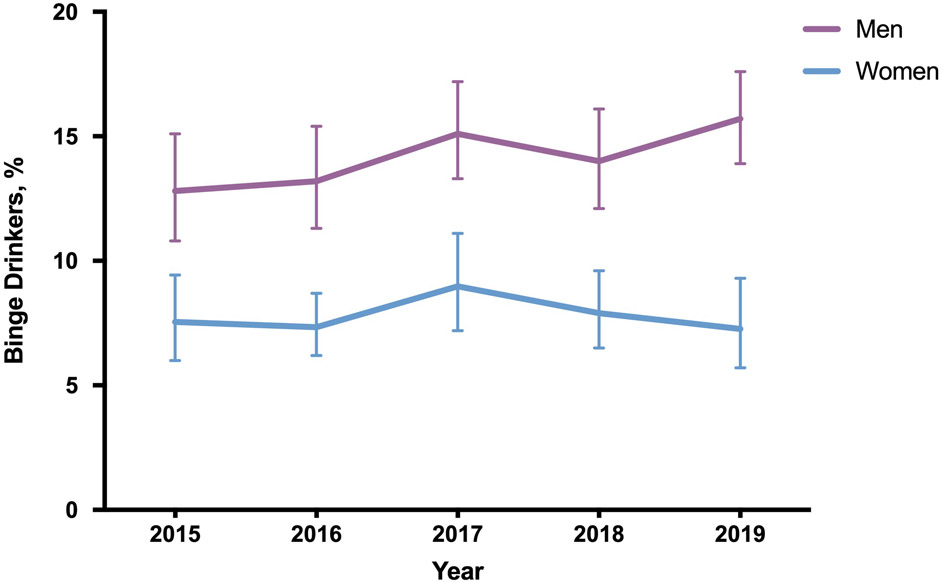
Results: Binge drinking among older men increased from 12.8% in 2015 to 15.7% in 2019 (p = 0.02) but remained stable among older women (7.6% to 7.3%, p = 0.97). In adjusted models, having a college degree was associated with higher risk of binge drinking among women (adjusted prevalence ratio [aPR] = 1.68, 95% CI: 1.13-2.50), but lower risk among men (aPR = 0.69, 95% CI: 0.56-0.85). Men who are separated or divorced were also at higher risk (aPR = 1.25, 95% CI: 1.05-1.50), but women were not. Both men and women reporting past-month use of tobacco (men aPR = 1.87, 95% CI: 1.61-2.17, women aPR = 2.11, 95% CI: 1.71-2.60) and cannabis (men aPR = 2.05, 95% CI: 1.63-2.58, women aPR = 2.77, 95% CI 2.00-3.85) were at higher risk of binge drinking.
Conclusions: Binge drinking has increased among older men whereas it has remained stable among older women in the United States. Interventions should consider that although tobacco and cannabis use is associated with an increased risk of binge drinking among both older men and women, demographic correlates tend to differ by sex.
Keywords: alcohol; binge drinking; epidemiology.
© 2021 The American Geriatrics Society.
Conflict of interest statement
Conflicts of Interest
The authors have no conflicts of interest.
Figures
References
-
- The National Institute on Alcohol Abuse and Alchoholism, “Drinking Levels Defined”. https://www.niaaa.nih.gov/alcohol-health/overview-alcohol-consumption/mo....
-
- Substance Abuse and Mental Health Services Administration (SAMHSA). 2019. National Survey on Drug Use and Health (NSDUH). Table 2.7B—Alcohol Use, Binge Alcohol Use, and Heavy Alcohol Use in Past Month Among Persons Aged 12 or Older, by Detailed Age Category: Percentages, 2018 and 2019. https://www.samhsa.gov/data/sites/default/files/reports/rpt29394/NSDUHDe.... Accessed June 29, 2021.
-
- Grant BF, Chou SP, Saha TD, et al. Prevalence of 12-month alcohol use, high-risk drinking, and DSM-IV alcohol use disorder in the United States, 2001-2002 to 2012-2013: results from the National Epidemiologic Survey on Alcohol and Related Conditions. JAMA psychiatry. 2017;74(9):911–923. - PMC - PubMed
