


A cross-sectional study on perceived workplace health support and health-related quality of life
- PMID: 34877733
- PMCID: PMC8652405
- DOI: 10.1002/1348-9585.12302
A cross-sectional study on perceived workplace health support and health-related quality of life
Erratum in
-
Correction to "A cross-sectional study on perceived workplace health support and health-related quality of life".J Occup Health. 2023 Jan;65(1):e12395. doi: 10.1002/1348-9585.12395. J Occup Health. 2023. PMID: 36933896 Free PMC article. No abstract available.
Abstract
Objective: Many companies in Japan have been increasingly interested in "health and productivity management (H&PM)." In terms of H&PM, we hypothesized that companies can enhance their employees' perceived workplace health support (PWHS) by supporting workers' lively working and healthy living. This could then improve their health-related quality of life (HRQOL) by increasing PWHS. Consequently, this study explored the relationship between PWHS and HRQOL.
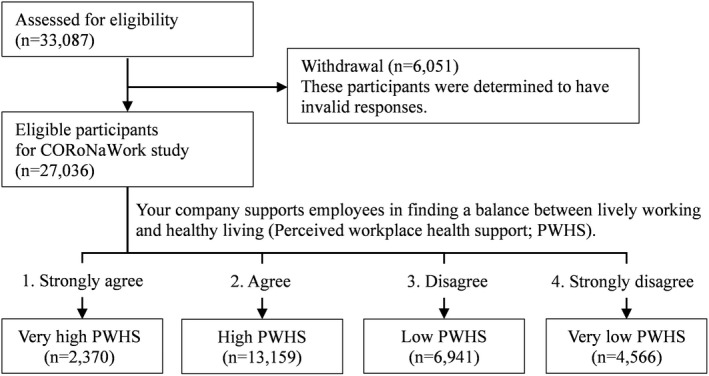
Methods: In December 2020, during the COVID-19 pandemic, we conducted an Internet-based nationwide health survey of Japanese workers (CORoNaWork study). A database of 27 036 participants was created. The intensity of PWHS was measured using a four-point Likert scale. We used multilevel ordered logistic regression to analyze the relationship between PWHS intensity and the four domains of the Centers for Disease Control's HRQOL-4 (self-rated health, number of poor physical health days, number of poor mental health days, and activity limitation days during the past 30 days).
Results: In the sex- and age-adjusted and multivariate models, the intensity of PWHS significantly affected self-rated health and the three domains of unhealthy days (physical, mental, and activity limitation). There was also a trend toward worse HRQOL scores as the PWHS decreased.
Conclusions: We found that the higher the PWHS of Japanese workers, the higher their self-rated health and the fewer their unhealthy days. Companies need to assess workers' PWHS and HRQOL and promote H&PM. H&PM is also necessary to maintain and promote the health of workers during the COVID-19 pandemic.
Keywords: COVID-19; health and productivity management; health-related quality of life; perceived workplace health support.
© 2021 The Authors. Journal of Occupational Health published by John Wiley & Sons Australia, Ltd on behalf of The Japan Society for Occupational Health.
Figures
References
-
- Statistics Bureau of Japan . Statistical Handbook of Japan 2019. Accessed April 20, 2021. https://www.stat.go.jp/english/data/handbook/c0117.html
-
- Ministry of Economy, Trade and Industry . Enhancing health and productivity management. Accessed April 21, 2021. https://www.meti.go.jp/policy/mono_info_service/healthcare/downloadfiles...
-
- Eisenberger R, Huntington R, Hutchison S, Sowa D. Perceived organizational support. J Appl Psychol. 1986;71(3):500.
-
- Allen DG, Shore LM, Griffeth RW. The role of perceived organizational support and supportive human resource practices in the turnover process. J Management. 2003;29(1):99‐118.
MeSH terms
Grants and funding
- University of Occupational and Environmental Health, Japan
- H30-josei-ippan-002/Japanese Ministry of Health, Labour and Welfare
- H30-roudou-ippan-007/Japanese Ministry of Health, Labour and Welfare
- 19JA1004/Japanese Ministry of Health, Labour and Welfare
- 20JA1006/Japanese Ministry of Health, Labour and Welfare
LinkOut - more resources
Full Text Sources
Medical
Miscellaneous
