Review
. 2022 May;22(3):271-285.
doi: 10.1007/s40256-021-00510-9. Epub 2021 Dec 8.

Current and Emerging Classes of Pharmacological Agents for the Management of Hypertension

Affiliations
Review

Current and Emerging Classes of Pharmacological Agents for the Management of Hypertension

Utkarsh Ojha et al. Am J Cardiovasc Drugs. 2022 May.

Abstract

Cardiovascular disease accounts for more than 17 million deaths globally every year, of which complications of hypertension account for 9.4 million deaths worldwide. Early detection and management of hypertension can prevent costly interventions, including dialysis and cardiac surgery. Non-pharmacological approaches for managing hypertension commonly involve lifestyle modification, including exercise and dietary regulations such as reducing salt and fluid intake; however, a majority of patients will eventually require antihypertensive medications. In 2020, the International Society of Hypertension published worldwide guidelines in its efforts to reduce the global prevalence of raised blood pressure (BP) in adults aged 18 years or over. Currently, several classes of medications are used to control hypertension, either as mono- or combination therapy depending on the disease severity. These drug classes include those that target the renin-angiotensin-aldosterone system (RAAS) and adrenergic receptors, calcium channel blockers, diuretics and vasodilators. While some of these classes of medications have shown significant benefits in controlling BP and reducing cardiovascular mortality, the prevalence of hypertension remains high. Significant efforts have been made in developing new classes of drugs that lower BP; these medications exert their therapeutic benefits through different pathways and mechanism of actions. With several of these emerging classes in phase III clinical trials, it is hoped that the discovery of these novel therapeutic avenues will aid in reducing the global burden of hypertension.


Conflict of interest statement

Utkarsh Ojha, Sanjay Ruddaraju, Navukkarasu Sabapathy, Varun Ravindran, Pitchaya Worapongsatitaya, Jeesanul Haq, Raihan Mohammed and Vinod Patel have no conflicts of interest to declare.

Figures
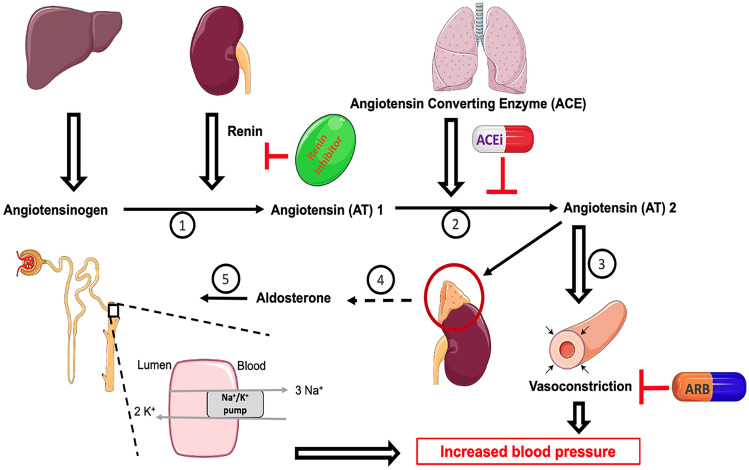
Fig. 1
Fig. 1
Mechanism of action of angiotensin converting enzyme inhibitors and angiotensin receptor blocker on The renin-angiotensin-aldosterone system (RAAS). The liver secretes angiotensinogen which is then converted to angiotensin 1 via the action of renin (1), which is released by the kidneys. Angiotensin 1 is subsequently converted into its active component (2) angiotensin 2 via the action of angiotensin converting enzyme, which is produced by the pulmonary vasculature. Angiotensin 2 increases blood pressure via two mechanisms: angiotensin 2 by itself is a potent vasoconstrictor (3) which increases systemic blood pressure. Furthermore, angiotensin 2 acts on the adrenal cortex to release aldosterone from the zona glomerulosa (4). Aldosterone acts on the collecting ducts and distal convoluted tubules (DCT) to facilitate sodium ion reabsorption by acting on the sodium-potassium pump (5); water is also reabsorbed in conjunction with sodium ions during this process (not shown). The reabsorption of sodium ions and water increases intravascular volume thereby increasing blood pressure
Fig. 2
Fig. 2
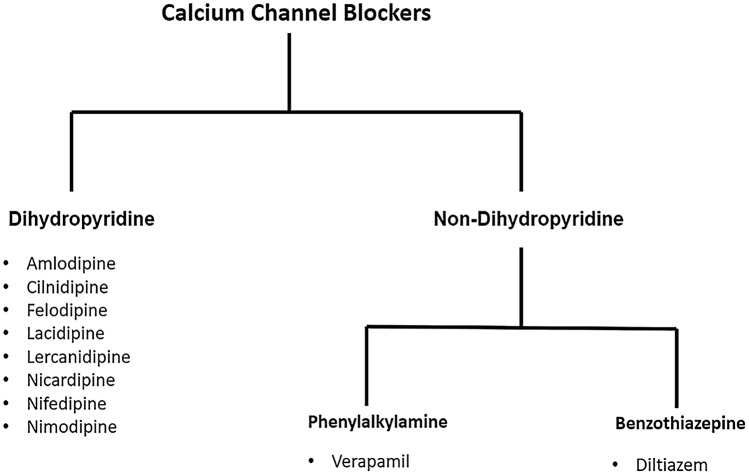
Commonly used calcium channel blockers (CCBs). CCBs can be categorised into dihydropyridine, which primarily act on vascular smooth muscle and non-dihydropyridine agents. Non-dihydropyridine CCBs can be further classified into phenylalkylamines, which are more selective for the myocardium, and benzothiazepine, which have both myocardium depressant and vascular smooth muscle relaxant properties
Fig. 3
Fig. 3
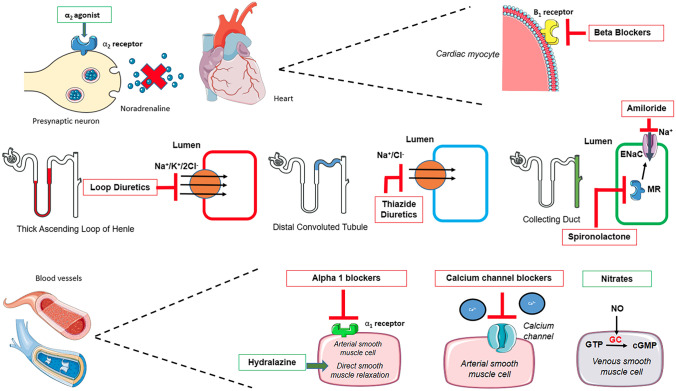
Sites of action of current classes of antihypertensive medications (ACEi and ARB shown in Fig. 1) cGMP cyclic guanosine monophosphate, GC guanylyl cyclase, GTP guanosine triphosphate, MR Mineralocorticoid Receptor, NO nitric oxide

References

    1. Chobanian AV, Bakris GL, Black HR, for the National Heart, Lung, and Blood Institute et al. Report of the Joint National Committee on Prevention, Detection, Evaluation, and Treatment of High Blood Pressure. Hypertension. 2003;42:1206–1252. doi: 10.1161/01.HYP.0000107251.49515.c2. - DOI - PubMed
    1. Alcocer L, Cueto L. Hypertension, a health economics perspective. Ther Adv Cardiovasc Dis. 2008;2:147–155. doi: 10.1177/1753944708090572. - DOI - PubMed
    1. Psaty BM, Lumley T, Furberg CD, et al. Health outcomes associated with various antihypertensive therapies used as first-line agents: a network meta-analysis. JAMA. 2003;289:2534–2544. doi: 10.1001/jama.289.19.2534. - DOI - PubMed
    1. Whelton P, Carey R, Aronow W, Casey D, Collins K, Dennison Himmelfarb C, et al. 2017 ACC/AHA/AAPA/ABC/ACPM/AGS/APhA/ASH/ASPC/NMA/PCNA Guideline for the Prevention, Detection, Evaluation, and Management of High Blood Pressure in Adults. J Am Coll Cardiol. 2018;71(19):e127–e248. doi: 10.1016/j.jacc.2017.11.006. - DOI - PubMed
    1. Unger T, Borghi C, Charchar F, Khan NA, Poulter NR, Prabhakaran D, et al. 2020 International Society of Hypertension Global Hypertension Practice Guidelines. Hypertension. 2020;75(6):1334–1357. doi: 10.1161/HYPERTENSIONAHA.120.15026. - DOI - PubMed