


The Standardization of Hospital-Acquired Infection Rates Using Prediction Models in Iran: Observational Study of National Nosocomial Infection Registry Data
- PMID: 34879002
- PMCID: PMC8693206
- DOI: 10.2196/33296
The Standardization of Hospital-Acquired Infection Rates Using Prediction Models in Iran: Observational Study of National Nosocomial Infection Registry Data
Abstract
Background: Many factors contribute to the spreading of hospital-acquired infections (HAIs).
Objective: This study aimed to standardize the HAI rate using prediction models in Iran based on the National Healthcare Safety Network (NHSN) method.
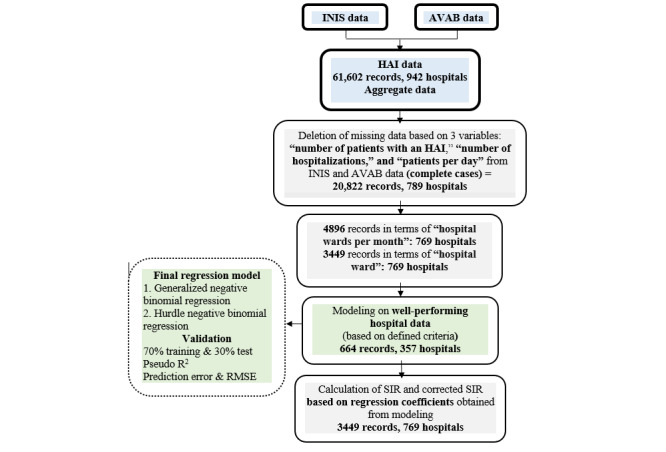
Methods: In this study, the Iranian nosocomial infections surveillance system (INIS) was used to gather data on patients with HAIs (126,314 infections). In addition, the hospital statistics and information system (AVAB) was used to collect data on hospital characteristics. First, well-performing hospitals, including 357 hospitals from all over the country, were selected. Data were randomly split into training (70%) and testing (30%) sets. Finally, the standardized infection ratio (SIR) and the corrected SIR were calculated for the HAIs.
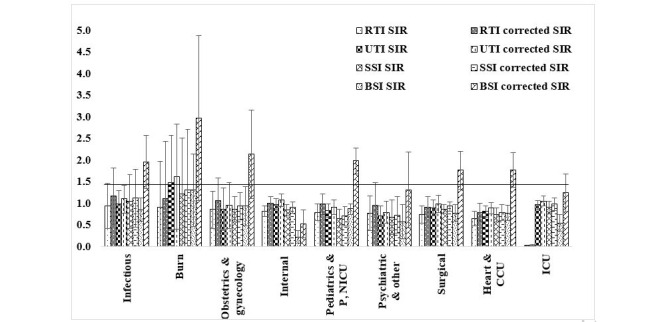
Results: The mean age of the 100,110 patients with an HAI was 40.02 (SD 23.56) years. The corrected SIRs based on the observed and predicted infections for respiratory tract infections (RTIs), urinary tract infections (UTIs), surgical site infections (SSIs), and bloodstream infections (BSIs) were 0.03 (95% CI 0-0.09), 1.02 (95% CI 0.95-1.09), 0.93 (95% CI 0.85-1.007), and 0.91 (95% CI 0.54-1.28), respectively. Moreover, the corrected SIRs for RTIs in the infectious disease, burn, obstetrics and gynecology, and internal medicine wards; UTIs in the burn, infectious disease, internal medicine, and intensive care unit wards; SSIs in the burn and infectious disease wards; and BSIs in most wards were >1, indicating that more HAIs were observed than expected.
Conclusions: The results of this study can help to promote preventive measures based on scientific evidence. They can also lead to the continuous improvement of the monitoring system by collecting and systematically analyzing data on HAIs and encourage the hospitals to better control their infection rates by establishing a benchmarking system.
Keywords: Iran; hospital-acquired infections; prediction model; standardized infection ratio.
©Neda Izadi, Koorosh Etemad, Yadollah Mehrabi, Babak Eshrati, Seyed Saeed Hashemi Nazari. Originally published in JMIR Public Health and Surveillance (https://publichealth.jmir.org), 07.12.2021.
Conflict of interest statement
Conflicts of Interest: None declared.
Figures
References
-
- Gebregiorgis BG, Takele GM, Ayenew KD, Amare YE. Prevalence of hospital-acquired infections (HAIs) and associated factors in Ethiopia: a systematic review and meta-analysis protocol. BMJ Open. 2020 Dec 23;10(12):e042111. doi: 10.1136/bmjopen-2020-042111. https://bmjopen.bmj.com/lookup/pmidlookup?view=long&pmid=33361167 bmjopen-2020-042111 - DOI - PMC - PubMed
-
- Rao R, Khan AA, Mathai D, Leon TC, Khaleel M, Igman A, Kumari BA, Nizami MI, Verma MK. Prevalence and risk factors for hospital-acquired infections “clean care is safer care". International Journal of Recent Scientific Research. 2020;11(04):38021–38028.
-
- Tolera M, Marami D, Abate D, Dheresa M. Are invasive procedures and a longer hospital stay increasing the risk of healthcare-associated infections among the admitted patients at Hiwot Fana Specialized University Hospital, Eastern Ethiopia? Adv Prev Med. 2020 Mar 31;2020:6875463–7. doi: 10.1155/2020/6875463. doi: 10.1155/2020/6875463. - DOI - PMC - PubMed
-
- Rosenthal VD, Jarvis WR, Jamulitrat S, Silva CPR, Ramachandran B, Dueñas L, Gurskis V, Ersoz G, Novales MGM, Khader IA, Ammar K, Guzmán NB, Navoa-Ng JA, Seliem ZS, Espinoza TA, Meng CY, Jayatilleke K. Socioeconomic impact on device-associated infections in pediatric intensive care units of 16 limited-resource countries. Pediatric Critical Care Medicine. 2012;13(4):399–406. doi: 10.1097/pcc.0b013e318238b260. - DOI - PubMed
Publication types
MeSH terms
LinkOut - more resources
Full Text Sources
Medical
