


Effects of mannan oligosaccharides and Lactobacillus mucosae on growth performance, immune response, and gut health of weanling pigs challenged with Escherichia coli lipopolysaccharides
- PMID: 34879142
- PMCID: PMC8653942
- DOI: 10.1093/jas/skab286
Effects of mannan oligosaccharides and Lactobacillus mucosae on growth performance, immune response, and gut health of weanling pigs challenged with Escherichia coli lipopolysaccharides
Abstract
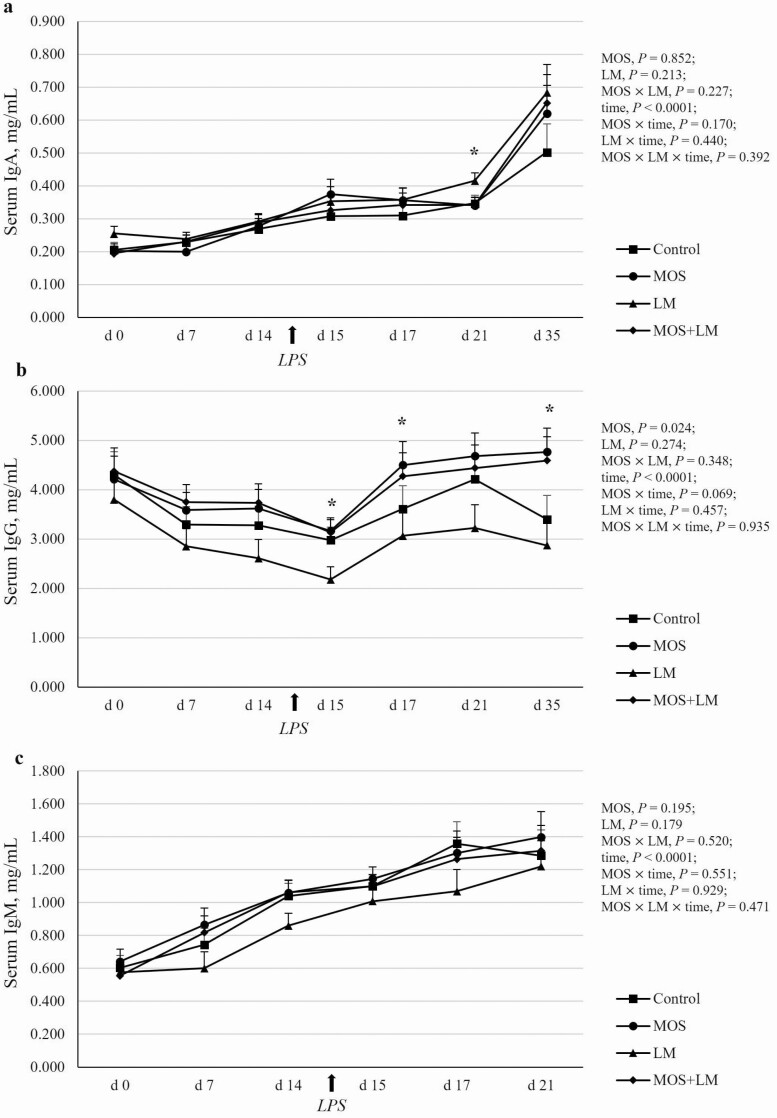
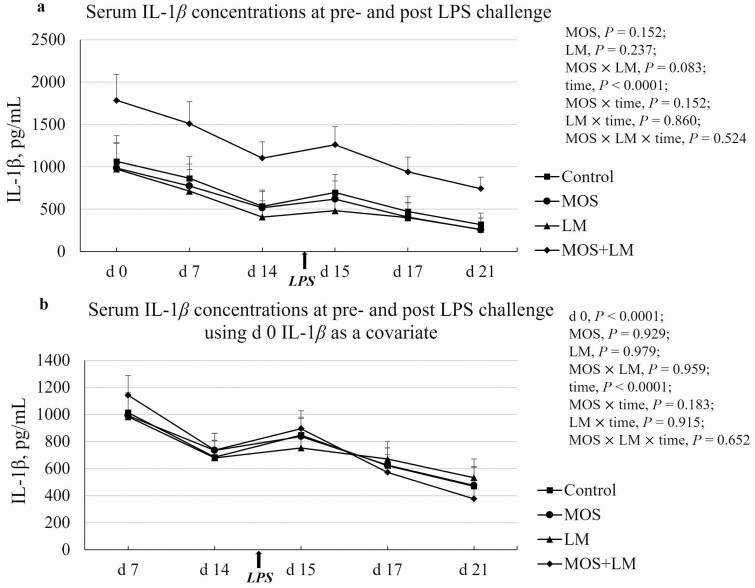
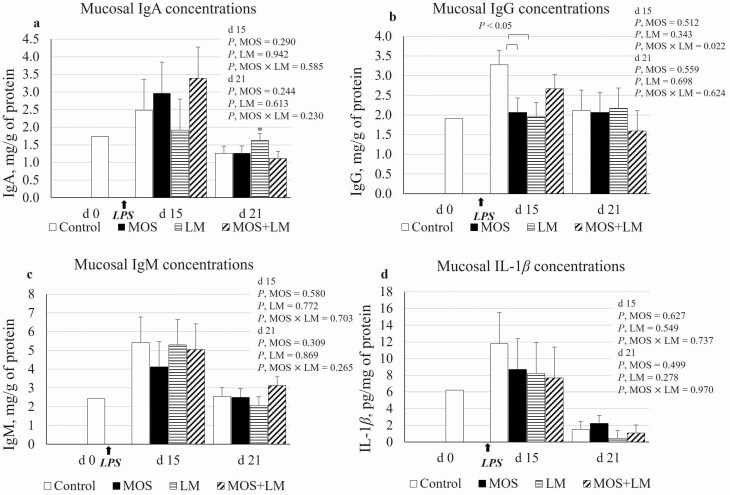
Addition of pre- and probiotics may confer growth and health benefits when added to the diet of pigs. To determine the effects of feeding mannan oligosaccharide (MOS) and Lactobacillus mucosae (LM) as prebiotic and probiotic sources in weanling pigs under immune challenge, 96 weaned pigs were randomly allotted to 16 experimental pens within a 2 × 2 factorial arrangement of treatments. Control diets with or without 0.1% yeast-derived MOS were randomly assigned to pens and 109 cfu/pig LM broth or a control broth were top-dressed daily. Pigs were fed one of four dietary treatments (control, MOS, LM, and MOS+LM) in Phases I and II (days 0 to 7 and days 7 to 21 postweaning, respectively) and a common diet during Phase III (days 21 to 35 postweaning). On day 14, all pigs were challenged with 100 µg/kg body weight (BW) Escherichia coli lipopolysaccharide (LPS) via intraperitonial injection. Feed disappearance and pig BW were measured weekly. Blood and fecal samples were collected weekly, and additional blood samples were collected on days 1 and 3 post-LPS challenge. On days 15 and 21, one pig per pen was euthanized for collection of ileal mucosa and duodenal and ileal tissue samples. From days 0 to 14, feeding LM decreased gain-to-feed ratio (G:F; P < 0.05). An interaction between LM and MOS was observed for G:F on days 14 to 21 (P < 0.05); G:F in LM (715 g/kg) was greater compared with MOS+LM (P < 0.05; 600 g/kg) and control (P < 0.10; 615 g/kg), but was not different (P > 0.10) from MOS (674 g/kg). After pigs were fed a common diet (days 21 to 35), G:F was decreased (P < 0.05) in the LM treatment groups. Pigs fed diets that included MOS had increased serum immunoglobulin (Ig) G on days 1 and 3 post-LPS challenge and 2 wk after removal of treatments (P < 0.05) and on days 14 and 21 postweaning (P < 0.10) compared with pigs fed diets without MOS. On day 15, mucosal immunoglobulin G was increased (P < 0.05) in control vs. MOS and LM groups. Circulating IL-1β in control and MOS+LM pigs increased (P < 0.05) on day 1 post-LPS challenge but did not change (P > 0.10) in MOS and LM groups. On day 15, pigs fed LM had decreased (P < 0.05) ileal crypt depth compared with pigs fed the control diet. On day 21, fecal propionate and butyrate tended to be lower (P < 0.10) in pigs fed MOS vs. control and MOS+LM diet. These preliminary findings suggest that feeding LM alone improved feed efficiency and ileal morphological structure during the first week of LPS challenge; additionally, feeding LM and MOS may have beneficial effects relative to immune biomarkers.
Keywords: growth; gut health; immunity; pigs; prebiotic; probiotic.
© The Author(s) 2021. Published by Oxford University Press on behalf of the American Society of Animal Science. All rights reserved. For permissions, please e-mail: journals.permissions@oup.com.
Figures
References
-
- Abbas, A. K., Lichtman A. H., and Pillai S.. . 2014. Cellular and molecular immunology. Philadelphia, PA: Elsevier Health Sciences.
-
- Agazzi, A., Perricone V., Omodei Zorini F., Sandrini S., Mariani E., Jiang X. R., Ferrari A., Crestani M., Nguyen T. X., Bontempo V., . et al. 2020. Dietary mannan oligosaccharides modulate gut inflammatory response and improve duodenal villi height in post-weaning piglets improving feed efficiency. Animals 10:1283. doi: 10.3390/ani10081283 - DOI - PMC - PubMed
Publication types
MeSH terms
Substances
Supplementary concepts
LinkOut - more resources
Full Text Sources
