


A new predictor for indicating clinical severity and prognosis in COVID-19 patients: Frontal QRS-T angle
- PMID: 34879478
- PMCID: PMC8457916
- DOI: 10.1016/j.ajem.2021.09.046
A new predictor for indicating clinical severity and prognosis in COVID-19 patients: Frontal QRS-T angle
Abstract
Objective: COVID-19; It spread rapidly around the world and led to a global pandemic. Indicators of poor prognosis are important in the treatment and follow-up of COVID-19 patients and have always been a matter of interest to researchers. The aim of this study was to investigate the relationship between frontal QRS-T angle values and clinical severity and prognosis in COVID-19 patients.
Methods: This prospective case-control study was conducted with 130 COVID-19 patients whose diagnosis was confirmed by reverse transcriptase-polymerase chain reaction (RT-PCR) and 100 healthy controls. The CURB-65 score was used as the clinical severity score.
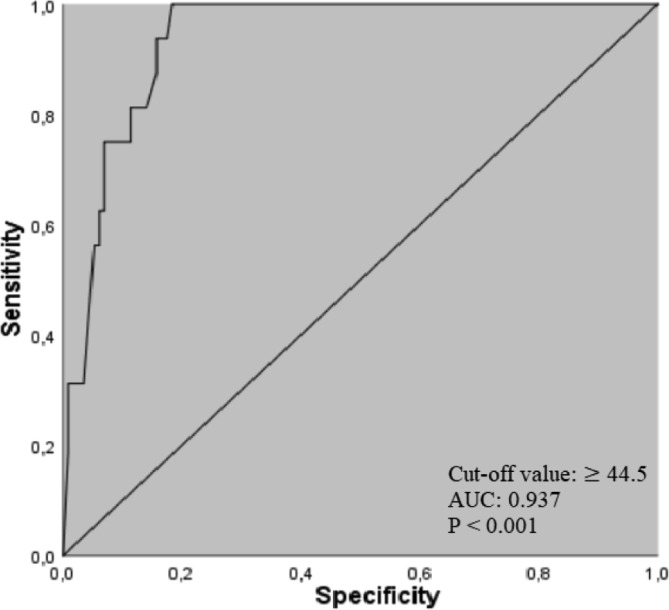
Results: A total of 130 patients and 100 healthy controls were included in the study. When the patient and control groups were compared a significant difference was found between QT (378.07 ± 33.75 vs. 368.63 ± 19.65, p < 0.001), QTc (410.79 ± 28.19 vs. 403.68 ± 11.70, p < 0.001), QRS time (95.04 ± 21.67 vs. 91.42 ± 11.08, p < 0.001) and frontal QRS-T angle (36.57 ± 22.86 vs. 22.72 ± 14.08, p < 0.001). According to clinical severity scoring, QT (370.27 ± 25.20 vs. 387.75 ± 40.19, p = 0.003), QTc (402.18 ± 19.92 vs. 421.48 ± 33.08, p < 0.001), frontal QRS-T angle (32.25 ± 18.79 vs. 41.94 ± 26.27), p = 0.0.16) parameters were found to be significantly different. Age (odds ratio [OR], 1.201; 95% confidence interval [CI], 1.111-1.298; p < 0.001) and frontal QRS-T angle ([OR], 1.045; 95% [CI], 1.015-1.075; p = 0.003) values were found to be an independent predictor for the severity of the disease. Frontal QRS-T angle ([OR], 1.101; 95% [CI], 1.030-1.176; p = 0.004), and CRP ([OR], 1.029; 95% [CI], 1.007-1.051; p = 0.01) parameters were found to be independent predictors for the mortality of the disease. As a mortality indicator; for the frontal QRS-T angle of ≥44.5°, specificity and sensitivity were 93.8% and 84.2%, respectively.
Conclusion: Frontal QRS-T angle can be used as a reproducible, convenient, inexpensive, new and powerful predictor in determining the clinical severity and prognosis of COVID-19 patients.
Keywords: COVID-19; Frontal QRS-T angle; Mortality; QT; QTc; Ventricular arrhythmia.
Copyright © 2021 Elsevier Inc. All rights reserved.
Comment in
-
Predictive efficacy of frontal QRS-T angle in COVID-19 patients.Am J Emerg Med. 2022 Jul;57:210. doi: 10.1016/j.ajem.2022.01.026. Epub 2022 Jan 23. Am J Emerg Med. 2022. PMID: 35101292 Free PMC article. No abstract available.
-
Is frontal QRS-T angle a valid predictor of COVID-19 severity?Am J Emerg Med. 2022 Jul;57:211-212. doi: 10.1016/j.ajem.2022.01.027. Epub 2022 Jan 22. Am J Emerg Med. 2022. PMID: 35131141 Free PMC article. No abstract available.
References
-
- Poortahmasebi V., Zandi M., Soltani S., Jazayeri S.M. Clinical performance of RT-PCR and chest CT scan for Covid-19 diagnosis; a systematic review. Adv J Emerg Med. 2020;4(2s):1–7.
-
- WHO. https://www.who.int/emergencies/diseases/novel-coronavirus-2019.18June 2021. 2021 [cited 20.06.2021].
MeSH terms
LinkOut - more resources
Full Text Sources
Medical
Research Materials
Miscellaneous
