. 2021 Dec 8;11(1):23678.
doi: 10.1038/s41598-021-02840-9.

A lab-on-a-chip approach integrating in-situ characterization and reactive transport modelling diagnostics to unravel (Ba,Sr)SO4 oscillatory zoning

Affiliations

A lab-on-a-chip approach integrating in-situ characterization and reactive transport modelling diagnostics to unravel (Ba,Sr)SO4 oscillatory zoning

Jenna Poonoosamy et al. Sci Rep. .

Abstract

The co-precipitation of sulphate minerals such as celestine and barite is widely studied because their formation is ubiquitous in natural and anthropogenic systems. Co-precipitation in porous media results in crystallization of solid solutions yielding characteristics such as oscillatory zoning that are rarely observed in bulk solution or in batch experiments. In the past, the precipitation of compositionally-zoned (Ba,Sr)SO4 crystals was observed post-mortem in macroscopic silica gel counter-diffusion experiments. Their formation was originally explained by the difference in the solubility products of the end-members combined with diffusion-limited transport of solutes to the mineral-fluid interface, while a later study favored the idea of kinetically controlled reactions. With recent advances combining in-operando microfluidic experiments and reactive transport modelling, it is now possible to verify hypotheses on the driving forces of transport-coupled geochemical processes. We developed a "lab on a chip" experiment that enabled the systematic study of the nucleation and growth of oscillatory-zoned (Ba,Sr)SO4 crystals in a microfluidic reactor. The compositions of the solid solutions were determined by in-situ Raman spectroscopy. Our investigation shows (1) that the composition of the nucleating phases can be approximated using classical nucleation theory, (2) that the oscillatory zoning is not solely controlled by the limited diffusional transport of solutes, and (3) that nucleation kinetics plays a major role in the switch between different stoichiometric compositions. The zoning phenomena is governed by the complex interplay between the diffusion of reactants and the crystallization kinetics as well as other factors, e.g. surface tension and lattice mismatch.


Conflict of interest statement

The authors declare no competing interests.

Figures
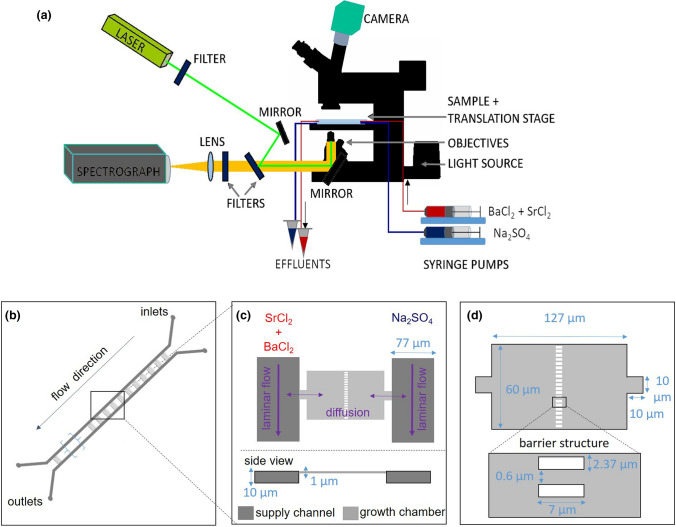
Figure 1
Figure 1
(a) Schematic representation of the microfluidic setup, (b) microfluidic reactor with an array of 50 growth chambers, (c) top view of microfluidic growth chamber with the two adjacent supply channels, (d) an enlargement of the growth chamber with an array of pillars constituting a barrier structure in the middle.
Figure 2
Figure 2
Temporal evolution of crystals in chamber 1 (a) and 4 (b) as revealed by optical microscopy. Image (c) shows hyperspectral Raman images of the ν1 (SO4) intensities from crystals formed after 1200 min in chamber 1 and 4 with intensities of 1000 ± 3 and 994 ± 3 cm−1.
Figure 3
Figure 3
(a) Comparison of the average Raman spectra of the barium (f, h) and strontium (g) enriched layers of selected crystals in chamber 1 and those of commercial 99% pure BaSO4 and SrSO4, (b) locations where the spectral averaging was done in chamber 1 with an enlargement of the ν1(SO4) band, (c) comparison of the average Raman spectra of the barium (j) and strontium (i) enriched layers of selected crystals in chamber 4 and those of commercial 99% pure BaSO4 and SrSO4 and PDMS, (d) locations where the spectral averaging was done in chamber 4 along with corresponding Raman spectra of the ν1(SO4) frequency region.
Figure 4
Figure 4
(ae) experimentally derived crystallization rates of crystals 1–5 in reaction chamber 4.
Figure 5
Figure 5
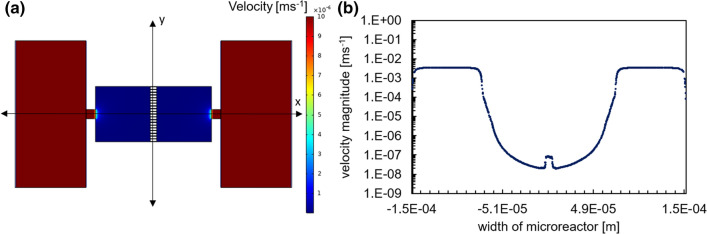
(a) Distribution map of the velocity magnitude at steady state, and (b) profile of the velocity magnitude along line y = 0 with the center of the growth chamber as origin.
Figure 6
Figure 6
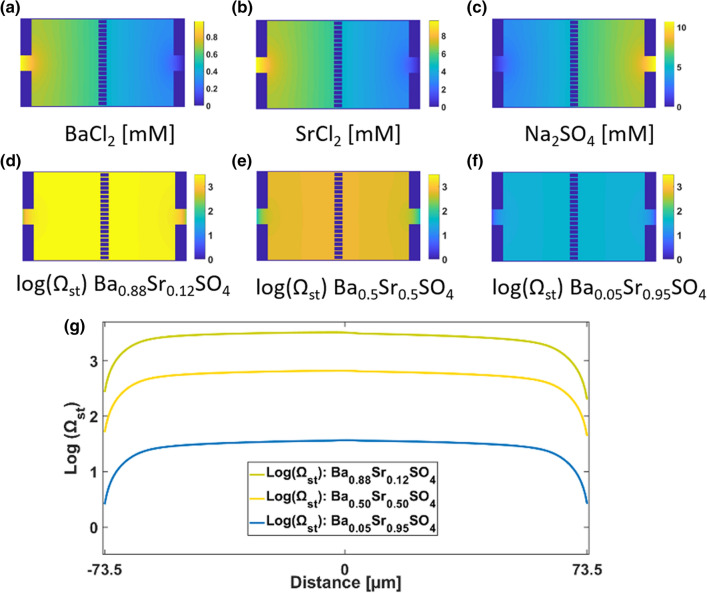
Map of (a) BaCl2, (b) SrCl2 and (c) Na2SO4 concentrations distributions in the growth chamber and associated stoichiometric supersaturation ratio with respect to (d) Ba0.88Sr0.12SO4, (e) Ba0.5Sr0.5SO4 and (f) Ba0.05Sr0.95SO4 with their respective plots of stoichiometric saturation ratio profiles along y = 0 in (g) for a better visualization.
Figure 7
Figure 7
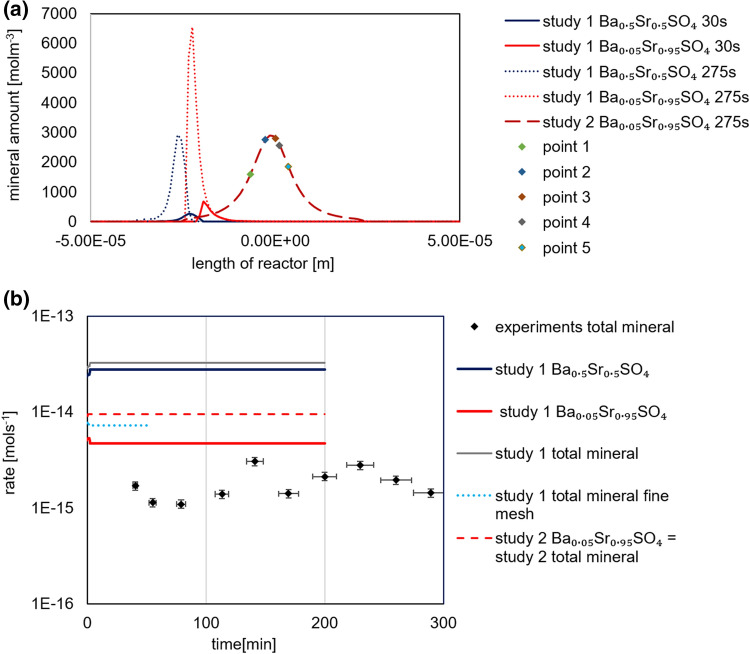
(a) Mineral distribution profiles of the two stoichiometric compositions (Ba0.05Sr0.95)SO4 and (Ba0.5Sr0.5)SO4 across a simulated 1D reactor for case study 1 at 30 and 275 s and case study 2 at 275 s using a discretization of 1 µm. Points 1–5 refer to the sampling points used to calculate nucleation and crystallization kinetics in Fig. 9. (b) Comparison of simulated precipitation rates using OGS-GEM with instantaneous precipitation (case study 1) and with kinetic constraints (case study 2) using mesh discretizations of 5 µm and 1 µm against experimental results (total amount of minerals that precipitated per unit time).
Figure 8
Figure 8
(a) Histograms of the solid solution compositions sampled in the first 5 growth chambers, (b) stoichiometric supersaturations computed for the aqueous solution compositions at the locations where crystals 1–5 in chamber 4 start to nucleate (aSr2+/aBa2+ ~ 10) and (c) corresponding nucleation rates, (d) stoichiometric supersaturation function and e) associated nucleation rate for a hypothetical aqueous solution composition with aSr2+/aBa2+ ~ 100.
Figure 9
Figure 9
(a) Nucleation rates, (b) associated crystallization rates, and (c) calculated effective surface tension (primary vertical axis) and lattice mismatch (secondary vertical axis) as function of the solid solution series.

References

    1. Heberling F, Schild D, Degering D, Schäfer T. How well suited are current thermodynamic models to predict or interpret the composition of (Ba, Sr)SO4 solid-solutions in geothermal scalings? Geotherm. Energy. 2017;358:1–16.
    1. Besançon C, Chautard C, Beaucaire C, Savoye S, Sardini P, Gérard M, Descostes M. The role of barite in the post-mining stabilization of radium-226: A modeling contribution for sequential extractions. Minerals. 2020 doi: 10.3390/min10060497. - DOI
    1. Zhang T, Gregory K, Hammack R, Vidic R. Co-precipitation of radium with barium and strontium sulfate and its impact on the fate of radium during treatment of produced water from unconventional gas extraction. Environ. Sci. Technol. 2014;48:4596–4603. doi: 10.1021/es405168b. - DOI - PubMed
    1. Ling F, Hunter H, Fitts J, Peters C, Ascerbo A, Huang X, Yan H, Nazaretski E, Chu Y. Nanospectroscopy captures nanoscale compositional zonation in barite solid solutions. Sci. Rep. 2018;8:1–11. - PMC - PubMed
    1. Heather H, Ling FT, Peters C. Metals coprecipitation with barite: Nano-XRF observation of enhanced strontium incorporation. Environ. Eng. Sci. 2020;37(4):235–245. doi: 10.1089/ees.2019.0447. - DOI - PMC - PubMed

Publication types