


Effect of Wenshentiaojing Decoction on Hormone Level and Follicular Number in Patients with Menstrual Disorder of Polycystic Ovary Syndrome
- PMID: 34880919
- PMCID: PMC8648443
- DOI: 10.1155/2021/4975867
Effect of Wenshentiaojing Decoction on Hormone Level and Follicular Number in Patients with Menstrual Disorder of Polycystic Ovary Syndrome
Abstract
Objective: To explore the curative effect of Wenshentiaojing Decoction on the treatment of menstrual disorder caused by PCOS.
Methods: Patients with menstrual disorders caused by PCOS admitted to our department from January 2020 to January 2021 were selected as the research objects and were divided into a control group and observation group according to the random number table method. The control group was treated with Western medicine, and the observation group was treated with Wenshentiaojing Decoction on the basis of Western medicine. The clinical efficacy of the two groups was compared. Before and after treatment, sex hormones (LH, FSH, LH/FSH, and testosterone (T)), ovarian volume, endometrial thickness, cervical mucus score, follicular number, menstrual conditions (menstrual duration, menstrual cycle, and menstrual volume), and other indicators in both groups were recorded.
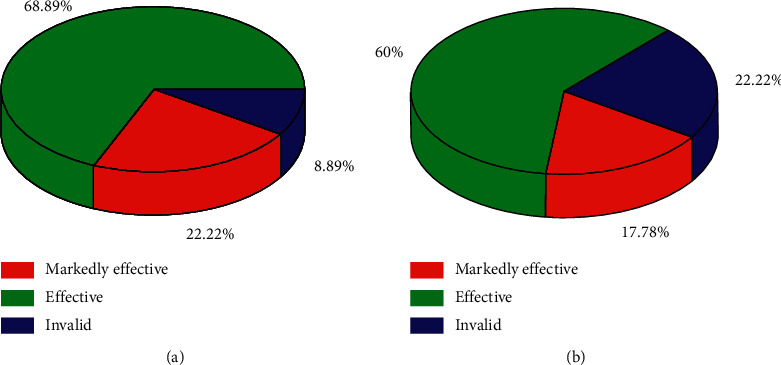
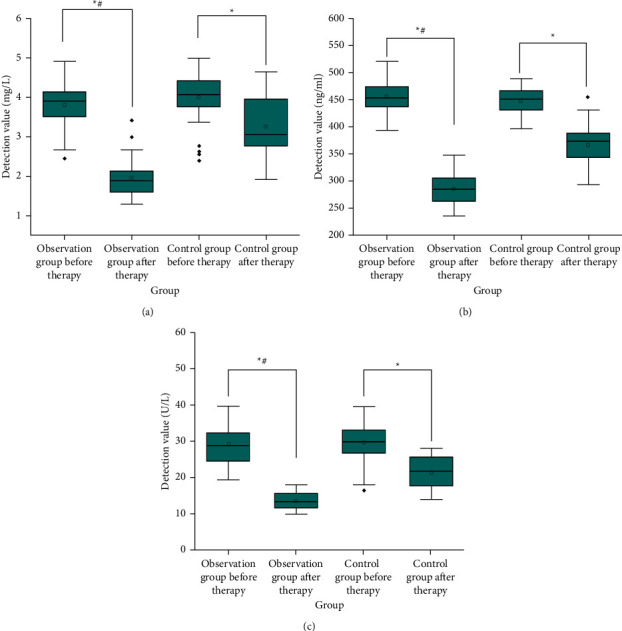
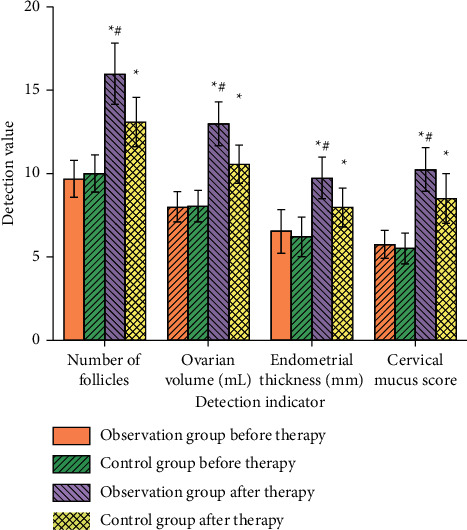
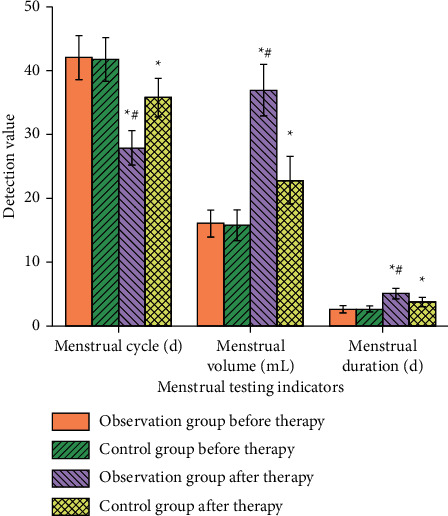
Results: After treatment, the total effective rate of the observation group (91.1% (41/45)) was higher than that of the control group (77.8% (35/45)), and the difference was statistically significant (P < 0.05). After treatment, the LH, LH/FSH, and T levels in the observation group were lower than those in the control group, while the FSH level was higher than that in the control group (P < 0.05). After treatment, the ovarian volume, endometrial thickness, cervical mucus score, and follicle number in the observation group were higher than those in the control group (P < 0.05). After treatment, the menstrual duration and menstrual volume in the observation group were longer than those in the conventional group, and the menstrual cycle was shorter than that in the conventional group (P < 0.05).
Conclusion: For patients with menstrual disorders caused by PCOS, the treatment effect of Wenshentiaojing Decoction assisted with Western medicine is better, which can effectively improve the level of sex hormones, cervical mucus, and menstrual conditions, increase the ovarian volume, endometrial thickness, and follicle number, and improve the treatment effect, with fewer adverse reactions, which is worthy of further promotion and application.
Copyright © 2021 Lanzhi Li et al.
Conflict of interest statement
The authors declare that there are no conflicts of interest.
Figures
References
-
- Lakkakula B. V. K. S., Thangavelu M., Godla U. R. Genetic variants associated with insulin signaling and glucose homeostasis in the pathogenesis of insulin resistance in polycystic ovary syndrome: a systematic review. Journal of Assisted Reproduction and Genetics . 2013;30(7):883–895. doi: 10.1007/s10815-013-0030-1. - DOI - PMC - PubMed
LinkOut - more resources
Full Text Sources
