. 2022 Jan;156(2):365-375.
doi: 10.1007/s11060-021-03918-0. Epub 2021 Dec 9.

Elevated baseline C-reactive protein levels predict poor progression-free survival in sporadic vestibular schwannoma

Affiliations

Elevated baseline C-reactive protein levels predict poor progression-free survival in sporadic vestibular schwannoma

Johannes Wach et al. J Neurooncol. 2022 Jan.

Abstract

Background: Recent investigations showed emerging evidence of the role of inflammation in the growth of sporadic vestibular schwannoma (VS). The present retrospective study investigated the impact of systemic inflammation on tumor progression using serum C-reactive protein (CRP) levels in a series of 87 surgically treated sporadic VS patients.

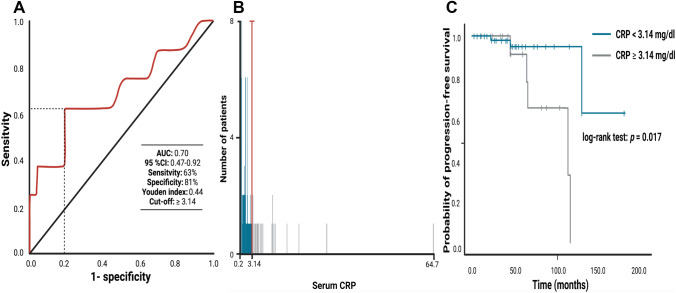
Methods: The optimal cut-off value for CRP was defined as 3.14 mg/dl according to the receiver operating characteristic curve (AUC: 0.70, 95% CI 0.47-0.92). Patient cohort was dichotomized into normal (n = 66; < 3.14 mg/dl) and high baseline (n = 21; ≥ 3.14 mg/dl) CRP groups.

Results: No significant differences in age, sex, comorbidities influencing the systemic inflammatory state, Karnofsky performance status (KPS), tumor size, extent of resection, or MIB-1 index were identified between the two groups defined by the baseline CRP levels. Univariable analysis demonstrated that a high CRP level (≥ 3.14 mg/dl) is significantly associated with a shortened progression-free survival (PFS) (hazard ratio (HR): 6.05, 95% CI 1.15-31.95, p = 0.03). Multivariable Cox regression analysis considering age, extent of resection, KPS, tumor size, and baseline CRP confirmed that an elevated CRP level (≥ 3.14 mg/dl) is an independent predictor of shortened PFS (HR: 7.20, 95% CI 1.08-48.14, p = 0.04).

Conclusions: The baseline CRP level thus serves as an independent predictor of PFS. Further investigations of the role of inflammation and tumor inflammatory microenvironment in the prediction of prognosis in sporadic VS are needed.

Keywords: C-reactive protein; Inflammation; Progression; Vestibular schwannoma.


Conflict of interest statement

The authors declare no conflict of interests.

Figures
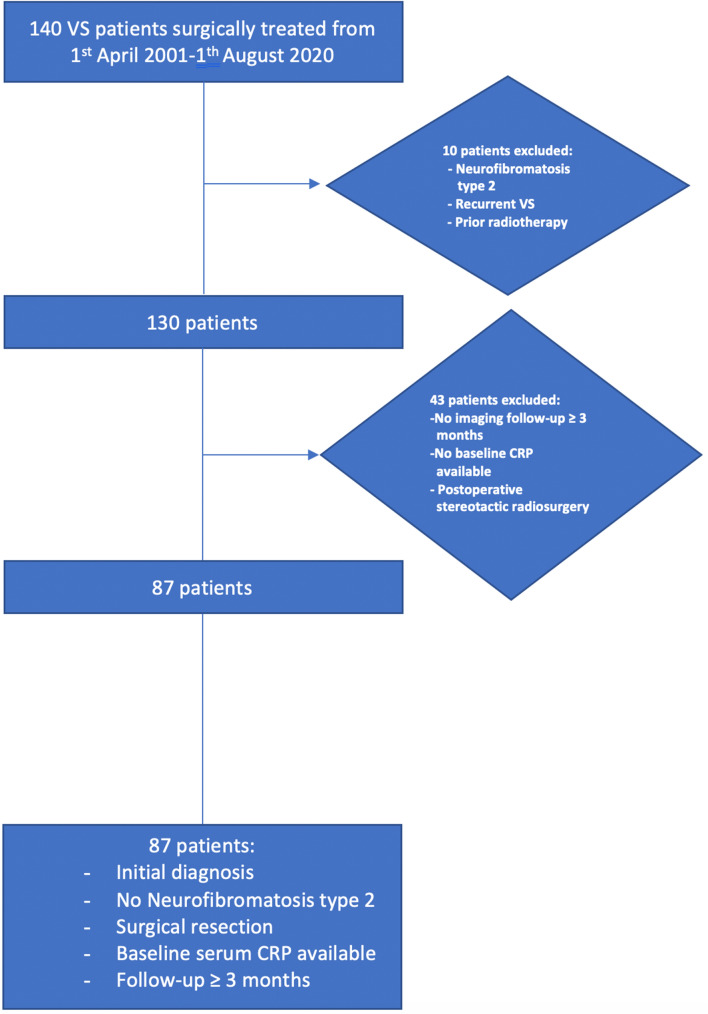
Fig. 1
Fig. 1
Flow chart illustrating the selection process of consecutive vestibular schwannoma patients between 2001 and 2020
Fig. 2
Fig. 2
A Receiver-operating characteristic curve illustrating the ability of baseline serum CRP level to predict tumor progression of vestibular schwannoma. The area under the ROC curve (AUC) of baseline CRP level for tumor progression was 0.70 [95% confidence interval (CI) 0.47–0.92]. Sensitivity and specificity of baseline CRP level for predicting tumor progression was 63.0% and 81.0%, respectively, with a threshold of ≥ 3.14 mg/dl. B Frequency distribution histogram for serum CRP levels in the analyzed cohort. Blue and grey bars indicate the number of patients exhibiting normal and high serum CRP levels, respectively. The red line at the junction of two colors displays the optimized cut-off point for serum CRP (CRP < / ≥ 3.14 mg/dl). C Kaplan–Meier analysis of the tumor progression probability stratified by “normal” CRP (< 3.14 mg/dl) and “high” CRP (≥ 3.14 mg/dl). The blue line represents the group of patients with normal CRP levels, whereas the grey line represents the group of patients with elevated CRP levels. Vertical dashes indicate censored data (here: progression-free at last follow-up) in the progression-free survival curves. The time axis is right-censored at 200 months. p = 0.017 (log-rank test)
Fig. 3
Fig. 3
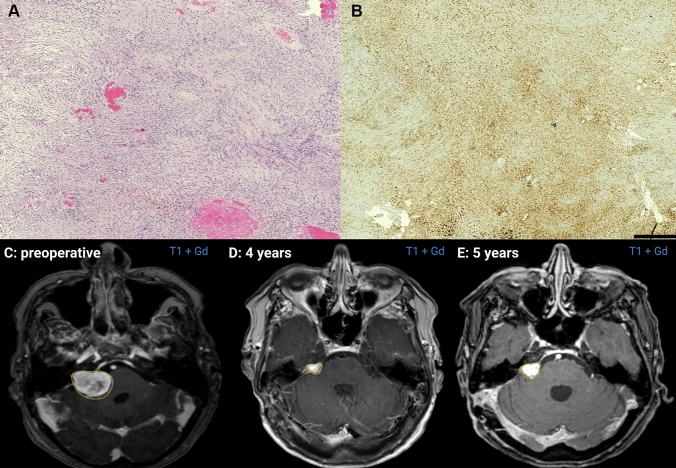
A Representative neuropathology of a vestibular schwannoma (A hematoxylin & eosin (H&E)) showing dense infiltrates of CD68-positive macrophages (B CD68; Clone KP1, dilution 1:1000, DAKO, Glastrop, Denmark; bar graph—500 µm). C Preoperative Gadolinium (Gd)-enhanced T1-weighted axial MR-image shows a right-sided giant vestibular schwannoma (volume: 16.2 cm3) of the same patient as in the neuropathological figures D Gd-enhanced T1-weighted axial MR-image shows a residual tumor at 4 years after subtotal resection of the right-sided giant vestibular schwannoma (volume: 1.5 cm3) E Gd-enhanced T1-weighted axial MR-image reveals a progress of the residual tumor at 5 years after surgery (volume: 2.0 cm3). Volumetric tumor measurements were performed using Brainlab iPlan® software (Brainlab, Feldkirchen, Germany)

References

    1. Ammar MB, Piccirillo E, Topsakal V, Taibah A, Sanna M. Surgical results and technical refinements in translabyrinthine excision of vestibular schwannomas: the Gruppo Otologico experience. Neurosurgery. 2012;70:1481–1491. doi: 10.1227/NEU.0b013e31824c010f. - DOI - PubMed
    1. Samii M, Gerganov VM, Samii A. Functional outcome after complete surgical removal of giant vestibular schwannomas. J Neurosurg. 2010;112:860–867. doi: 10.3171/2009.7.JNS0989. - DOI - PubMed
    1. Iwai Y, Ishibashi K, Watanabe Y, Uemura G, Yamanaka K. Functional preservation after planned partial resection followed by gamma knife radiosurgery for large vestibular schwannomas. World Neurosurg. 2015;84:292–300. doi: 10.1016/j.wneu.2015.03.012. - DOI - PubMed
    1. Sughrue ME, Kaur R, Rutkowski MJ, et al. Extent of resection and the long-term durability of vestibular schwannoma surgery. J Neurosurg. 2011;114:1218–1223. doi: 10.3171/2010.11.JNS10257. - DOI - PubMed
    1. Kondziolka D, Mousavi SH, Kano H, Flickinger JC, Lunsford LD. The newly diagnosed verstibular schwannoma: radiosurgery, resection, or observation? Neurosurg Focus. 2012;33(3):E8. doi: 10.3171/2012.6.FOCUS12192. - DOI - PubMed

Substances