


Multimodal analgesia reduces opioid requirements in trauma patients with rib fractures
- PMID: 34882599
- PMCID: PMC8866226
- DOI: 10.1097/TA.0000000000003486
Multimodal analgesia reduces opioid requirements in trauma patients with rib fractures
Abstract
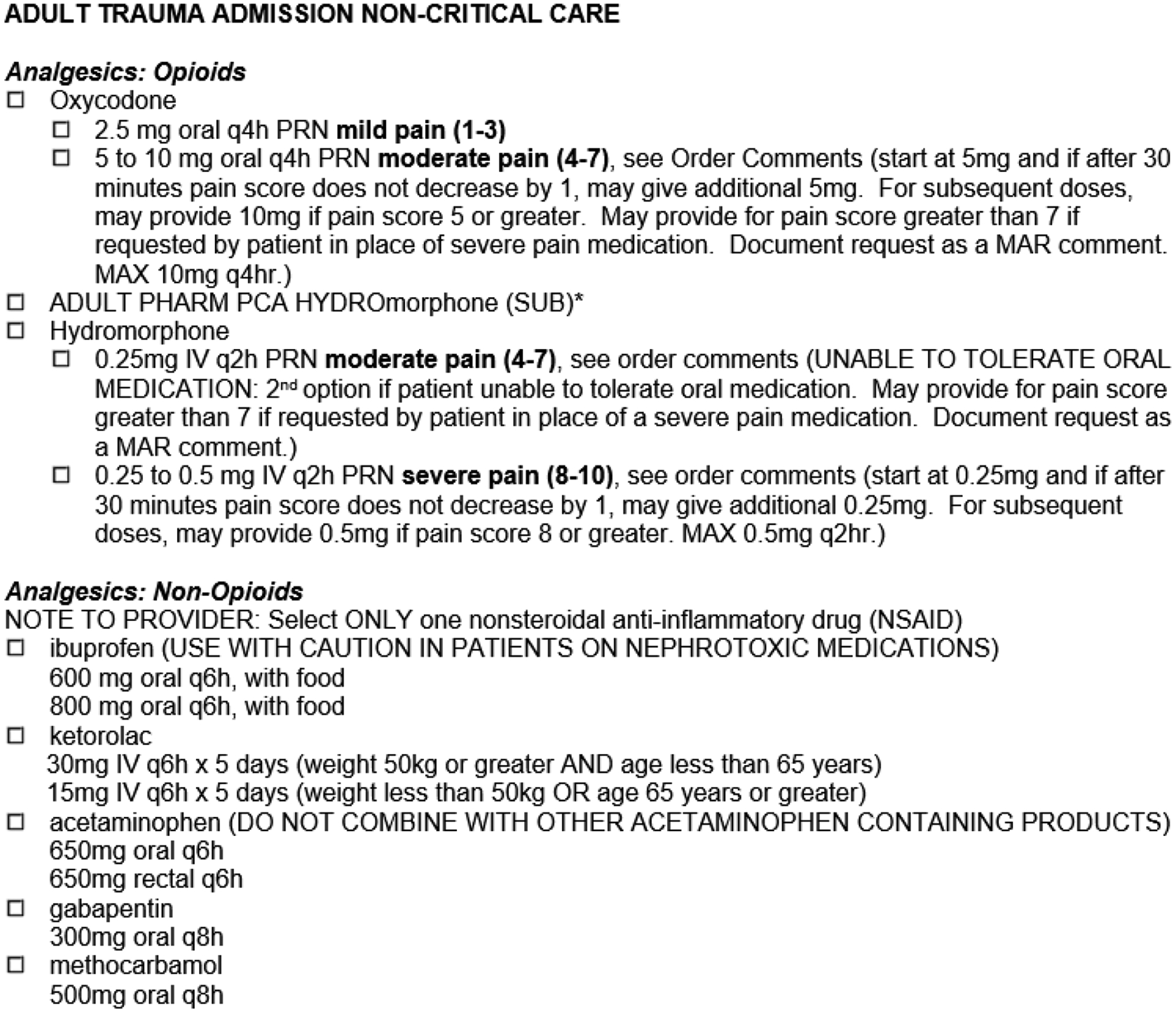
Background: Rib fractures are common in trauma patients and are associated with significant morbidity and mortality. Adequate analgesia is essential to avoid the complications associated with rib fractures. Opioids are frequently used for analgesia in these patients. This study compared the effect of a multimodal pain regimen (MMPR) on inpatient opioid use and outpatient opioid prescribing practices in adult trauma patients with rib fractures.
Study design: A pre-post cohort study of adult trauma patients with rib fractures was conducted at a Level I trauma center before (PRE) and after (POST) implementation of an MMPR. Patients on long-acting opioids before admission and those on continuous opioid infusions were excluded. Primary outcomes were oral opioid administration during the first 5 days of hospitalization and opioids prescribed at discharge. Opioid data were converted to morphine milligram equivalents (MMEs).
Results: Six hundred fifty-three patients met inclusion criteria (323 PRE, 330 POST). There was a significant reduction in the daily MME during the second through fifth days of hospitalization; and the average inpatient MME over the first five inpatient days (23 MME PRE vs. 17 MME POST, p = 0.0087). There was a significant reduction in the total outpatient MME prescribed upon discharge (322 MME PRE vs. 225 MME POST, p = 0.006).
Conclusion: The implementation of an MMPR in patients with rib fractures resulted in significant reduction in inpatient opioid consumption and was associated with a reduction in the quantity of opiates prescribed at discharge.
Level of evidence: Therapeutic/Care Management; level IV.
Copyright © 2021 Wolters Kluwer Health, Inc. All rights reserved.
Conflict of interest statement
Conflicts of Interest
Michael Bosse reports stock ownership in an orthopaedic implant company and a grand from the DOD. Christopher Griggs reports American College of Emergency Physicians board membership and payment from Boston University for preparation of pain management and opioid prescribing. Daniel Leas reports consultancy for Restor3d and ownership in Pressio. Joseph R. Hsu reports consultancy for Globus Medical and personal fees from Smith & Nephew speakers’ bureau. Michael Runyon reports research funding from Abbott Laboratories and Bristol-Myers Squibb. All other authors have nothing to declare.
Figures


References
-
- Flagel BT, Luchette FA, Reed RL, Eposito TJ, Davis KA, Santaniello JM, Gamelli RL. Half-a-dozen ribs: the breakpoint for mortality. Surgery. 2005;138:717–23;discussion 723–5. - PubMed
-
- Ziegler DW, Agarwal NN. The morbidity and mortality of rib fractures. J Trauma. 1994;37:975–9. - PubMed
-
- Baker JE, Skinner M, Heh V, Pritts TA, Goodman MD, Millar DA, Janowak CF. Readmission rates and associated factors following rib cage injury. J Trauma Acute Care Surg. 2019. Dec;87(6):1269–1276. - PubMed
-
- Hedegaard H, Warner M, Miniño AM. Drug overdose deaths in the United States, 1999–2016. NCHS Data Brief, no 294. 2017. Dec. - PubMed
Publication types
MeSH terms
Substances
Grants and funding
LinkOut - more resources
Full Text Sources
Medical
Research Materials
Miscellaneous
