


Melanocortin-4 receptor complexity in energy homeostasis,obesity and drug development strategies
- PMID: 34882941
- PMCID: PMC9302617
- DOI: 10.1111/dom.14618
Melanocortin-4 receptor complexity in energy homeostasis,obesity and drug development strategies
Abstract
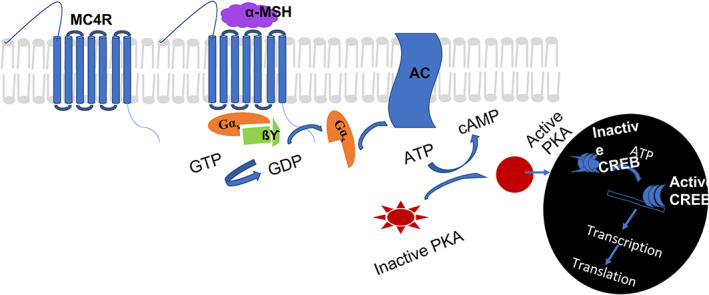
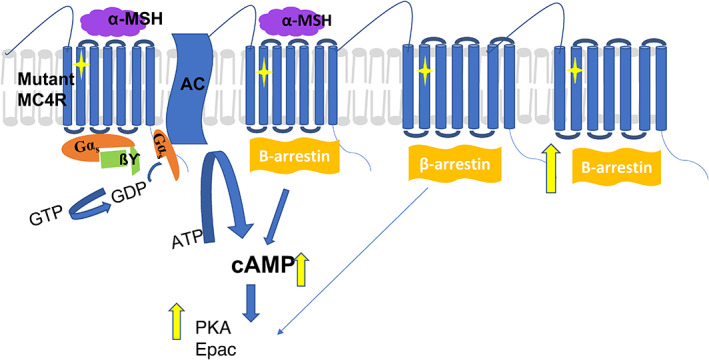
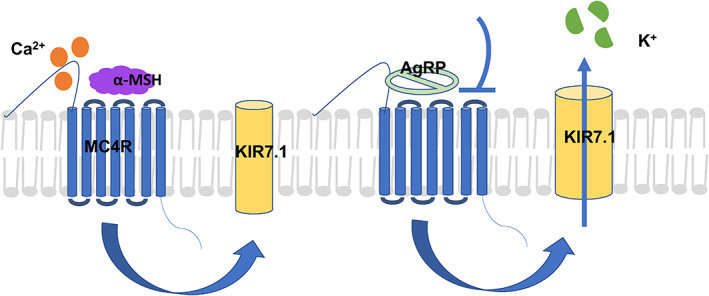
The melanocortin-4 receptor (MC4R) has been critically investigated for the past two decades, and novel findings regarding MC4R signalling and its potential exploitation in weight loss therapy have lately been emphasized. An association between MC4R and obesity is well established, with disease-causing mutations affecting 1% to 6% of obese patients. More than 200 MC4R variants have been reported, although conflicting results as to their effects have been found in different cohorts. Most notably, some MC4R gain-of-function variants seem to rescue obesity and related complications via specific pathways such as beta-arrestin (ß-arrestin) recruitment. Broadly speaking, however, dysfunctional MC4R dysregulates satiety and induces hyperphagia. The picture at the mechanistic level is complicated as, in addition to the canonical G stimulatory pathway, the ß-arrestin signalling pathway and ions (particularly calcium) seem to interact with MC4R signalling to contribute to or alleviate obesity pathogenesis. Thus, the overall complexity of the MC4R signalling spectra has broadened considerably, indicating there is great potential for the development of new drugs to manage obesity and its related complications. Alpha-melanocyte-stimulating hormone is the major endogenous MC4R agonist, but structure-based ligand discovery studies have identified possible superior and selective agonists that can improve MC4R function. However, some of these agonists characterized in vitro and in vivo confer adverse effects in patients, as demonstrated in clinical trials. In this review, we provide a comprehensive insight into the genetics, function and regulation of MC4R and its contribution to obesity. We also outline new approaches in drug development and emerging drug candidates to treat obesity.
Keywords: Ca2+; Gs; MC4R; drug design; obesity; ß-arrestin.
© 2021 The Authors. Diabetes, Obesity and Metabolism published by John Wiley & Sons Ltd.
Conflict of interest statement
The author(s) declare(s) that they have no competing interests
Figures
References
-
- Scully T, Ettela A, LeRoith D, Gallagher EJ. Obesity, type 2 diabetes, and cancer risk. Front Oncologia. 2021;10. doi: 10.3389/fonc.2020.615375 615375–615375. https://www.frontiersin.org/articles/10.3389/fonc.2020.615375/full - DOI - PMC - PubMed
-
- WHO (World Health Organization) . WHO obesity and overweight fact sheet no 311. Obes Oveweight Fact Sheet 2013.
-
- WHO . Obesity and overweight. Fact sheet no 311 January 2015. Factsheeds 2015.
Publication types
MeSH terms
Substances
LinkOut - more resources
Full Text Sources
Medical
Miscellaneous
