


Volume-Independent Sodium Toxicity in Peritoneal Dialysis: New Insights from Bench to Bed
- PMID: 34884617
- PMCID: PMC8657906
- DOI: 10.3390/ijms222312804
Volume-Independent Sodium Toxicity in Peritoneal Dialysis: New Insights from Bench to Bed
Abstract
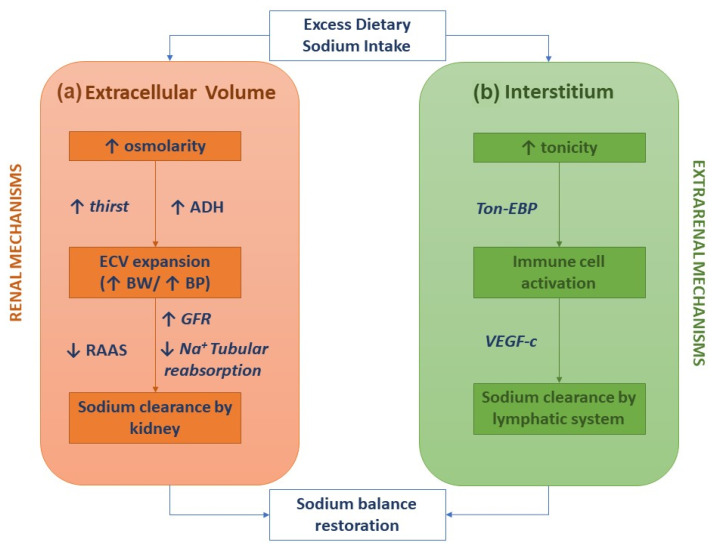
Sodium overload is common in end-stage kidney disease (ESKD) and is associated with increased cardiovascular mortality that is traditionally considered a result of extracellular volume expansion. Recently, sodium storage was detected by Na23 magnetic resonance imaging in the interstitial tissue of the skin and other tissues. This amount of sodium is osmotically active, regulated by immune cells and the lymphatic system, escapes renal control, and, more importantly, is associated with salt-sensitive hypertension. In chronic kidney disease, the interstitial sodium storage increases as the glomerular filtration rate declines and is related to cardiovascular damage, regardless of the fluid overload. This sodium accumulation in the interstitial tissues becomes more significant in ESKD, especially in older and African American patients. The possible negative effects of interstitial sodium are still under study, though a higher sodium intake might induce abnormal structural and functional changes in the peritoneal wall. Interestingly, sodium stored in the interstial tissue is not unmodifiable, since it is removable by dialysis. Nevertheless, the sodium removal by peritoneal dialysis (PD) remains challenging, and new PD solutions are desirable. In this narrative review, we carried out an update on the pathophysiological mechanisms of volume-independent sodium toxicity and possible future strategies to improve sodium removal by PD.
Keywords: end-stage kidney disease; peritoneal dialysis; sodium.
Conflict of interest statement
The authors declare no conflict of interest.
Figures
References
-
- Rose B.D. Regulation of Water and Electrolyte Balance. 4th ed. McGraw-Hill; New York, NY, USA: 1994.
Publication types
MeSH terms
Substances
LinkOut - more resources
Full Text Sources
Medical
