Review
. 2021 Nov 26;22(23):12797.
doi: 10.3390/ijms222312797.

Hypothyroidism-Associated Dyslipidemia: Potential Molecular Mechanisms Leading to NAFLD

Affiliations
Review

Hypothyroidism-Associated Dyslipidemia: Potential Molecular Mechanisms Leading to NAFLD

Maria Mavromati et al. Int J Mol Sci. .

Abstract

Thyroid hormones control lipid metabolism by exhibiting specific effects on the liver and adipose tissue in a coordinated manner. Different diseases of the thyroid gland can result in hypothyroidism. Hypothyroidism is frequently associated with dyslipidemia. Hypothyroidism-associated dyslipidemia subsequently results in intrahepatic accumulation of fat, leading to nonalcoholic fatty liver disease (NAFLD), which leads to the development of hepatic insulin resistance. The prevalence of NAFLD in the western world is increasing, and evidence of its association with hypothyroidism is accumulating. Since hypothyroidism has been identified as a modifiable risk factor of NAFLD and recent data provides evidence that selective thyroid hormone receptor β (THR-β) agonists are effective in the treatment of dyslipidemia and NAFLD, interest in potential therapeutic options for NAFLD targeting these receptors is growing. In this review, we summarize current knowledge regarding clinical and molecular data exploring the association of hypothyroidism, dyslipidemia and NAFLD.

Keywords: NAFLD; hypothyroidism; insulin resistance.


Conflict of interest statement

The authors declare no conflict of interest.

Figures
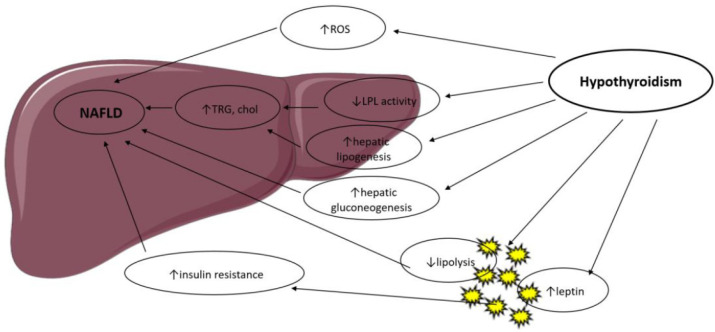
Figure 1
Figure 1
Possible mechanisms in the association between hypothyroidism and NAFLD. LPL: Lipoprotein Lipase; ROS: Reactive Oxygen Species; TRG: Triglyceride; Chol: Cholesterol.
Figure 2
Figure 2
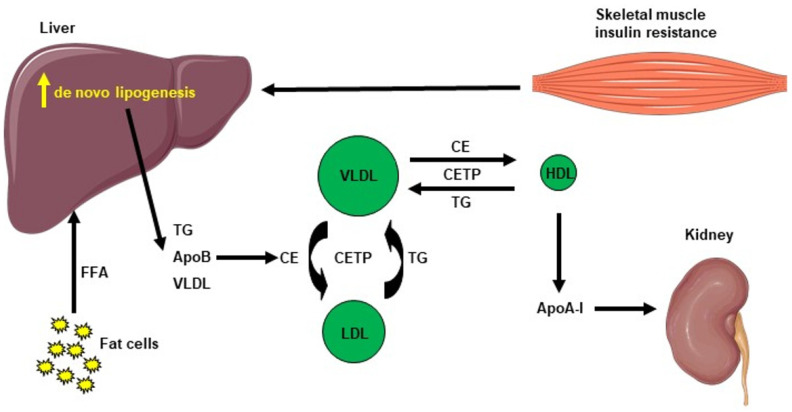
Cholesterol metabolism induced by hepatic de novo lipogenesis. Skeletal muscle insulin resistance increases hepatic de novo lipogenesis, leading to increased hepatic triglycerides (TG). TG can be exchanged for high-density lipoprotein (HDL) cholesterol in the presence of increased plasma very low–density lipoprotein (VLDL) concentrations and normal activity of cholesteryl ester transfer protein (CETP). A VLDL particle then donates a molecule of TG to an HDL particle in return for one of the cholesteryl ester (CE) molecules from HDL. The TG-rich HDL particle can be hydrolyzed of its TG, leading to dissociation of the Apolipoprotein A-1 (Apo A-1) protein. The resulting free Apo A-1 is cleared more rapidly in plasma than the apo A-1 bound to HDL particles, leading to reduced circulating apo A-1, HDL cholesterol and the number of HDL particles.

References

    1. Tanase D.M., Gosav E.M., Neculae E., Costea C.F., Ciocoiu M., Hurjui L.L., Tarniceriu C.C., Floria M. Hypothyroidism-Induced Nonalcoholic Fatty Liver Disease (HIN): Mechanisms and Emerging Therapeutic Options. Int. J. Mol. Sci. 2020;21:5927. doi: 10.3390/ijms21165927. - DOI - PMC - PubMed
    1. Jornayvaz F.R., Shulman G.I. Diacylglycerol activation of protein kinase Cepsilon and hepatic insulin resistance. Cell Metab. 2012;15:574–584. doi: 10.1016/j.cmet.2012.03.005. - DOI - PMC - PubMed
    1. Huang Y.Y., Gusdon A.M., Qu S. Cross-talk between the thyroid and liver: A new target for nonalcoholic fatty liver disease treatment. World J. Gastroenterol. 2013;19:8238–8246. doi: 10.3748/wjg.v19.i45.8238. - DOI - PMC - PubMed
    1. Motomura K., Brent G.A. Mechanisms of thyroid hormone action. Implications for the clinical manifestation of thyrotoxicosis. Endocrinol. Metab. Clin. N. Am. 1998;27:1–23. doi: 10.1016/S0889-8529(05)70294-2. - DOI - PubMed
    1. Perra A., Simbula G., Simbula M., Pibiri M., Kowalik M.A., Sulas P., Cocco M.T., Ledda-Columbano G.M., Columbano A. Thyroid hormone (T3) and TRbeta agonist GC-1 inhibit/reverse nonalcoholic fatty liver in rats. FASEB J. 2008;22:2981–2989. doi: 10.1096/fj.08-108464. - DOI - PubMed