


Azobenzene/Tetraethyl Ammonium Photochromic Potassium Channel Blockers: Scope and Limitations for Design of Para-Substituted Derivatives with Specific Absorption Band Maxima and Thermal Isomerization Rate
- PMID: 34884976
- PMCID: PMC8658355
- DOI: 10.3390/ijms222313171
Azobenzene/Tetraethyl Ammonium Photochromic Potassium Channel Blockers: Scope and Limitations for Design of Para-Substituted Derivatives with Specific Absorption Band Maxima and Thermal Isomerization Rate
Abstract
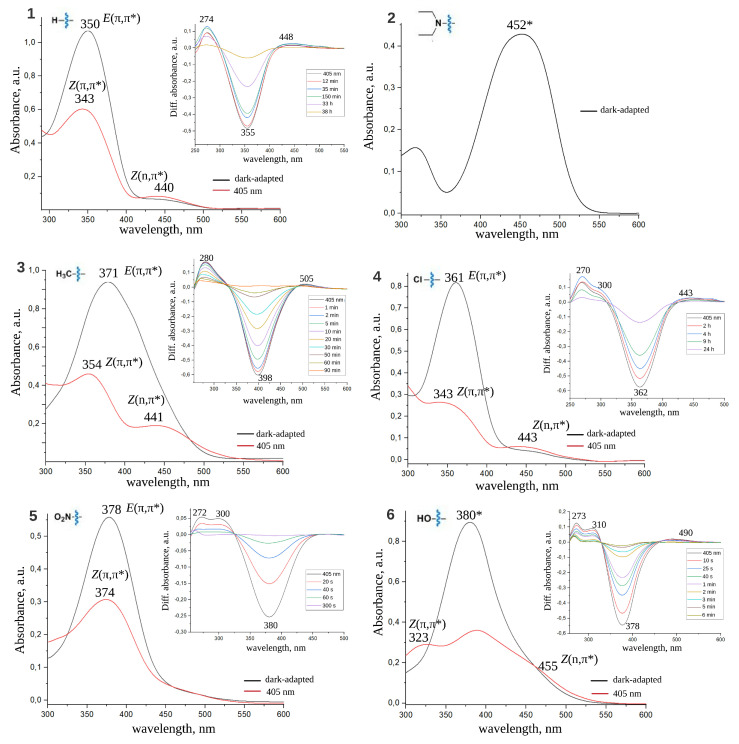
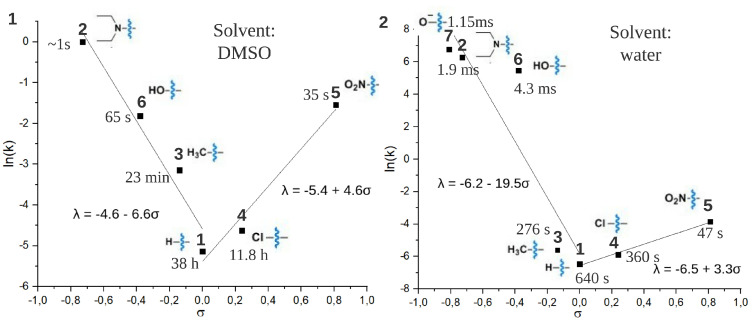
Azobenzene/tetraethyl ammonium photochromic ligands (ATPLs) are photoactive compounds with a large variety of photopharmacological applications such as nociception control or vision restoration. Absorption band maximum and lifetime of the less stable isomer are important characteristics that determine the applicability of ATPLs. Substituents allow to adjust these characteristics in a range limited by the azobenzene/tetraethyl ammonium scaffold. The aim of the current study is to find the scope and limitations for the design of ATPLs with specific spectral and kinetic properties by introducing para substituents with different electronic effects. To perform this task we synthesized ATPLs with various electron acceptor and electron donor functional groups and studied their spectral and kinetic properties using flash photolysis and conventional spectroscopy techniques as well as quantum chemical modeling. As a result, we obtained diagrams that describe correlations between spectral and kinetic properties of ATPLs (absorption maxima of E and Z isomers of ATPLs, the thermal lifetime of their Z form) and both the electronic effect of substituents described by Hammett constants and structural parameters obtained from quantum chemical calculations. The provided results can be used for the design of ATPLs with properties that are optimal for photopharmacological applications.
Keywords: DENAQ; azobenzene; azobenzene thermal isomerization rate; photochromic ion channel blockers; photopharmacology; red-shifting azobenzenes; spectral tuning of azobenzene photoswitches.
Conflict of interest statement
The authors declare no conflict of interest.
Figures





References
-
- Bregestovski P., Maleeva G. Photopharmacology: A brief review using the control of potassium channels as an example. Neurosci. Behav. Physiol. 2019;49:184–191. doi: 10.1007/s11055-019-00713-3. - DOI
-
- Ryazantsev M.N., Strashkov D.M., Nikolaev D.M., Shtyrov A.A., Panov M.S. Photopharmacological compounds based on azobenzenes and azoheteroarenes: Principles of molecular design, molecular modelling, and synthesis. Russ. Chem. Rev. 2021;90:868. doi: 10.1070/RCR5001. - DOI
MeSH terms
Substances
LinkOut - more resources
Full Text Sources
