. 2021 Nov 26;26(23):7168.
doi: 10.3390/molecules26237168.

Neuroprotective Potential of Synthetic Mono-Carbonyl Curcumin Analogs Assessed by Molecular Docking Studies

Affiliations

Neuroprotective Potential of Synthetic Mono-Carbonyl Curcumin Analogs Assessed by Molecular Docking Studies

Haya Hussain et al. Molecules. .

Abstract

Cognitive decline in dementia is associated with deficiency of the cholinergic system. In this study, five mono-carbonyl curcumin analogs were synthesized, and on the basis of their promising in vitro anticholinesterase activities, they were further investigated for in vivo neuroprotective and memory enhancing effects in scopolamine-induced amnesia using elevated plus maze (EPM) and novel object recognition (NOR) behavioral mice models. The effects of the synthesized compounds on the cholinergic system involvement in the brain hippocampus and their binding mode in the active site of cholinesterases were also determined. Compound h2 (p < 0.001) and h3 (p < 0.001) significantly inhibited the cholinesterases and reversed the effects of scopolamine by significantly reducing TLT (p < 0.001) in EPM, while (p < 0.001) increased the time exploring the novel object. The % discrimination index (DI) was significantly increased (p < 0.001) in the novel object recognition test. The mechanism of cholinesterase inhibition was further validated through molecular docking study using MOE software. The results obtained from the in vitro, in vivo and ex vivo studies showed that the synthesized curcumin analogs exhibited significantly higher memory-enhancing potential, and h3 could be an effective neuroprotective agent. However, more study is suggested to explore its exact mechanism of action.

Keywords: EPM; NORT; amnesia; cholinesterases; hippocampus; molecular docking; mono-carbonyl curcumin analogs; scopolamine.


Conflict of interest statement

The authors declare that they have no conflict of interest.

Figures
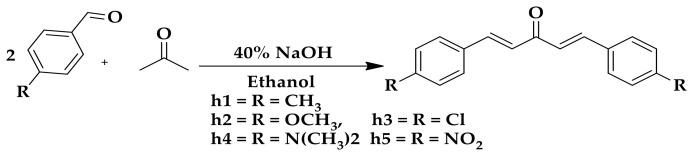
Figure 1
Figure 1
Mono-carbonyl curcumin analogs used in this study for memory enhancing effect.
Figure 2
Figure 2
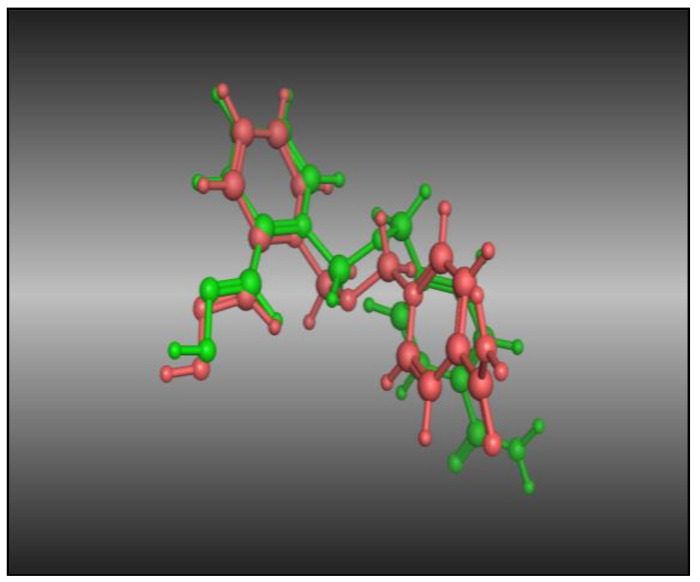
Dark pink: co-crystallized ligand; green: dock ligand.
Figure 3
Figure 3
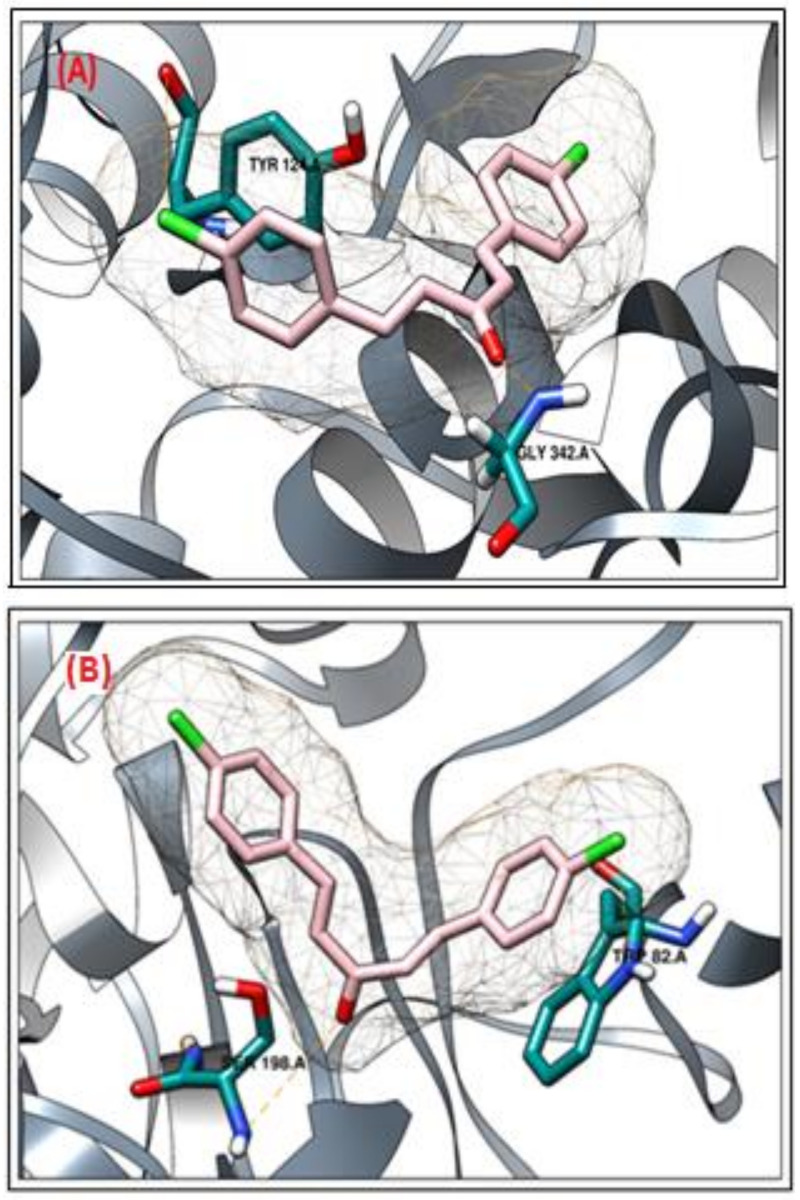
3D binding mode of compound h3 against AChE (A) and BChE (B) proteins.
Figure 4
Figure 4
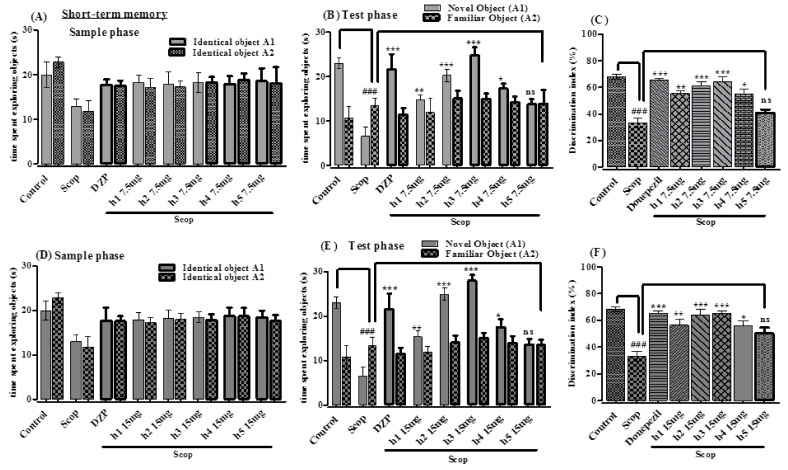
The effect of the synthesized curcumin analogs (h1–h5) in NORT (A,D,G,J) sample phase, (B,E,H,K) test phase (C,F,I,L) % DI versus scopolamine-treated group for the evaluation of short- and long-term memory. All values are presented in mean ± SEM (n = 6), ### p < 0.001 vs. normal control. Significantly different values are with respect to the amnesic (scopolamine) group; p-value <0.001, <0.01, <0.05, >0.05 are expressed as ***, **, * and ‘ns’, respectively. One-way ANOVA followed by Dunnett’s multiple comparison tests was applied on this data.
Figure 4
Figure 4
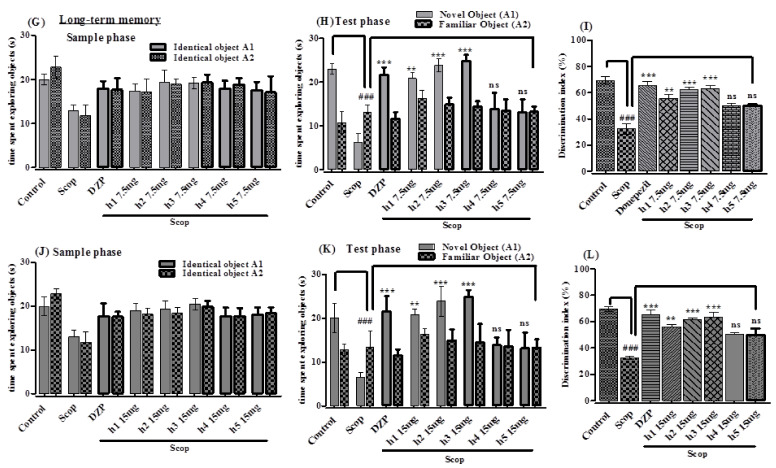
The effect of the synthesized curcumin analogs (h1–h5) in NORT (A,D,G,J) sample phase, (B,E,H,K) test phase (C,F,I,L) % DI versus scopolamine-treated group for the evaluation of short- and long-term memory. All values are presented in mean ± SEM (n = 6), ### p < 0.001 vs. normal control. Significantly different values are with respect to the amnesic (scopolamine) group; p-value <0.001, <0.01, <0.05, >0.05 are expressed as ***, **, * and ‘ns’, respectively. One-way ANOVA followed by Dunnett’s multiple comparison tests was applied on this data.
Figure 5
Figure 5
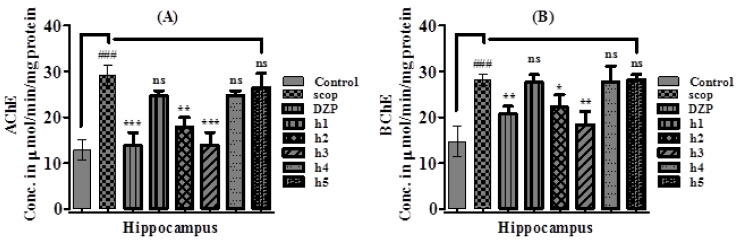
Ex vivo anticholinesterase effect of synthesized curcumin analogs (h1h5) in AChE (A) and BChE (B) in the hippocampus region of mouse brain versus the scopolamine-treated group. All values are presented as mean ± SEM (n = 6), ### p < 0.001 vs. normal control. Significantly different values are with reference to the scopolamine-treated group; p-value <0.001, <0.01, <0.05 are expressed as ***, **, and *, respectively. One-way ANOVA followed by Dunnett’s multiple comparison tests was applied.

References

    1. Stanciu G.D., Luca A., Rusu R.N., Bild V., Ioan S., Chiriac B., Solcan C., Bild W., Ababei D.C. Alzheimer’s Disease Pharmacotherapy in Relation to Cholinergic System Involvement. Biomolecules. 2020;10:40. doi: 10.3390/biom10010040. - DOI - PMC - PubMed
    1. Shal B., Khan A., Khan A.U., Ullah R., Ali G., Islam S.U., Haq I.U., Ali H., Seo E.K., Khan S. Alleviation of memory deficit by bergenin via the regulation of reelin and Nrf-2/NF-κB pathway in transgenic mouse model. Int. J. Mol. Sci. 2021;22:6603. doi: 10.3390/ijms22126603. - DOI - PMC - PubMed
    1. Nazir N., Zahoor M., Nisar M., Karim N., Latif A., Ahmad S., Uddin Z. Evaluation of neuroprotective and antiamnesic effects of elaeagnus umbellate thunb. On scopolamine-induced memory impairment in mice. BMC Complement. Med. Ther. 2020;20:143. doi: 10.1186/s12906-020-02942-3. - DOI - PMC - PubMed
    1. Francis P.T., Palmer A.M., Snape M., Wilcock G.K. The cholinergic hypothesis of Alzheimer’s disease: A review of progress. J. Neurol. Neurosurg. Psychiatry. 1999;66:137–147. doi: 10.1136/jnnp.66.2.137. - DOI - PMC - PubMed
    1. Mushtaq A., Anwar R., Ahmad M. Lavandula stoechas (L) a very potent antioxidant attenuates dementia in scopolamine induced memory deficit mice. Front. Pharmacol. 2018;9:1375. doi: 10.3389/fphar.2018.01375. - DOI - PMC - PubMed

MeSH terms