


Berberine as a Potential Anticancer Agent: A Comprehensive Review
- PMID: 34885950
- PMCID: PMC8658774
- DOI: 10.3390/molecules26237368
Berberine as a Potential Anticancer Agent: A Comprehensive Review
Abstract
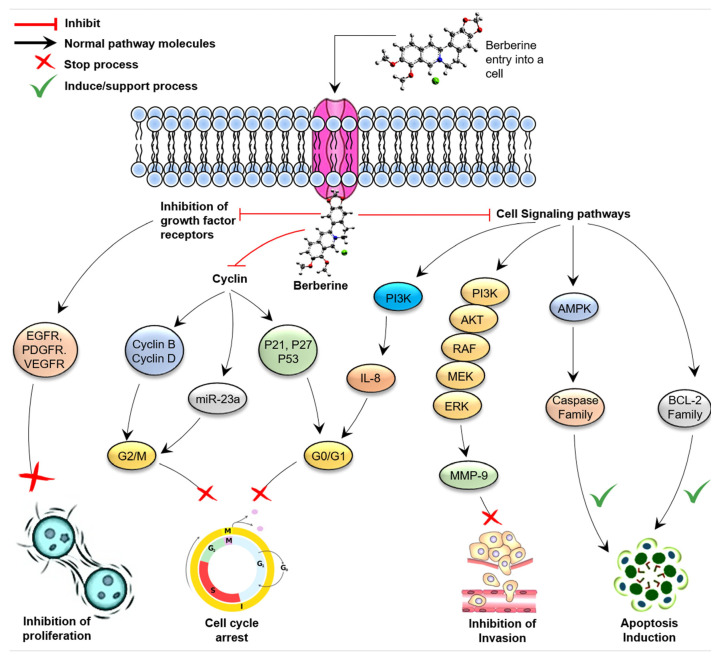
Berberine (BBR), a potential bioactive agent, has remarkable health benefits. A substantial amount of research has been conducted to date to establish the anticancer potential of BBR. The present review consolidates salient information concerning the promising anticancer activity of this compound. The therapeutic efficacy of BBR has been reported in several studies regarding colon, breast, pancreatic, liver, oral, bone, cutaneous, prostate, intestine, and thyroid cancers. BBR prevents cancer cell proliferation by inducing apoptosis and controlling the cell cycle as well as autophagy. BBR also hinders tumor cell invasion and metastasis by down-regulating metastasis-related proteins. Moreover, BBR is also beneficial in the early stages of cancer development by lowering epithelial-mesenchymal transition protein expression. Despite its significance as a potentially promising drug candidate, there are currently no pure berberine preparations approved to treat specific ailments. Hence, this review highlights our current comprehensive knowledge of sources, extraction methods, pharmacokinetic, and pharmacodynamic profiles of berberine, as well as the proposed mechanisms of action associated with its anticancer potential. The information presented here will help provide a baseline for researchers, scientists, and drug developers regarding the use of berberine as a promising candidate in treating different types of cancers.
Keywords: alkaloids; berberine; cancer; cancer preventive agents; pharmacokinetic study.
Conflict of interest statement
The authors declare no conflict of interest.
Figures
References
-
- Hussain A., Bourguet-Kondracki M.L., Hussain F., Rauf A., Ibrahim M., Khalid M., Hussain H., Hussain J., Ali I., Khalil A.A., et al. The potential role of dietary plant ingredients against mammary cancer: A comprehensive review. Crit. Rev. Food. Sci. Nutr. 2020;15:26. doi: 10.1080/10408398.2020.1855413. - DOI - PubMed
-
- Cicero A.F.G., Baggioni A. Berberine and its role in chronic disease. Adv. Exp. Med. Biol. 2016;928:27–45. - PubMed
-
- Kukulka-Koch W.A., Widelski J. Alkaloids. Pharmacognosy. 2017;1:163–198.
Publication types
MeSH terms
Substances
LinkOut - more resources
Full Text Sources
Medical
