Review
. 2021 Nov 23:12:775648.
doi: 10.3389/fphys.2021.775648. eCollection 2021.

The Crucial Roles of Phospholipids in Aging and Lifespan Regulation

Affiliations
Review

The Crucial Roles of Phospholipids in Aging and Lifespan Regulation

Yucan Dai et al. Front Physiol. .

Abstract

Phospholipids are major membrane lipids that consist of lipid bilayers. This basic cellular structure acts as a barrier to protect the cell against various environmental insults and more importantly, enables multiple cellular processes to occur in subcellular compartments. Numerous studies have linked the complexity of membrane lipids to signal transductions, organelle functions, as well as physiological processes, and human diseases. Recently, crucial roles for membrane lipids in the aging process are beginning to emerge. In this study, we summarized current advances in our understanding of the relationship between membrane lipids and aging with an emphasis on phospholipid species. We surveyed how major phospholipid species change with age in different organisms and tissues, and some common patterns of membrane lipid change during aging were proposed. Further, the functions of different phospholipid molecules in regulating healthspan and lifespan, as well as their potential mechanisms of action, were also discussed.

Keywords: aging; lifespan; membrane lipid; organelle; phospholipid.


Conflict of interest statement

The authors declare that the research was conducted in the absence of any commercial or financial relationships that could be construed as a potential conflict of interest.

Figures
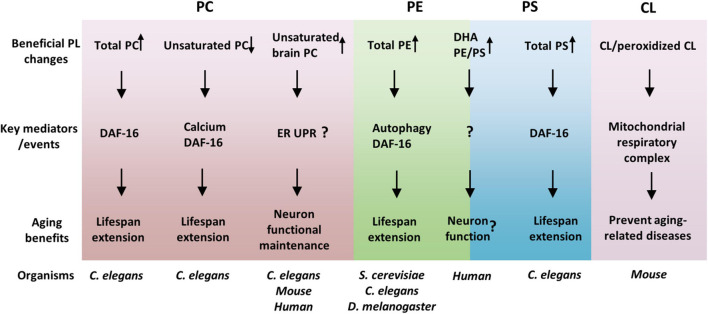
FIGURE 1
FIGURE 1
Phospholipids (PLs) regulate aging via overlapped but distinct molecular mechanisms. PL species with beneficial effects on healthspan and lifespan were suggested and their key mediators were listed. Among the mediators, DAF-16 seems to be common and important for many PLs effects. Moreover, the functions of organelles, such as the ER and mitochondria, are crucial links between PLs and aging, consistent with PLs as membrane lipids.

References

    1. Ammendolia D. A., Bement W. M., Brumell J. H. (2021). Plasma membrane integrity: implications for health and disease. BMC Biol. 19:71. 10.1186/s12915-021-00972-y - DOI - PMC - PubMed
    1. Antonny B., Vanni S., Shindou H., Ferreira T. (2015). From zero to six double bonds: phospholipid unsaturation and organelle function. Trends Cell Biol. 25 427–436. 10.1016/j.tcb.2015.03.004 - DOI - PubMed
    1. Bennett S. A. L., Valenzuela N., Xu H., Franko B., Fai S., Figeys D. (2013). Using neurolipidomics to identify phospholipid mediators of synaptic (dys)function in Alzheimer’s disease. Front. Physiol. 4:168. 10.3389/fphys.2013.00168 - DOI - PMC - PubMed
    1. Braun F., Rinschen M. M., Bartels V., Frommolt P., Habermann B., Hoeijmakers J. H., et al. (2016). Altered lipid metabolism in the aging kidney identified by three layered omic analysis. Aging 8 441–454. 10.18632/aging.100900 - DOI - PMC - PubMed
    1. Calzada E., Avery E., Sam P. N., Modak A., Wang C., McCaffery J. M., et al. (2019). Phosphatidylethanolamine made in the inner mitochondrial membrane is essential for yeast cytochrome bc1 complex function. Nat. Commun. 10:1432. 10.1038/s41467-019-09425-1 - DOI - PMC - PubMed

LinkOut - more resources
