


Stigmatisation of COVID-19 in Riyadh, Saudi Arabia: A cross-sectional study
- PMID: 34888070
- PMCID: PMC8631232
- DOI: 10.18295/squmj.4.2021.044
Stigmatisation of COVID-19 in Riyadh, Saudi Arabia: A cross-sectional study
Abstract
Objectives: Infectious diseases are the most common cause of disease stigmatisation, which can lead to a denial of healthcare, education, housing and employment as well as physical violence. Such stigmatisation is common during pandemics. This study aimed to examine the social stigmatisation of COVID-19 among residents of Riyadh, Saudi Arabia.
Methods: A cross-sectional descriptive study was conducted in Riyadh in May 2020. Non-probability convenient sampling was used to recruit 847 participants through social media platforms, including WhatsApp. The data were analysed using descriptive statistics, the Pearson correlation coefficient and the chi-squared test were used along with a multiple linear regression model.
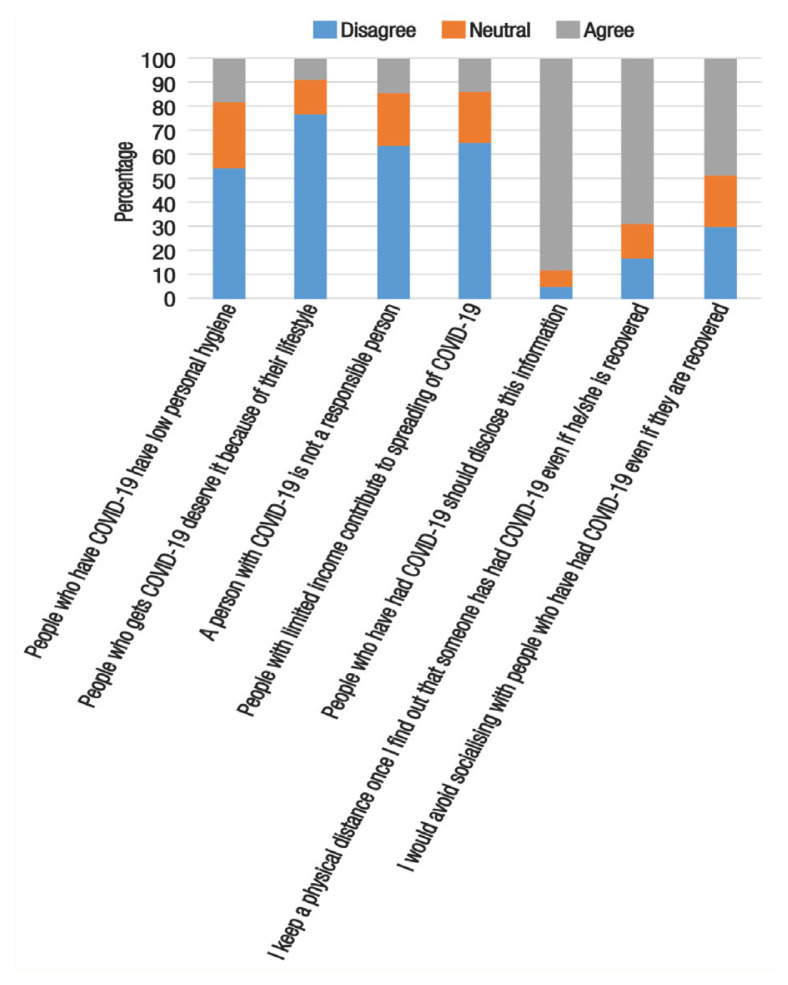
Results: There was a high level of stigma among 21% of the participants and an intermediate level in almost 49% of the participants. Low stigma was indicated among 30% of the study's sample. A highly significant association existed between stigma, on the one hand, and older age groups, being married and lower levels of education, on the other.
Conclusion: Future awareness programmes should educate patients and their families about stigma as well as the consequences of stigmatising COVID-19. Stigma eradication policies and interventions should be implemented to avoid potentially harmful consequences for public health.
Keywords: COVID-19; Pandemic; Saudi Arabia; Social stigma.
© Copyright 2021, Sultan Qaboos University Medical Journal, All Rights Reserved.
Conflict of interest statement
CONFLICT OF INTEREST The authors report no conflicts of interest.
Figures
References
-
- Neuberg SL, Smith DM, Asher T. Why people stigmatize: Toward a biocultural framework. In: Heatherton TF, Kleck RE, Hebl MR, Hull JG, editors. The social psychology of stigma. New York, USA: Guilford Press; 2000. pp. 31–61.
-
- Williams J, Gonzalez-Medina D, Le Q. Infectious diseases and social stigma. Med Health Sci J. 2011;4:58–70. doi: 10.15208/mhsj.2011.127. - DOI
-
- de Vries SG, Cremers AL, Heuvelings CC, Greve PF, Visser BJ, Bélard S, et al. Barriers and facilitators to the uptake of tuberculosis diagnostic and treatment services by hard-to-reach populations in countries of low and medium tuberculosis incidence: a systematic review of qualitative literature. Lancet Infect Dis. 2017;17:E128–43. doi: 10.1016/S1473-3099(16)30531-X. - DOI - PubMed
MeSH terms
LinkOut - more resources
Full Text Sources
Medical