


Historic redlining, structural racism, and firearm violence: A structural equation modeling approach
- PMID: 34888540
- PMCID: PMC8654098
- DOI: 10.1016/j.lana.2021.100052
Historic redlining, structural racism, and firearm violence: A structural equation modeling approach
Abstract
Background: Firearm homicides disproportionately affect Black communities. Redlining - discriminatory lending practices of the early 20th century - are associated with current increased rates of firearm violence. Poverty and concentrated disadvantage are also associated with firearm violence. The interaction of these factors with racist redlining housing practices remains unclear.
Methods: We used generalized structural equation modeling to characterize the mediators through which redlining practices of the 1930s led to present rates of firearm violence in Boston using a negative binomial model. Principle component analysis was used to create four distinct mediating variables representing census block socioeconomic and built environment information, while reducing dimensionality. We calculated the direct effect between harmful (Red and Yellow) vs beneficial (Green) designations and firearm incident rate, indirect effect between redlining designation and firearm incident rate through each mediating variable, and the total effect. The percentage mediation of each mediator was subsequently calculated.
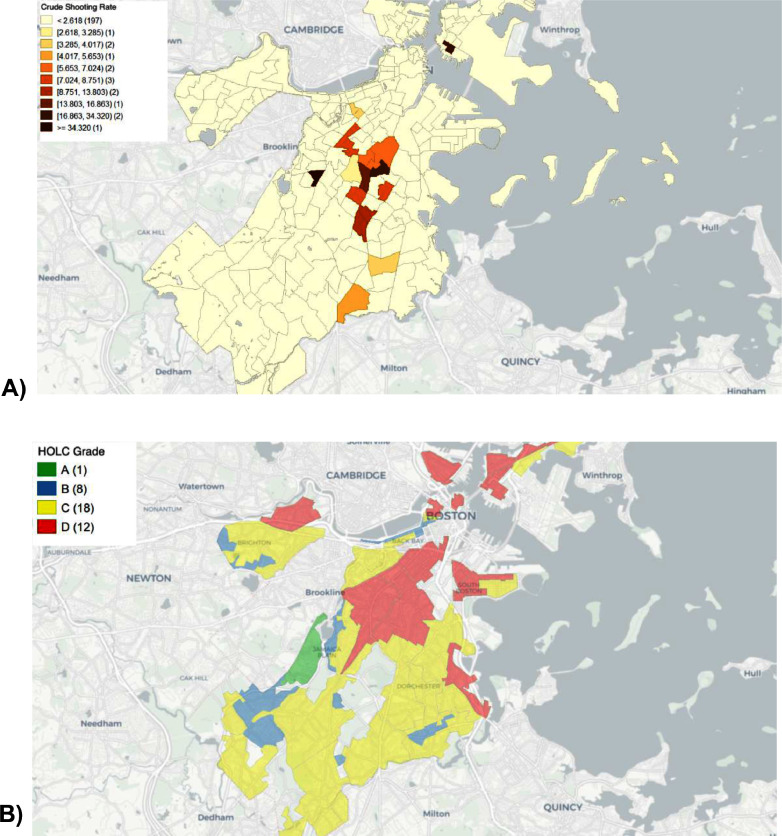
Findings: Red and Yellow areas of Boston were associated with an 11•1 (95% CI 5•5,22•4) and 11•4 (5•7,22•8) increased incident rate of shooting when compared to Green. In the pathway between Red designation and firearm incident rate, poverty and poor educational attainment mediated 20% of the interaction, share of rented housing mediated 8%, and Black share of the population 3%. In the pathway between Yellow designation and firearm incident rate, poverty and poor educational attainment mediated 16% of the association, and Black share of the population mediated 13%.
Interpretation: Redlining practices of the 1930s potentially contribute to increased rates of firearm violence through changes to neighborhood environments, namely through preclusion from homeownership, poverty, poor educational attainment, and concentration (i.e. segregation) of Black communities. These downstream mediating factors serve as points for policy interventions to address urban firearm violence.
Funding: Michael Poulson and Miriam Neufeld were supported by T32 Training Grants (HP10028, GM86308).
Keywords: Firearm violence; Health policy; Socioeconomic; Structural equation modeling; Structural racism.
Conflict of interest statement
Declaration of interest The authors have nothing to disclose.
Figures

References
-
- Underlying Cause of Death 1999-2017 on CDC WONDER Online Database.; 2018. https://wonder.cdc.gov/controller/saved/D76/D61F659
-
- Leading Causes of Death in Males, United States. Centers for Disease Control and Prevention. Published 2020. Accessed May 1, 2021. https://www.cdc.gov/healthequity/lcod/index.htm
-
- Riddell CA, Harper S, Cerda M, Kaufman JS. Comparison of Rates of Firearm and Non rearm Homicide and Suicide in Black and White Non-Hispanic Men, by U.S. State. Ann Intern Med. 2018;168(10):712–720. - PubMed
Grants and funding
LinkOut - more resources
Full Text Sources
