


Coronavirus Disease 2019 Outcomes Among Recipients of Anti-CD20 Monoclonal Antibodies for Immune-Mediated Diseases: A Comparative Cohort Study
- PMID: 34890478
- PMCID: PMC8916578
- DOI: 10.1002/acr2.11386
Coronavirus Disease 2019 Outcomes Among Recipients of Anti-CD20 Monoclonal Antibodies for Immune-Mediated Diseases: A Comparative Cohort Study
Abstract
Objective: Patients with immune-mediated diseases treated with anti-CD20 monoclonal antibodies may have worse coronavirus disease 2019 (COVID-19) outcomes due to impaired humoral immunity, but differences compared with the general population are unknown.
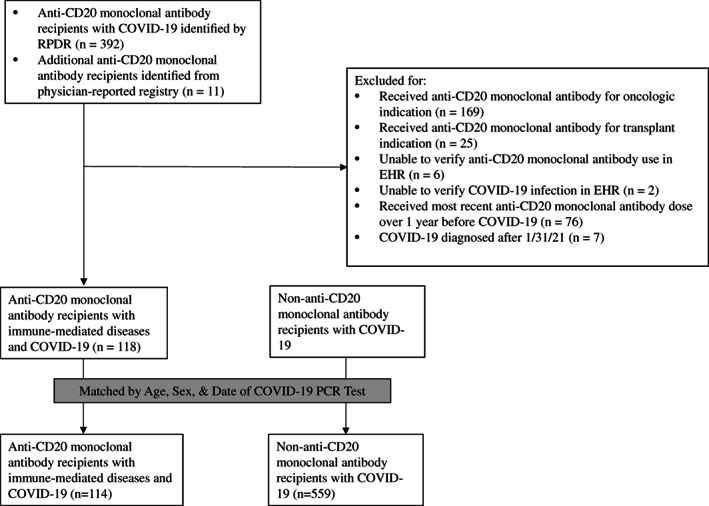
Methods: We identified patients with immune-mediated diseases who received anti-CD20 monoclonal antibodies within 1 year prior to the index date of polymerase chain reaction-confirmed COVID-19 between January 31, 2020, and January 31, 2021. General population comparators with COVID-19 were matched up 5:1 by age, sex, and polymerase chain reaction date. Unadjusted and multivariable adjusted (for age, race, body mass index, and Charlson Comorbidity Index) hazard ratios (HRs) and 95% confidence intervals (CIs) for hospitalization, mechanical ventilation, and death in recipients of anti-CD20 monoclonal antibodies versus comparators were estimated by using Cox regression.
Results: We identified 114 cases patients COVID-19 who had received anti-CD20 monoclonal antibodies for immune-mediated diseases (mean age 55 years, 70% female) and 559 matched comparators with COVID-19 (mean age 54 years, 70% female). Patients treated with anti-CD20 monoclonal antibodies had higher mortality (adjusted HR 2.16; 95% CI: 1.03-4.54) than matched comparators. Risks of hospitalization (adjusted HR 0.88; 95% CI: 0.62-1.26) and mechanical ventilation use (adjusted HR 0.82; 95% CI: 0.36-1.87) were similar. Similar trends were seen in analyses according to type of indication (eg, rheumatic or neurologic disease) and duration of anti-CD20 monoclonal antibody use (<1 or ≥1 year) and after patients with interstitial lung disease, those with cancer, and those on glucocorticoids prior to COVID-19 diagnosis were excluded.
Conclusion: Patients who received anti-CD20 monoclonal antibodies for immune-mediated diseases prior to COVID-19 had higher mortality following COVID-19 than matched comparators, highlighting the urgent need to mitigate excess risks in recipients of anti-CD20 monoclonal antibodies during the ongoing pandemic.
© 2021 The Authors. ACR Open Rheumatology published by Wiley Periodicals LLC on behalf of American College of Rheumatology.
Figures
Update of
-
COVID-19 Outcomes Among Users of CD20 Inhibitors for Immune-Mediated Diseases: A Comparative Cohort Study.medRxiv [Preprint]. 2021 Aug 9:2021.08.05.21261643. doi: 10.1101/2021.08.05.21261643. medRxiv. 2021. Update in: ACR Open Rheumatol. 2022 Mar;4(3):238-246. doi: 10.1002/acr2.11386. PMID: 34401883 Free PMC article. Updated. Preprint.
References
-
- Gianfrancesco MA, Hyrich KL, Al‐Adely S, Carmona L, Danila MI, Gossec L, et al. Characteristics associated with hospitalisation for COVID‐19 in people with rheumatic disease: data from the COVID‐19 Global Rheumatology Alliance physician‐reported registry. Ann Rheum Dis 2020;79:859–66. - PMC - PubMed
Grants and funding
- R. Bruce and Joan M. Mickey Research Scholar Fund
- K23 AR073334/AR/NIAMS NIH HHS/United States
- P30 AR070253/AR/NIAMS NIH HHS/United States
- T32 AR007530/AR/NIAMS NIH HHS/United States
- T32-AR-007530/National Institutes of Health Ruth L. Kirschstein Institutional National Research Service Award
- K23 AR069688/AR/NIAMS NIH HHS/United States
- L30 AR066953/AR/NIAMS NIH HHS/United States
- R03 AR075886/AR/NIAMS NIH HHS/United States
- Brigham Research Institute
- R03 AR078938/AR/NIAMS NIH HHS/United States
- P30 AR072577/AR/NIAMS NIH HHS/United States
- T32 AR007258/AR/NIAMS NIH HHS/United States
- Rheumatology Research Foundation R Bridge Award
- T32-AR-007258/National Institutes of Health Ruth L. Kirschstein Institutional National Research Service Award
LinkOut - more resources
Full Text Sources
