Multicenter Study
. 2022 Apr;56(4):418-431.
doi: 10.1111/medu.14711. Epub 2022 Jan 9.

Junior doctors' experiences with interprofessional collaboration: Wandering the landscape

Affiliations
Multicenter Study

Junior doctors' experiences with interprofessional collaboration: Wandering the landscape

Titia S van Duin et al. Med Educ. 2022 Apr.

Abstract

Context: The transition from medical student to junior doctor is challenging. Junior doctors need to become part of the physician community of practice (CoP), while dealing with new responsibilities, tasks and expectations. At the same time, they need to learn how to navigate the frontiers and intersections with the other communities of practice that form the Landscape of Practice (LoP). This study aims to understand how junior doctors experience interprofessional collaboration (IPC) and what elements shape these experiences considering their transition to clinical practice.

Methods: In this multicentre qualitative study, 13 junior doctors individually drew two rich pictures of IPC experiences, one positive and one negative. A rich picture is a visual representation, a drawing of a particular situation intended to capture the complex and non-verbal elements of an experience. We used semi-structured interviews to deepen the understanding of junior doctors' depicted IPC experiences. We analysed both visual materials and interview transcripts iteratively, for which we adopted an inductive constructivist thematic analysis.

Results: While transitioning into a doctor, junior doctors become foremost members of the physician CoP and shape their professional identity based on perceived values in their physician community. Interprofessional learning occurs implicitly, without input from the interprofessional team. As a result, junior doctors struggle to bridge the gap between themselves and the interprofessional team, preventing IPC learning from developing into an integrative process. This professional isolation leaves junior doctors wandering the landscape of practice without understanding roles, attitudes and expectations of others.

Conclusions: Learning IPC needs to become a collective endeavour and an explicit learning goal, based on multisource feedback to take advantage of the expertise already present in the LoP. Furthermore, junior doctors need a safe environment to embrace and reflect on the emotions aroused by interprofessional interactions, under the guidance of experienced facilitators.


Conflict of interest statement

The authors declare that there is no conflict of interest.

Figures
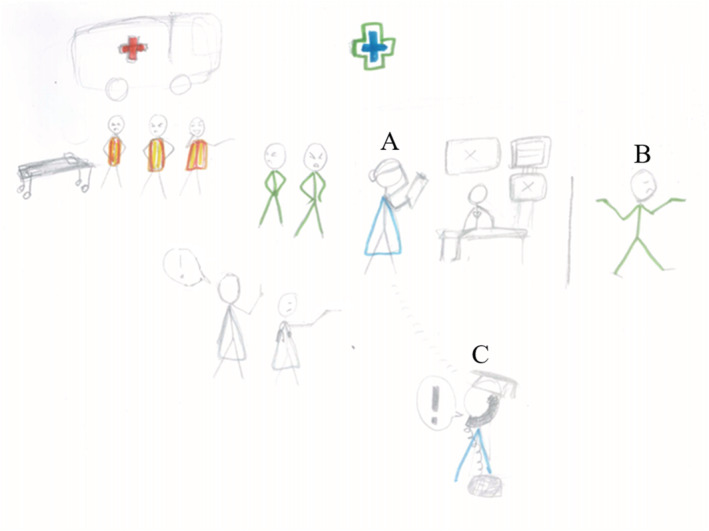
FIGURE 1
FIGURE 1
This rich picture tells the story of a junior doctor (A, Sarah, fictitious name) who was called to the emergency department to evaluate and admit a psychiatric patient. Sarah decided to exclude a cardiologic cause for the patient's symptoms. Still, the emergency crew clearly wanted Sarah to admit the patient as fast as possible and leave the emergency department. The tension increased when Sarah tried to order additional laboratory tests but was denied by the angry emergency crew. Sarah felt like an outsider and perceived antipathy from the whole team. This antipathy is depicted by their angry and even jeering faces (top left) and by a nurse walking away from Sarah (B, top right), showing she did not have the time to interact. Sarah felt belittled, intimidated and sad by the fact that she had been judged before she was able to explain her side of the story. In the meantime, her supervisor kept insisting and pressing her over the phone to admit the patient only after checking the tests. In the end, Sarah felt ashamed that she was not self‐confident enough and did not handle the situation smoothly. She also felt embarrassed that she had to follow her supervisors' orders without considering the opinions of the emergency crew. Sarah did not share her feelings with the emergency crew, neither did she discuss them with her supervisor. Only the technicalities of the case were addressed during supervision. The supervisor (C) wears a professor's hat as a metaphor for his top‐down behaviour [Color figure can be viewed at wileyonlinelibrary.com]
FIGURE 2
FIGURE 2
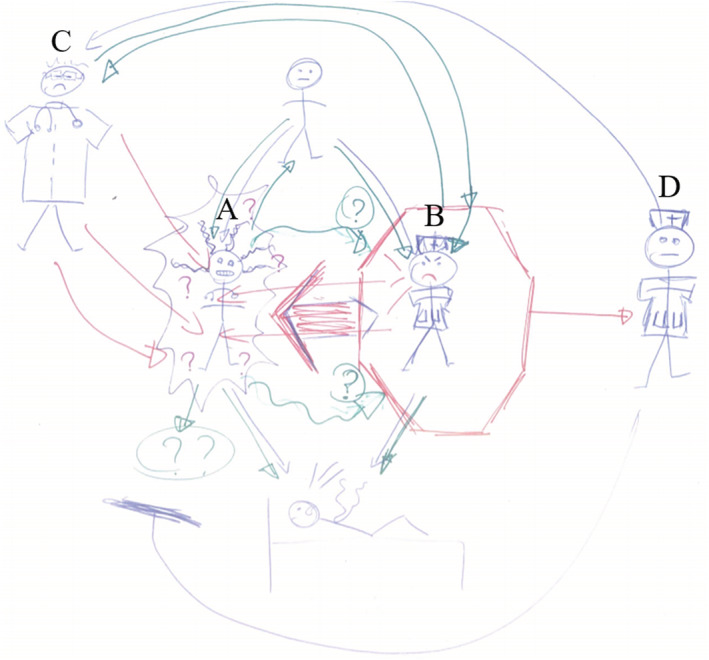
This rich picture tells the story of a junior doctor (A, Jane fictitious name) taking care of a patient with advanced brain tumour—stage IV glioblastoma (figure lying in bed at the bottom of the drawing). The patient was receiving palliative care at the radiotherapy department and would return to the residence where he was living. The nurse (B) confronted Jane the morning of his discharge, telling her she disagreed with the patient's discharge and treatment plan. Jane listened to the nurse's concerns in an engaging conversation and changed some of the medication to be prescribed for the patient. During the process, Jane felt like hitting a wall, with the nurse coming across aggressively bringing forth personal arguments as Jane did not take up all of the nurse's advice. After this, Jane received a call from her supervisor (C), telling her he had received a call from the head nurse of the department (D) and that he would change the treatment. Jane felt betrayed (‘stabbed in the back’). After such a long conversation with the nurse, she did not expect to be crossed over like this. She felt no support or respect from the team. Jane drew herself chaotic, with the red lines representing all the bad vibes coming towards her. The big red arrow indicates the angry nurse shouting directly at her. The question marks show Jane's insecurity, feeling so responsible to do what she thought was best for the patient and her failure in reaching out to her co‐workers. Jane drew her supervisor a bit outside of the situation, adding to it that there was a big threshold between them [Color figure can be viewed at wileyonlinelibrary.com]
FIGURE 3
FIGURE 3
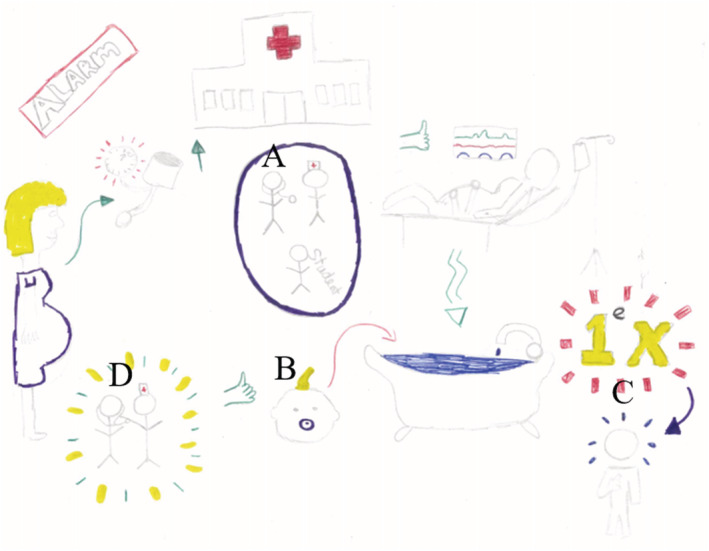
This rich picture tells the story of a junior doctor (A, Emily fictitious name) working in gynaecology. Emily assisted a pregnant woman who came in with a high blood pressure during her delivery. The pregnant woman asked to give birth in a bath, which made Emily insecure as she had never done this before. Emily felt supported by the midwife (figure standing next to A), which made her confident enough to try a bath delivery for the first time. Together, Emily and the midwife assisted the bath delivery and it went well: The woman had a positive birth experience and the baby was healthy (indicated by the green thumb up next to the baby's head, B). Emily felt so proud to have successfully managed her first bath delivery (C). Afterwards, the midwife complimented Emily, represented by the green and yellow circle around Emily and the midwife, and the midwife putting her hand on Emily's shoulder (D). The midwife expressed that she was very happy that Emily tried it and felt that Emily was in control of the situation. Emily explained that she, the midwife and student midwife worked and acted as a team and that the three of them were in the centre of the experience of the delivering woman and her partner [Color figure can be viewed at wileyonlinelibrary.com]

Comment in

References

    1. Sturman N, Tan Z, Turner J. “A steep learning curve”: Junior doctor perspectives on the transition from medical student to the health‐care workplace. BMC Med Educ. 2017;17(1):92. doi: 10.1186/s12909-017-0931-2 - DOI - PMC - PubMed
    1. Brennan N, Corrigan O, Allard J, et al. The transition from medical student to junior doctor: today's experiences of Tomorrow's Doctors. Med Educ. 2010;44(5):449‐458. doi: 10.1111/j.1365-2923.2009.03604.x - DOI - PubMed
    1. Teunissen PW, Westerman M. Junior doctors caught in the clash: the transition from learning to working explored. Med Educ. 2011;45(10):968‐970. doi: 10.1111/j.1365-2923.2011.04052.x - DOI - PubMed
    1. Chang LY, Eliasz KL, Cacciatore DT, Winkel AF. The transition from medical student to resident: a qualitative study of new residents' perspectives. Acad Med. 2020;95(9):1421‐1427. doi: 10.1097/ACM.0000000000003474 - DOI - PubMed
    1. Kilminster S, Zukas M, Quinton N, Roberts T. Preparedness is not enough: understanding transitions as critically intensive learning periods. Med Educ. 2011;45(10):1006‐1015. doi: 10.1111/j.1365-2923.2011.04048.x - DOI - PubMed

Publication types