


Analysis of maturation dynamics and developmental competence of in vitro matured oocytes under time-lapse monitoring
- PMID: 34893069
- PMCID: PMC8662918
- DOI: 10.1186/s12958-021-00868-0
Analysis of maturation dynamics and developmental competence of in vitro matured oocytes under time-lapse monitoring
Abstract
Background: To improve the developmental competence of in vitro cultured oocytes, extensive literature focused on maturation rate improvement with different additives in culture medium, while studies investigating the maturation dynamics of oocytes during in vitro maturation (IVM) and the influencing factors on oocyte viability are scarce.
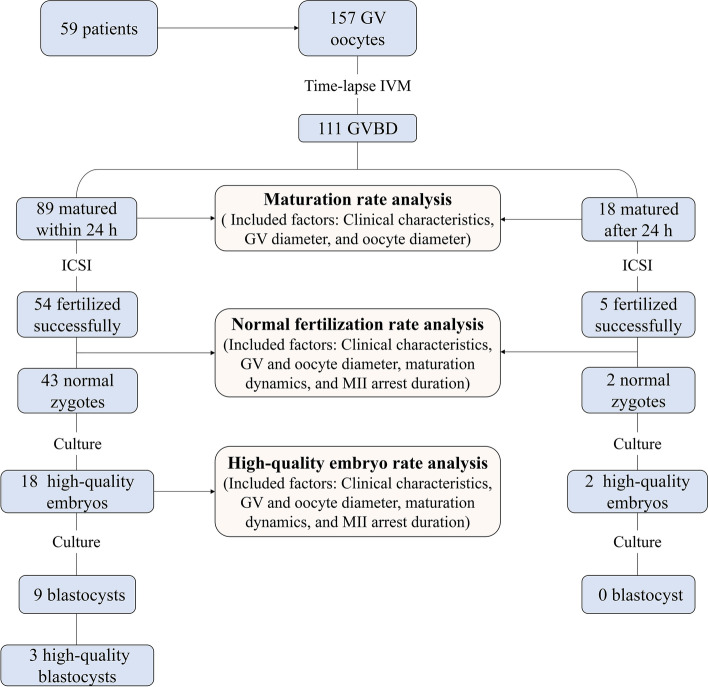
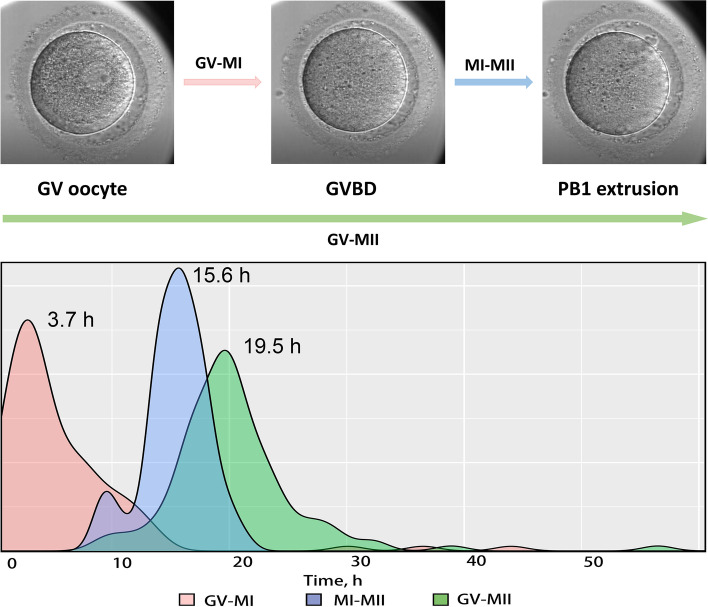
Methods: The study involved a retrospective observation by time-lapse monitoring of the IVM process of 157 donated GV oocytes from 59 infertile couples receiving ICSI in 2019, in Tongji Hospital, Wuhan, China. The GV oocytes derived from controlled ovarian hyperstimulation (COH) cycles underwent rescue IVM (R-IVM), and the maturation dynamics, including GVBD time (GV-MI), time from GVBD to maturation (MI-MII), maturation time (GV-MII), and MII arrest duration (MII-ICSI), were recorded by time-lapse monitoring. The matured oocytes were inseminated at different MII arrest points and subsequent embryo developments were assessed. The effects of baseline clinical characteristics, oocyte diameters, and maturation dynamics on the developmental competence of the oocytes were also analyzed.
Results: Totally, 157 GV oocytes were collected. GVBD happened in 111 oocytes, with a median GV-MI duration of 3.7 h. The median MI-MII duration was 15.6 h and the median GV-MII duration was 19.5 h. The maturation rate reached 56.7% at 24 h and 66.9% at 48 h, and the clinical factors, including patient age, FSH level, AMH level, ovarian stimulation protocol, and serum estradiol and progesterone levels on hCG trigger day, showed no effects on the 24-h maturation rate. The normal fertilization rate of oocytes resuming meiosis within 8 h and matured within 24 h was significantly higher than that of oocytes resuming meiosis after 8 h and matured after 24 h. Furthermore, among those oocytes matured within 24 h, the high-quality embryo formation rate of oocytes resuming meiosis within 4.5 h and matured within 19 h was significantly higher. All stated time was measured from the start point of IVM. Additionally, for oocytes from patients with serum progesterone levels less than 1 ng/ml on hCG trigger day, the high-quality embryo formation rate was significantly increased.
Conclusion: R-IVM technology could increase the available embryos for patients in routine COH cycles, but excessive culture beyond 24 h is not recommended. GV-MI duration of the oocyte, recorded by time-lapse system, and serum progesterone levels of patients on hCG trigger day can significantly affect the developmental potential of the IVM oocytes.
Keywords: Developmental competence; In vitro maturation; Oocyte maturation dynamics; Progesterone; Time-lapse monitoring.
© 2021. The Author(s).
Conflict of interest statement
The authors declare that they have no competing interests.
Figures
References
-
- Lee HJ, Barad DH, Kushnir VA, Shohat-Tal A, Lazzaroni-Tealdi E, Wu YG, et al. Rescue in vitro maturation (IVM) of immature oocytes in stimulated cycles in women with low functional ovarian reserve (LFOR) Endocrine. 2016;52:165–171. - PubMed
-
- Escrich L, Pellicer A, Meseguer M. Let's rescue oocytes: in vitro maturation 2.0 is coming. Fertil Steril. 2018;110:638–639. - PubMed
-
- Liu Y, Jiang H, Du X, Huang J, Wang X, Hu Y, et al. Contribution of rescue in-vitro maturation versus double ovarian stimulation in ovarian stimulation cycles of poor-prognosis women. Reprod BioMed Online. 2020;40:511–517. - PubMed
-
- Omidi M, Khalili MA, Ashourzadeh S, Rahimipour M. Zona pellucida birefringence and meiotic spindle visualisation of human oocytes are not influenced by IVM technology. Reprod Fertil Dev. 2014;26:407–413. - PubMed
MeSH terms
Grants and funding
LinkOut - more resources
Full Text Sources
Medical
