. 2022 Feb;54(1):1-8.
doi: 10.1007/s10863-021-09926-z. Epub 2021 Dec 10.

Characterization of oxidation of glutathione by cytochrome c

Affiliations

Characterization of oxidation of glutathione by cytochrome c

K B Csomó et al. J Bioenerg Biomembr. 2022 Feb.

Abstract

Cytochrome c is a member of the respiratory chain of the mitochondria. Non-membrane-bound (free) cytochrome c can be reduced by gluthatione as well as ascorbic acid. We investigated the effect of pH, Ca2+, Mg2+ and anionic phospholipids on the reduction of cytochrome c by glutathione.The reduction of cytochrome c by thiols was measured using photometry. Mitochondrial oxygen consumption was detected by use of oxygen electrode. Glutathione does not reduce cytochrome c at pH = 7.0 in the absence of Ca2+ and Mg2+. The reduction of cytochrome c by glutathione is inhibited by anionic lipids, especially cardiolipin. The typical conditions of apoptosis-elevated pH, Ca2+ level and Mg2+-increases the reduction of cytochrome c. Glutathione (5 mM) causes increased mitochondrial O2 consumption at pH = 8.0, in the presence of ADP either 1 mM Mg2+ or 1 mM Ca2+. Our results suggest that membrane bound cyt c does not oxidize glutathione. Free (not membrane bound) cytochrome c can oxidize glutathione. In mitochondria, O2 is depleted only in the presence of ADP, so the O2 depletion observed in the presence of glutathione can be related to the respiratory chain. Decreased glutathione levels play a role in apoptosis. Therefore, membrane unbound cyt c can contribute to apoptosis by oxidation of glutathione.

Keywords: Cytochrome c; Glutathione; Mitochondria.


Conflict of interest statement

The authors declare that they have no conflict of interest.

Figures

Fig. 1
Fig. 1
Cyt c reduction by GSH at differently pH. 100 µM bovine cytochrome c, 1 mM GSH, 1 mM EDTA at 25 °C. A pH = 7.0, 7.4 and 8.0 (40 mM Tris/HCl). B pH = 6.0, 6.5 (40 mM NaHCO3) and 7.0 (40 mM Tris/HCl). The reaction was started by adding cytochrome c (n = 6 ± SD)
Fig. 2
Fig. 2
Cyt c reduction by GSH at differently concentrations of Ca2+. 100 µM bovine cytochrome c, 1 mM GSH, Ca2+ concentrations 0–10 mM, 40 mM Tris/HCl (pH = 8.0), at 25 °C. The reaction was started by adding cytochrome c (n = 6 ± SD)
Fig. 3
Fig. 3
Cyt c reduction by GSH at differently concentrations of Mg2+. 100 µM bovine cytochrome c, 1 mM GSH, Mg2+ concentrations 0–10 mM 40 mM Tris/HCl (pH = 8.0), at 25 °C. The reaction was started by adding cytochrome c (n = 6 ± SD)
Fig. 4
Fig. 4
Effect of thiols on the reduction of cytochrome c. 100 µM bovine cytochrome c, 1 mM GSH, 1 mM cysteine (Cys), 0.5 mM (1 mM thiol) dithiothreitol (DTT), 40 mM Tris/HCl (pH = 8.0), at 25 °C. The reaction was started by adding cytochrome c (n = 6 ± SD)
Fig. 5
Fig. 5
Effect of phospholipids on the reduction rate of cytochrome c by GSH. 100 µM bovine cytochrome c, 40 mM Tris/HCl (pH = 8.0); 0.1 mM EDTA, at 25 °C; 250 µg/ml phosphatidic acid (PA); 250 µg/ml phosphatidyl-serine (PS); 250 μg/ml cardiolipin (CL) 1 mM GSH; 5 v/v% ethanol (phospholipid solvent). The reaction was started by adding cytochrome c
Fig. 6
Fig. 6
Effect of Ca2+, Mg2+ and phospholipids on the reduction rate of cytochrome c by GSH. 100 µM bovine cytochrome c; 40 mM Tris/HCl (pH = 8.0); 5 v/v% ethanol (cardiolipin solvent); 1 mM GSH; at 25 °C. 250 μg/ml cardiolipin (CL); 25 μg/ml cardiolipin and 1 mM Ca2+ (Ca, CL); control (cont) was without cardiolipin, Ca2+, Mg2+. The reaction was started by adding cytochrome c
Fig. 7
Fig. 7
Effect of Mg2+ on O2 consumption of mitochondria. 80 mM KCl; 20 mM TRIS/HCl; 0,1 mM EGTA; 10 mM KH2PO4; pH 8.0; 37 °C; 5 mM GSH; 1 mg mitochondrial protein/ml
Fig. 8
Fig. 8
Effect of Ca2+ on O2 consumption of mitochondria. 80 mM KCl; 20 mM TRIS/HCl; 0,1 mM EGTA; 10 mM KH2PO4; pH 8.0; 37 °C; 5 mM GSH; 1 mg mitochondrial protein/ml
Fig. 9
Fig. 9
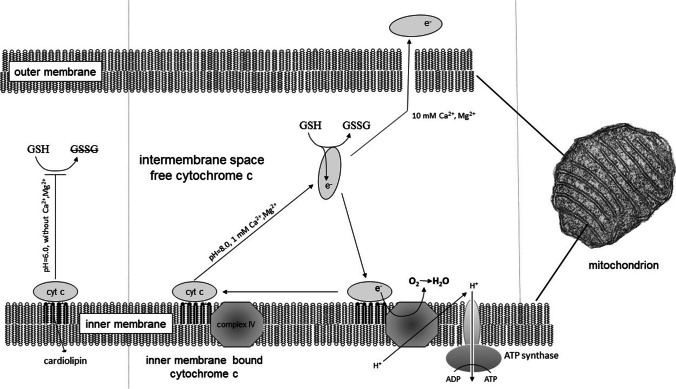
Summary. Putative mechanism of action. GSH: glutathione; GSSG: oxidized glutathione

References

    1. Alvarez-Paggi D, Hannibal L, Castro MA, Oviedo-Rouco S, Demicheli V, Tórtora V, Tomasina F, Radi R, Murgida DH. Multifunctional cytochrome c: learning new tricks from an old dog. Chem Rev. 2017;117(21):13382–13460. doi: 10.1021/acs.chemrev.7b00257. - DOI - PubMed
    1. Aon MA, Cortassa S, Maack C, O'Rourke B. Sequential opening of mitochondrial ion channels as a function of glutathione redox thiol status. J Biol Chem. 2007;282(30):21889–21900. doi: 10.1074/jbc.M702841200. - DOI - PMC - PubMed
    1. Bártfai T. Preparation of metal-chelate complexes and the design of steady-state kinetic experiments involving metal nucleotide complexes. Adv Cyclic Nucleotide Res. 1979;10:219–242. - PubMed
    1. Bayir H, Fadeel B, Palladino MJ, Witasp E, Kurnikov IV, Tyurina YY, Tyurin VA, Amoscato AA, Jiang J, Kochanek PM, DeKosky ST, Greenberger JS, Shvedova AA, Kagan VE. Apoptotic interactions of cytochrome c: Redox flirting with anionic phospholipids within and outside of mitochondria. Biochem Biophys Acta. 2006;1757:648–659. - PubMed
    1. Beatrice MC, Stiers DL, Pfeiffer DR. The role of glutathione in the retention of Ca2+ by liver mitochondria. J Biol Chem. 1984;259(2):1279–1287. doi: 10.1016/S0021-9258(17)43600-3. - DOI - PubMed

Publication types

LinkOut - more resources