


Intake of fruits and vegetables according to pesticide residue status in relation to all-cause and disease-specific mortality: Results from three prospective cohort studies
- PMID: 34894487
- PMCID: PMC8771456
- DOI: 10.1016/j.envint.2021.107024
Intake of fruits and vegetables according to pesticide residue status in relation to all-cause and disease-specific mortality: Results from three prospective cohort studies
Abstract
Background: Intake of conventionally grown fruits and vegetables (FVs) is an important route of exposure to pesticide residues in the general population. However, whether health risk stemming from exposure to pesticides through diet could offset benefits of consuming FVs is unclear.
Objective: We assessed the association of FV intake, classified according to their pesticide residue status, with total and cause-specific mortality.
Methods: We followed 137,378 women (NHS, 1998-2019, and NHSII, 1999-2019) and 23,502 men (HPFS, 1998-2020) without cardiovascular disease, cancer, or diabetes at baseline. FV intake was assessed using validated food frequency questionnaires and categorized as having high- or low-pesticide-residues using data from the USDA Pesticide Data Program. Cox proportional hazards models were used to estimate hazard ratios (HRs) and 95% confidence intervals (CI) for total and cause-specific mortality associated with high- and low-pesticide-residue FV intake.
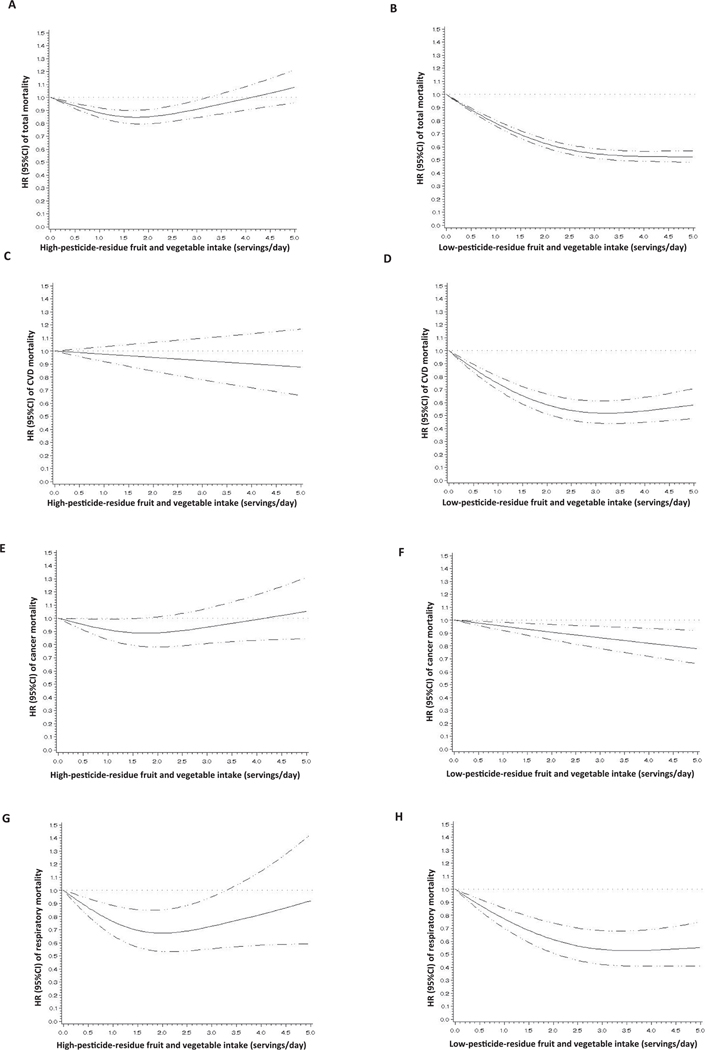
Results: A total of 27,026 deaths, including 4,318 from CVD and 6,426 from cancer, were documented during 3,081,360 person-years of follow-up. In multivariable-adjusted analyses, participants who consumed ≥4 servings/day of low-pesticide-residue FVs had 36% (95% CI: 32%-41%) lower mortality risk compared to participants who consumed <1 serving/day. The corresponding estimate for high-pesticide residue FV intake was 0.93 (95% CI: 0.81-1.07). This pattern was similar across the three most frequent causes of death (cardiovascular disease, cancer and respiratory diseases).
Conclusions: High-pesticide-residue FV intake was unrelated whereas low-pesticide residue FV intake was inversely related to all-cause mortality, suggesting that exposure to pesticide residues through diet may offset the beneficial effect of FV intake on mortality.
Copyright © 2021 The Authors. Published by Elsevier Ltd.. All rights reserved.
Conflict of interest statement
Declaration of Competing Interest
The authors declare that they have no known competing financial interests or personal relationships that could have appeared to influence the work reported in this paper.
Figures
References
-
- Eckel RH, Jakicic JM, Ard JD, de Jesus JM, Houston Miller N, Hubbard VS, Lee I-M, Lichtenstein AH, Loria CM, Millen BE, Nonas CA, Sacks FM, Smith SC, Svetkey LP, Wadden TA, Yanovski SZ, 2014. 2013 AHA/ACC Guideline on Lifestyle Management to Reduce Cardiovascular Risk. Journal of the American College of Cardiology 63 (25), 2960–2984. - PubMed
-
- Xue J, Zartarian V, Tornero-Velez R, Tulve NS, 2014. EPA’s SHEDS-multimedia model: children’s cumulative pyrethroid exposure estimates and evaluation against NHANES biomarker data. Environment international. 73, 304–311. - PubMed
-
- Yu Y, Li C, Zhang X, Zhang X, Pang Y, Zhang S, Fu J, 2012. Route-specific daily uptake of organochlorine pesticides in food, dust, and air by Shanghai residents. China. Environment international. 50, 31–37. - PubMed
-
- Fortes C, Mastroeni S, Pilla MA, Antonelli G, Lunghini L, Aprea C, 2013. The relation between dietary habits and urinary levels of 3-phenoxybenzoic acid, a pyrethroid metabolite. Food and chemical toxicology: an international journal published for the British Industrial Biological Research Association. 52, 91–96. - PubMed
Publication types
MeSH terms
Substances
Grants and funding
LinkOut - more resources
Full Text Sources
