. 2021 Dec 11;9(1):61.
doi: 10.1186/s40462-021-00296-0.

Migration distance affects how closely Eurasian wigeons follow spring phenology during migration

Affiliations

Migration distance affects how closely Eurasian wigeons follow spring phenology during migration

Mariëlle L van Toor et al. Mov Ecol. .

Abstract

Background: The timing of migration for herbivorous migratory birds is thought to coincide with spring phenology as emerging vegetation supplies them with the resources to fuel migration, and, in species with a capital breeding strategy also provides individuals with energy for use on the breeding grounds. Individuals with very long migration distances might however have to trade off between utilising optimal conditions en route and reaching the breeding grounds early, potentially leading to them overtaking spring on the way. Here, we investigate whether migration distance affects how closely individually tracked Eurasian wigeons follow spring phenology during spring migration.

Methods: We captured wigeons in the Netherlands and Lithuania and tracked them throughout spring migration to identify staging sites and timing of arrival. Using temperature-derived indicators of spring phenology, we investigated how maximum longitude reached and migration distance affected how closely wigeons followed spring. We further estimated the impact of tagging on wigeon migration by comparing spring migratory timing between tracked individuals and ring recovery data sets.

Results: Wigeons migrated to locations between 300 and 4000 km from the capture site, and migrated up to 1000 km in a single day. We found that wigeons migrating to more north-easterly locations followed spring phenology more closely, and increasingly so the greater distance they had covered during migration. Yet we also found that despite tags equalling only around 2% of individual's body mass, individuals were on average 11-12 days slower than ring-marked individuals from the same general population.

Discussion: Overall, our results suggest that migratory strategy can vary dependent on migration distance within species, and even within the same migratory corridor. Individual decisions thus depend not only on environmental cues, but potentially also trade-offs made during later life-history stages.

Keywords: Arrival timing; Herbivore; Hidden Markov model; Mareca penelope; Migration timing; Telemetry; Thermal growing season.


Conflict of interest statement

The authors declare that they have no competing interests.

Figures
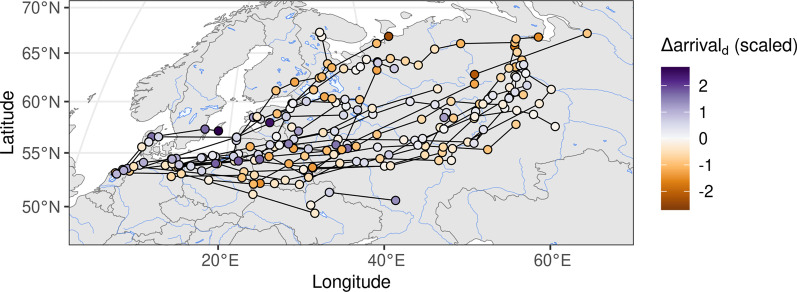
Fig. 1
Fig. 1
Arrival events at staging sites relative to the TGSonset Each arrival event is shown as point coloured according to the (scaled) Δarrivald, with arrival events early relative to the TGSonset shown in orange, and arrivals occurring later relative to the TGSonset shown in purple. Subsequent arrival events recorded for the same individual and year are connected by lines. Data are shown in interrupted Goode Homolosine projection
Fig. 2
Fig. 2
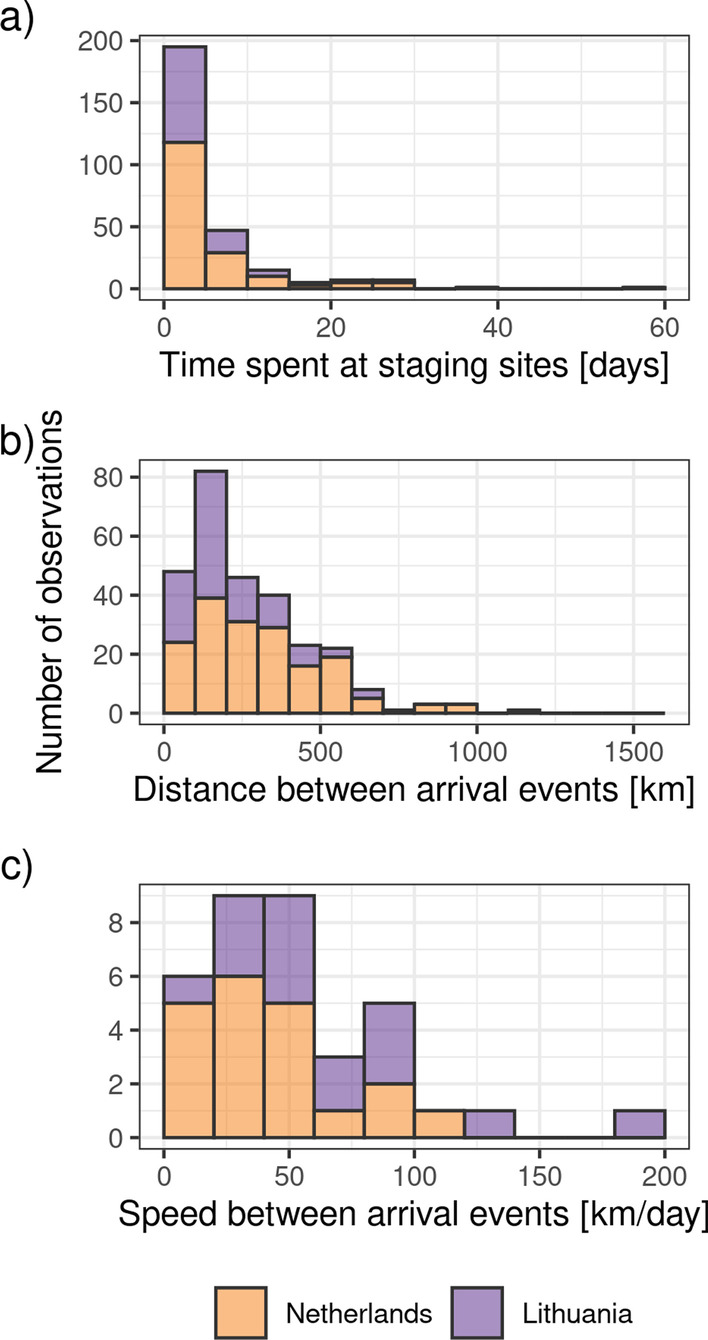
Summaries for staging duration, and distance and speed between subsequent staging sites. a shows the time that individuals spent at staging sites in days; b shows geodesic distance between subsequent staging sites in kilometers; and c shows how fast individuals traveled between staging sites, calculated as the distance shown in (b) divided by the time between the last location in one staging site, and the first location recorded in the subsequent staging site
Fig. 3
Fig. 3
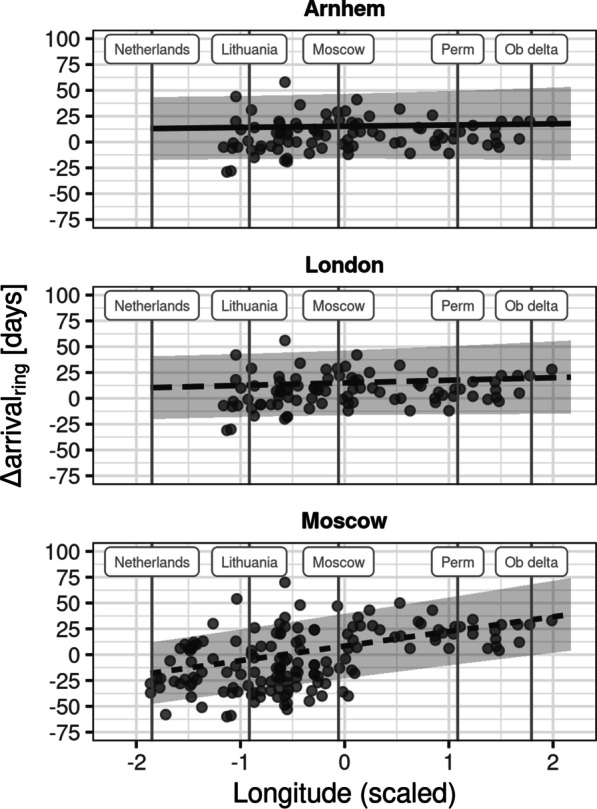
Timing of arrival compared to ring recovery data. The scatterplots show how the delay of tagged wigeons relative to ring recovery data changes of longitude. Points represent the measured Δarrivalring, the lines and shaded areas show the estimates and 95% CIs for the effect of longitude for the respective ringing scheme. Three three panels show the data and model estimates for the ringing schemes of a Arnhem, b London, and c Moscow, respectively. Vertical lines and labels provide reference longitudes for locations along the migration corridor of tracked wigeons
Fig. 4
Fig. 4
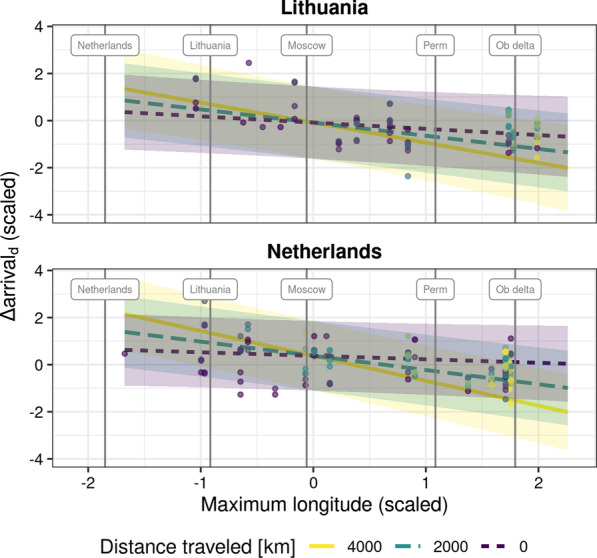
Wigeon arrival timing relative to the TGSonset Here we show the interaction effect between maximum longitude and distance traveled on Δarrivald, specifically the effect of maximum longitude for three different values of distance traveled. The lines show the estimate for the effect at the given distance, and the shaded areas reflect the 95% confidence intervals for the estimate. The data used to fit the model are shown as scatterplot. Vertical lines and labels provide reference longitudes for locations along the migration corridor of tracked wigeons

References

    1. Visser ME, Both C. Shifts in phenology due to global climate change: the need for a yardstick. Proc R Soc B Biol Sci. 2005;272(1581):2561–2569. doi: 10.1098/rspb.2005.3356. - DOI - PMC - PubMed
    1. Visser ME, Gienapp P. Evolutionary and demographic consequences of phenological mismatches. Nat Ecol Evol. 2019;3(6):879–885. doi: 10.1038/s41559-019-0880-8. - DOI - PMC - PubMed
    1. Verhulst S, Nilsson J-Å. The timing of birds’ breeding seasons: a review of experiments that manipulated timing of breeding. Philos Trans R Soc Lond Ser B Biol Sci. 2008;363(1490):399–410. doi: 10.1098/rstb.2007.2146. - DOI - PMC - PubMed
    1. McNamara JM, Houston AI. Optimal annual routines: behaviour in the context of physiology and ecology. Philos Trans R Soc Lond B Biol Sci. 2008;363(1490):301–319. doi: 10.1098/rstb.2007.2141. - DOI - PMC - PubMed
    1. Both C, Bouwhuis S, Lessells CM, Visser ME. Climate change and population declines in a long-distance migratory bird. Nature. 2006;441(7089):81–83. doi: 10.1038/nature04539. - DOI - PubMed

Grants and funding