


Artificial Intelligence for Large-Vessel Occlusion Stroke: A Systematic Review
- PMID: 34896351
- PMCID: PMC9172262
- DOI: 10.1016/j.wneu.2021.12.004
Artificial Intelligence for Large-Vessel Occlusion Stroke: A Systematic Review
Abstract
Background: Optimal outcomes after large-vessel occlusion (LVO) stroke are highly dependent on prompt diagnosis, effective communication, and treatment, making LVO an attractive avenue for the application of artificial intelligence (AI), specifically machine learning (ML). Our objective is to conduct a systematic review to describe existing AI applications for LVO strokes, delineate its effectiveness, and identify areas for future AI applications in stroke treatment and prognostication.
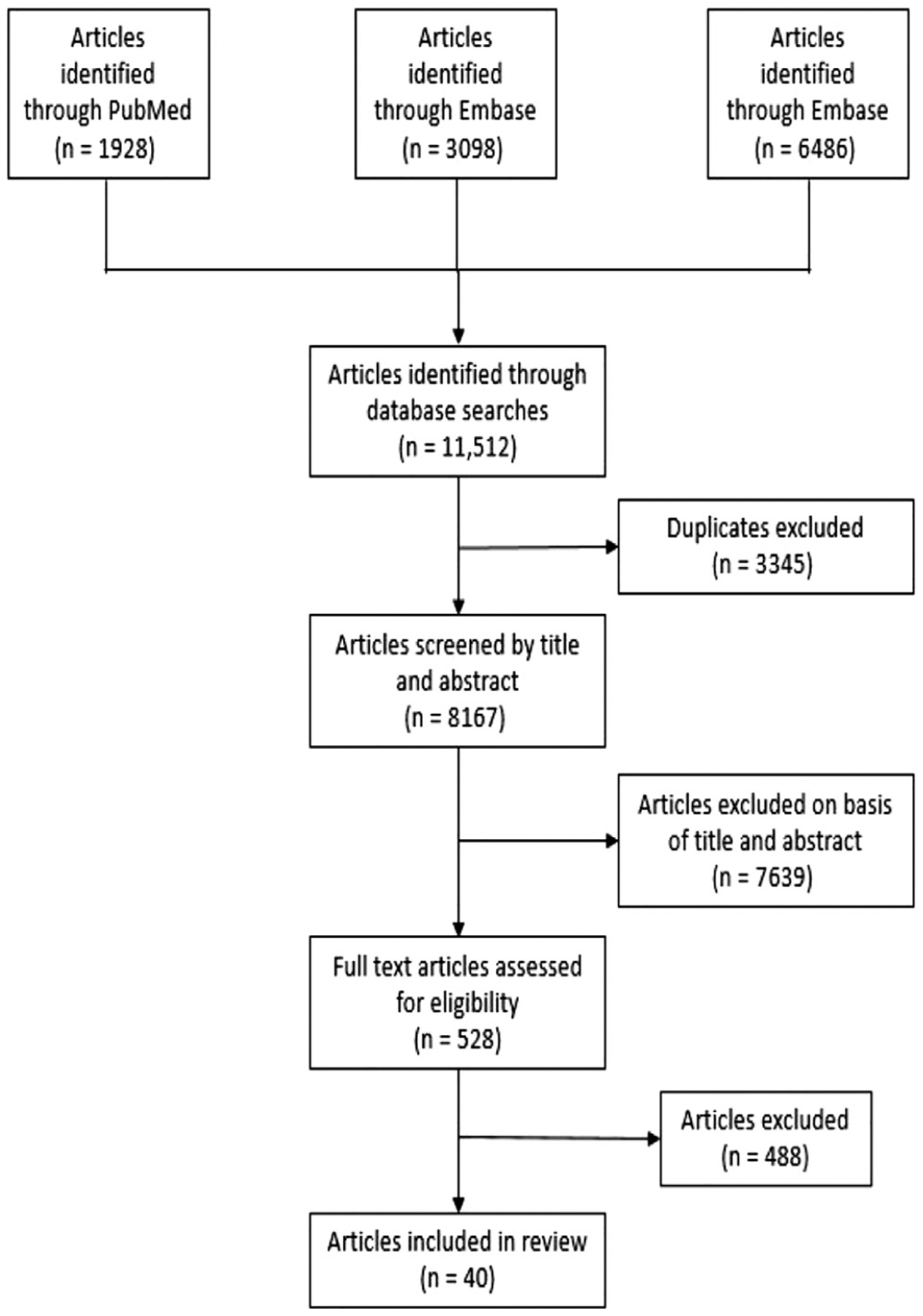
Methods: A systematic review was conducted by searching the PubMed, Embase, and Scopus databases. After deduplication, studies were screened by title and abstract. Full-text studies were screened for final inclusion based on prespecified inclusion and exclusion criteria. Relevant data were extracted from each study.
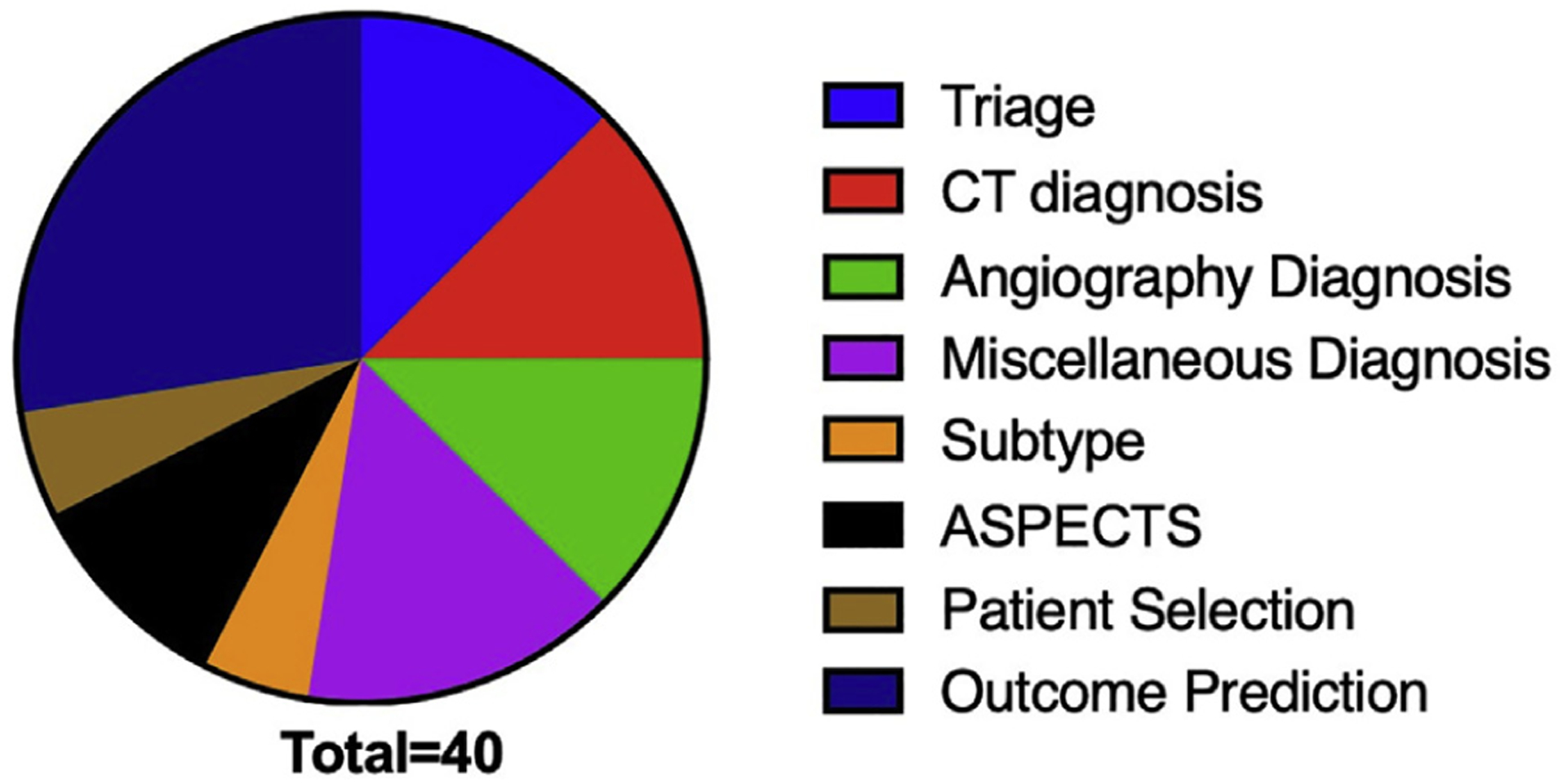
Results: Of 11,512 resultant articles, 40 were included. Of 30 studies with reported ML algorithms, the most commonly used ML algorithms were convolutional neural networks in 10 (33.3%), support vector machines in 10 (33.0%), and random forests in 9 (30.0%). Studies examining triage favored direct transport to a stroke center and predicted improved outcomes. ML techniques proved vastly accurate in identifying LVO on computed tomography. Applications of AI to patient selection for thrombectomy are lacking, although some studies determine individual patient eligibility for endovascular treatment with high accuracy. ML algorithms have reasonable accuracy in predicting clinical and angiographic outcomes and associated factors.
Conclusions: AI has shown promise in the diagnosis and triage of patients with acute stroke. However, the role of AI in the management and prognostication remains limited and warrants further research to help in decision support.
Keywords: Artificial intelligence; Ischemic stroke; Large-vessel occlusion; Machine learning; Stroke.
Copyright © 2021 Elsevier Inc. All rights reserved.
Conflict of interest statement
Conflict of interest statement: competing interests: disclosure of relationships/potential conflicts of interest: N.A.S., M.W., T.R.P., R.H.D., M.W., J.M.C., A.A.B., and V.M.T.: none. E.I.L. has shareholder/ownership interests in NeXtGen Biologics, RAPID Medical, Claret Medical, Cognition Medical, Imperative Care (formerly the Stroke Project), Rebound Therapeutics, StimMed, and Three Rivers Medical; serves as National Principal Investigator or on Steering Committees for Medtronic (merged with Covidien Neurovascular) SWIFT Prime and SWIFT Direct Trials; receives honoraria from Medtronic (training and lectures); is a consultant for Claret Medical, GLG Consulting, Guidepoint Global, Imperative Care, Medtronic, Rebound, and StimMed; serves on the advisory board for Stryker (AIS Clinical Advisory Board), NeXtGen Biologics, MEDX, Cognition Medical, and Endostream Medical; and is Site Principal Investigator for the CONFIDENCE study (MicroVention), STRATIS Study–Sub I (Medtronic). A.H.S. has financial interest/investor/stock options/ownership in Adona Medical, Inc, Amnis Therapeutics (purchased by Boston Scientific, October 2017), Blink TBI Inc., Buffalo Technology Partners Inc., Cerebrotech Medical Systems, Inc., Cognition Medical, Endostream Medical Ltd., Imperative Care, International Medical Distribution Partners, Neurovascular Diagnostics Inc., Q’Apel Medical Inc, Rebound Therapeutics Corp. (purchased in 2019 by Integra Lifesciences Corp.), Rist Neurovascular Inc., Sense Diagnostics, Inc., Serenity Medical Inc., Silk Road Medical, Spinnaker Medical, Inc., StimMed, Synchron, Three Rivers Medical Inc., Vastrax, LLC, VICIS, Inc., ViseonInc; serves as a consultant/advisory board member for Amnis Therapeutics, Boston Scientific, Canon Medical Systems USA Inc., Cerebrotech Medical Systems Inc., Cerenovus, Corindus Inc., Endostream Medical Ltd., Imperative Care, Inc. Integra LifeSciences Corp., Medtronic, MicroVention, MinnetronixNeuro, Inc., Northwest University–DSMB Chair for HEAT Trial, Penumbra, Q’Apel Medical Inc., Rapid Medical, Rebound Therapeutics Corp. (purchased by Integra LifeSciences Corp.), Serenity Medical Inc., Silk Road Medical, StimMed, Stryker, Three Rivers Medical, Inc., VasSol, and W.L. Gore & Associates; and is principal investigator/steering committee member for the following trials: Cerenovus NAPA and ARISE II; Medtronic SWIFT PRIME and SWIFT DIRECT; MicroVention FRED & CONFIDENCE; MUSC POSITIVE; and Penumbra 3D Separator, COMPASS, INVEST, TIGER.
Figures
References
-
- Brott T, Bogousslavsky J. Treatment of acute ischemic stroke. N Engl J Med. 2000;343:710–722. - PubMed
-
- Virani SS, Alonso A, Aparicio HJ, et al. Heart Disease and Stroke Statistics–2021 Update: A Report From the American Heart Association. Circulation. 2021;143:e254–e743. - PubMed
-
- Vaartjes I, O’Flaherty M, Capewell S, Kappelle J, Bots M. Remarkable decline in ischemic stroke mortality is not matched by changes in incidence. Stroke. 2013;44:591–597. - PubMed
-
- Koton S, Schneider AL, Rosamond WD, et al. Stroke incidence and mortality trends in US communities, 1987 to 2011. JAMA. 2014;312: 259–268. - PubMed
Publication types
MeSH terms
Grants and funding
LinkOut - more resources
Full Text Sources
Medical
