Educational applications of metaverse: possibilities and limitations
- PMID: 34897242
- PMCID: PMC8737403
- DOI: 10.3352/jeehp.2021.18.32
Educational applications of metaverse: possibilities and limitations
Abstract
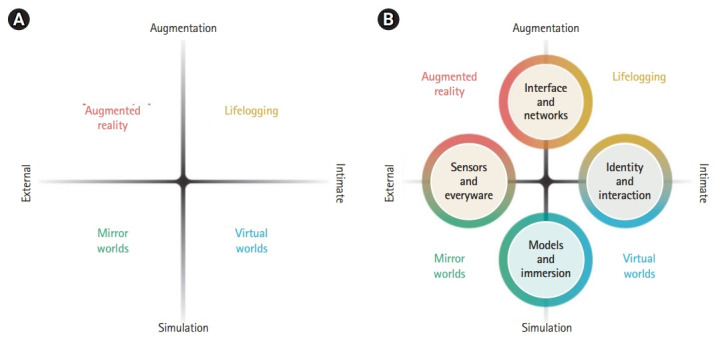
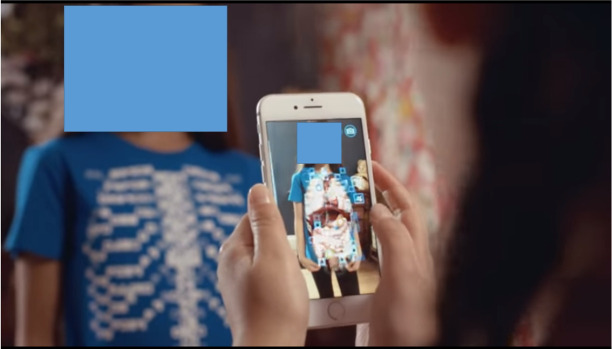
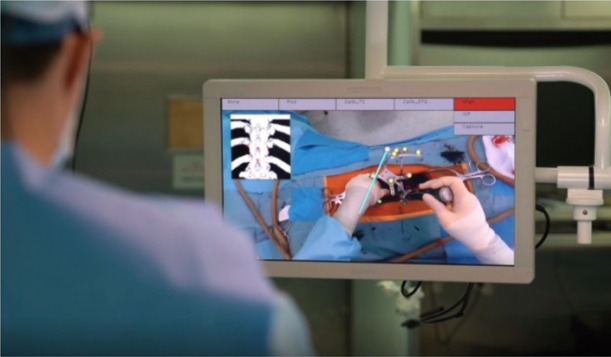
This review aims to define the 4 types of the metaverse and to explain the potential and limitations of its educational applications. The metaverse roadmap categorizes the metaverse into 4 types: augmented reality, lifelogging, mirror world, and virtual reality. An example of the application of augmented reality in medical education would be an augmented reality T-shirt that allows students to examine the inside of the human body as an anatomy lab. Furthermore, a research team in a hospital in Seoul developed a spinal surgery platform that applied augmented reality technology. The potential of the metaverse as a new educational environment is suggested to be as follows: a space for new social communication; a higher degree of freedom to create and share; and the provision of new experiences and high immersion through virtualization. Some of its limitations may be weaker social connections and the possibility of privacy impingement; the commission of various crimes due to the virtual space and anonymity of the metaverse; and maladaptation to the real world for students whose identity has not been established. The metaverse is predicted to change our daily life and economy beyond the realm of games and entertainment. The metaverse has infinite potential as a new social communication space. The following future tasks are suggested for the educational use of the metaverse: first, teachers should carefully analyze how students understand the metaverse; second, teachers should design classes for students to solve problems or perform projects cooperatively and creatively; third, educational metaverse platforms should be developed that prevent misuse of student data.
Keywords: Augmented reality; Communication; Educational personnel; Medical education; Virtual reality.
Conflict of interest statement
Bokyung Kye, Na-Ra Han, Eun-Ji Kim, and So Young Jo have been employees of the Korea Education and Research Information Service. However, this review article is not an official opinion of the Korea Education and Research Information Service, but rather reflects the authors’ opinions. Otherwise, no potential conflict of interest relevant to this article was reported.
Figures
References
-
- Kim S. Metaverse: digital world, world of emerging items. Hwaseong: PlanB Design; 2020. p. 376.
-
- Go SY, Jeong HG, Kim JI, Sin YT. Concept and developmental direction of metaverse. Korea Inf Process Soc Rev [Internet] 2021. [cited 2021 Nov 29];28:7-16. Available from: http://www.koreascience.kr/article/JAKO202122450520317.pdf.
-
- Lee S. Seongnam: Software Policy & Research Institute; 2021. Log in Metaverse: revolution of human×space×time (IS-115) [Internet] [cited 2021 Nov 29]. Available from: https://spri.kr/posts/view/23165?code=issue_reports.
-
- Smart J, Cascio J, Paffendorf J. Ann Arbor (MI): Acceleration Studies Foundation; 2007. Metaverse roadmap: pathway to the 3D web [Internet] [cited 2021 Nov 29]. Available from: https://metaverseroadmap.org/MetaverseRoadmapOverview.pdf.
-
- Han S, Lim CI. Research trends on augmented reality education in Korea from 2008 to 2019. J Educ Technol. 2020;36:505–528. doi: 10.17232/KSET.36.3.505. - DOI
Publication types
MeSH terms
LinkOut - more resources
Full Text Sources
Miscellaneous