


A one-stop shop model for improved efficiency of pre-exposure prophylaxis delivery in public clinics in western Kenya: a mixed methods implementation science study
- PMID: 34898032
- PMCID: PMC8666585
- DOI: 10.1002/jia2.25845
A one-stop shop model for improved efficiency of pre-exposure prophylaxis delivery in public clinics in western Kenya: a mixed methods implementation science study
Abstract
Introduction: In public clinics in Kenya, separate, sequential delivery of the component services of pre-exposure prophylaxis (PrEP) (e.g. HIV testing, counselling, and dispensing) creates long wait times that hinder clients' ability and desire to access and continue PrEP. We conducted a mixed methods study in four public clinics in western Kenya to identify strategies for operationalizing a one-stop shop (OSS) model and evaluate whether this model could improve client wait time and care acceptability among clients and providers without negatively impacting uptake or continuation.
Methods: From January 2020 through November 2020, we collected and analysed 47 time-and-motion observations using Mann-Whitney U tests, 29 provider and client interviews, 68 technical assistance reports, and clinic flow maps from intervention clinics. We used controlled interrupted time series (cITS) to compare trends in PrEP initiation and on-time returns from a 12-month pre-intervention period (January-December 2019) to an 8-month post-period (January-November 2020, excluding a 3-month COVID-19 wash-out period) at intervention and control clinics.
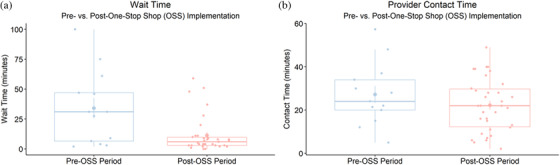
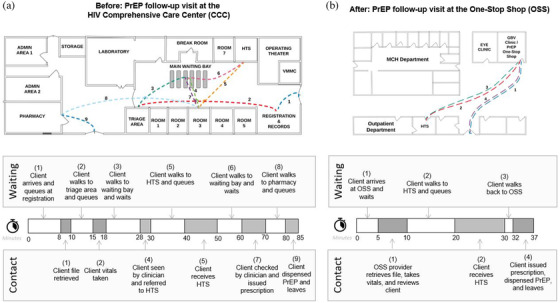
Results: From the pre- to post-period, median client wait time at intervention clinics dropped significantly from 31 to 6 minutes (p = 0.02), while median provider contact time remained around 23 minutes (p = 0.4). Intervention clinics achieved efficiency gains by moving PrEP delivery to lower volume departments, moving steps closer together (e.g. relocating supplies; cross-training and task-shifting), and differentiating clients based on the subset of services needed. Clients and providers found the OSS model highly acceptable and additionally identified increased privacy, reduced stigma, and higher quality client-provider interactions as benefits of the model. From the pre- to post-period, average monthly initiations at intervention and control clinics increased by 6 and 2.3, respectively, and percent of expected follow-up visits occurring on time decreased by 18% and 26%, respectively; cITS analysis of PrEP initiations (n = 1227) and follow-up visits (n = 2696) revealed no significant difference between intervention and control clinics in terms of trends in PrEP initiation and on-time returns (all p>0.05).
Conclusions: An OSS model significantly improved client wait time and care acceptability without negatively impacting initiations or continuations, thus highlighting opportunities to improve the efficiency of PrEP delivery efficiency and client-centredness.
Keywords: HIV prevention; Kenya; implementation science; organizational efficiency; pre-exposure prophylaxis; quality improvement.
© 2021 The Authors. Journal of the International AIDS Society published by John Wiley & Sons Ltd on behalf of the International AIDS Society.
Conflict of interest statement
JMB is an employee of Gilead Sciences. For the remaining authors, none were declared.
Figures
References
-
- World Health Organization . WHO expands recommendation on oral pre‐exposure prophlaxis of HIV infection (PrEP). Geneva: World Health Organization; 2015.
-
- PrEPWatch . Global PrEP Tracker. PrEP Watch; 2020. [cited 2020 Apr 13]. Available from: https://www.prepwatch.org/in‐practice/global‐prep‐tracker/
-
- Bavinton BR, Grulich AE. HIV pre‐exposure prophylaxis: scaling up for impact now and in the future. Lancet Public Health. 2021;6(7):e528–33. - PubMed
-
- Irungu EM, Baeten JM. PrEP rollout in Africa: status and opportunity. Nat Med. 2020;26(5):655–64. - PubMed
Publication types
MeSH terms
Grants and funding
LinkOut - more resources
Full Text Sources
Medical
Miscellaneous
