


An Association Between Montessori Education in Childhood and Adult Wellbeing
- PMID: 34899465
- PMCID: PMC8656358
- DOI: 10.3389/fpsyg.2021.721943
An Association Between Montessori Education in Childhood and Adult Wellbeing
Abstract
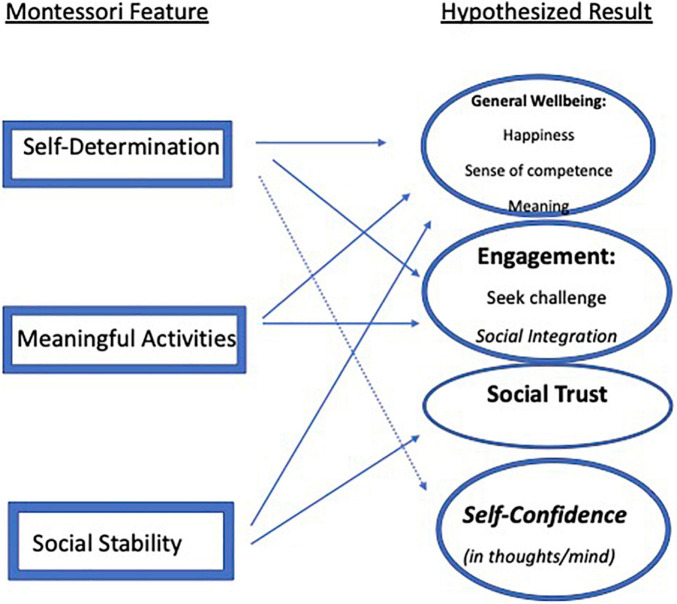
Wellbeing, or how people think and feel about their lives, predicts important life outcomes from happiness to health to longevity. Montessori pedagogy has features that enhance wellbeing contemporaneously and predictively, including self-determination, meaningful activities, and social stability. Here, 1905 adults, ages 18-81 (M = 36), filled out a large set of wellbeing scales followed by demographic information including type of school attended each year from 2 to 17. About half the sample had only attended conventional schools and the rest had attended Montessori for between 2 and 16 years (M = 8 years). To reduce the variable set, we first developed a measurement model of wellbeing using the survey data with exploratory then confirmatory factor analyses, arriving at four factors: general wellbeing, engagement, social trust, and self-confidence. A structural equation model that accounted for age, gender, race, childhood SES, and years in private school revealed that attending Montessori for at least two childhood years was associated with significantly higher adult wellbeing on all four factors. A second analysis found that the difference in wellbeing between Montessori and conventional schools existed even among the subsample that had exclusively attended private schools. A third analysis found that the more years one attended Montessori, the higher one's wellbeing as an adult. Unmeasured selection effects could explain the results, in which case research should determine what third variable associated with Montessori schooling causes adult wellbeing. Several other limitations to the study are also discussed. Although some of these limitations need to be addressed, coupled with other research, including studies in which children were randomly assigned to Montessori schools, this study suggests that attending Montessori as a child might plausibly cause higher adult wellbeing.
Keywords: Montessori; education; human development; positive psychology; wellbeing.
Copyright © 2021 Lillard, Meyer, Vasc and Fukuda.
Conflict of interest statement
The authors declare that the research was conducted in the absence of any commercial or financial relationships that could be construed as a potential conflict of interest.
Figures


References
-
- 180 Studio and Saunders Eckenhoff (2020). Seed + Spark: Using nature as a model to reimagine how we learn and live. Chicago: 180 Press.
-
- Ansari A., Winsler A. (2020). The long-term benefits of Montessori pre-K for Latinx children from low-income families. Appl. Dev. Sci. 2020 1–15. 10.1080/10888691.2020.1781632 - DOI
-
- Baker S. R. (2004). Intrinsic, extrinsic, and amotivational orientations: Their role in university adjustment, stress, well-being, and subsequent academic performance. Curr. Psychol. 23 189–202. 10.1007/s12144-004-1019-9 - DOI
LinkOut - more resources
Full Text Sources
