


Early Prediction of Disease Progression in Patients with Severe COVID-19 Using C-Reactive Protein to Albumin Ratio
- PMID: 34900028
- PMCID: PMC8664519
- DOI: 10.1155/2021/6304189
Early Prediction of Disease Progression in Patients with Severe COVID-19 Using C-Reactive Protein to Albumin Ratio
Abstract
Background: Early identification of patients with severe coronavirus disease (COVID-19) at an increased risk of progression may promote more individualized treatment schemes and optimize the use of medical resources. This study is aimed at investigating the utility of the C-reactive protein to albumin (CRP/Alb) ratio for early risk stratification of patients.
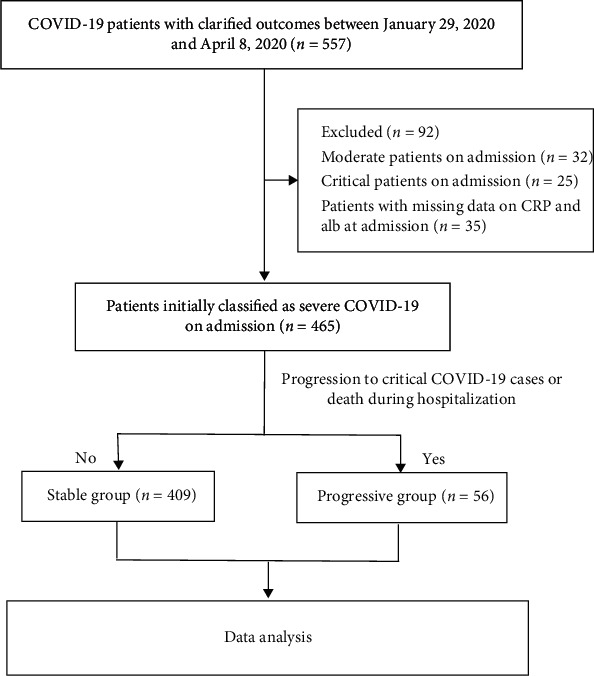
Methods: We retrospectively reviewed 557 patients with COVID-19 with confirmed outcomes (discharged or deceased) admitted to the West Court of Union Hospital, Wuhan, China, between January 29, 2020 and April 8, 2020. Patients with severe COVID-19 (n = 465) were divided into stable (n = 409) and progressive (n = 56) groups according to whether they progressed to critical illness or death during hospitalization. To predict disease progression, the CRP/Alb ratio was evaluated on admission.
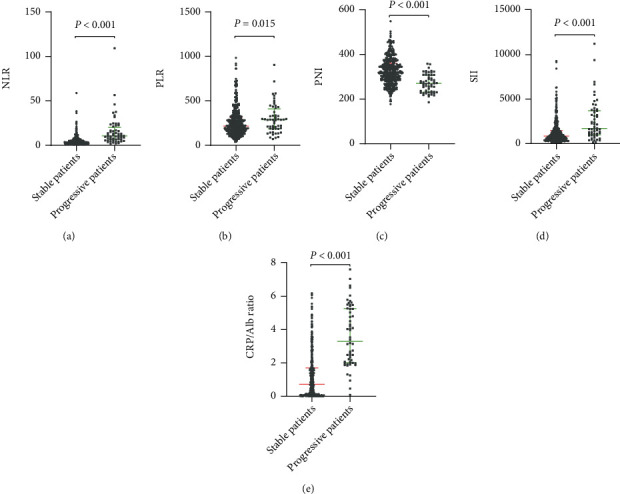
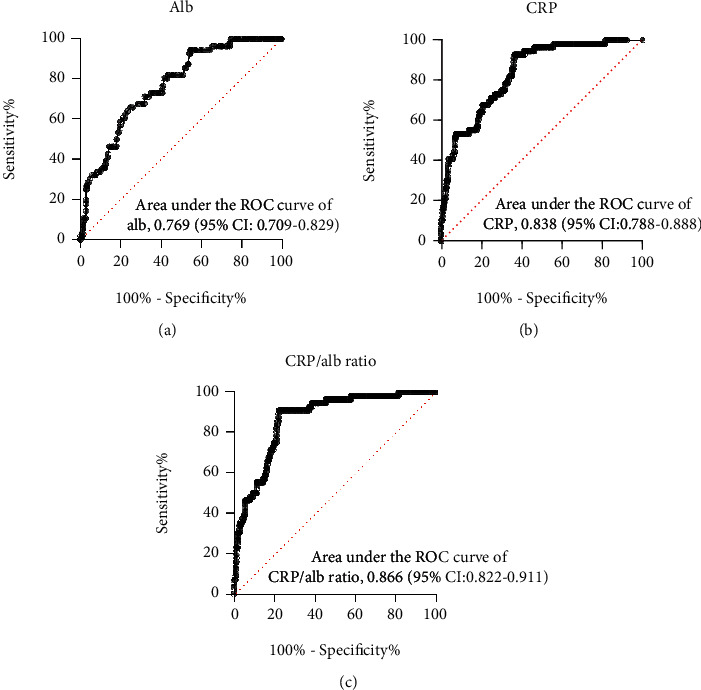
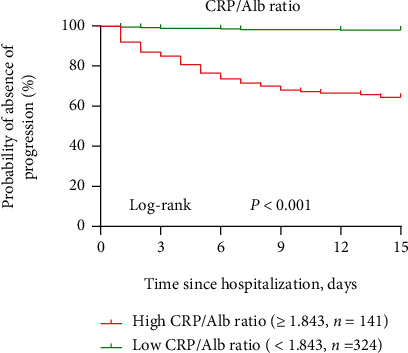
Results: The levels of new biomarkers, including neutrophil-to-lymphocyte ratio, platelet-to-lymphocyte ratio, CRP/Alb ratio, and systemic immune-inflammation index, were higher in patients with progressive disease than in those with stable disease. Correlation analysis showed that the CRP/Alb ratio had the strongest positive correlation with the sequential organ failure assessment score and length of hospital stay in survivors. Multivariate logistic regression analysis showed that percutaneous oxygen saturation (SpO2), D-dimer levels, and the CRP/Alb ratio were risk factors for disease progression. To predict clinical progression, the areas under the receiver operating characteristic curves of Alb, CRP, CRP/Alb ratio, SpO2, and D-dimer were 0.769, 0.838, 0.866, 0.107, and 0.748, respectively. Moreover, patients with a high CRP/Alb ratio (≥1.843) had a markedly higher rate of clinical deterioration (log - rank p < 0.001). A higher CRP/Alb ratio (≥1.843) was also closely associated with higher rates of hospital mortality, ICU admission, invasive mechanical ventilation, and a longer hospital stay.
Conclusion: The CRP/Alb ratio can predict the risk of progression to critical disease or death early, providing a promising prognostic biomarker for risk stratification and clinical management of patients with severe COVID-19.
Copyright © 2021 Yi Li et al.
Conflict of interest statement
The authors declare no conflicts of interest.
Figures
References
-
- World Health Organization. Weekly operational update on COVID-19. November 2021, https://www.who.int/publications/m/item/weekly-operational-update-on-cov....
MeSH terms
Substances
LinkOut - more resources
Full Text Sources
Medical
Research Materials
Miscellaneous
