


Newborn infant parasympathetic evaluation for the assessment of analgosedation adequacy in infants treated by mechanical ventilation - a multicenter pilot study
- PMID: 34900045
- PMCID: PMC8641521
- DOI: 10.5114/aoms/134234
Newborn infant parasympathetic evaluation for the assessment of analgosedation adequacy in infants treated by mechanical ventilation - a multicenter pilot study
Abstract
Introduction: Adequate analgosedation is important in infants treated in pediatric/neonatal intensive care units (P/NICUs), because both too deep and insufficient analgosedation is disadvantageous. To assess the severity of pain, several behavioral and behavioral-physiological scales are used, but their usefulness is limited. It is therefore justified to search for additional methods to assess the adequacy of analgosedation in these patients. The aim of the present study is to evaluate the usefulness of Newborn Infant Parasympathetic Evaluation (NIPE) in the assessment of analgosedation quality in infants requiring mechanical ventilation, who are treated in P/NICUs.
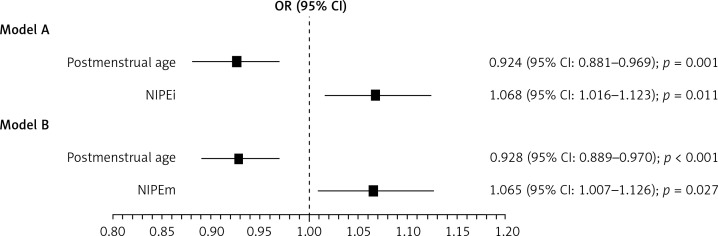
Material and methods: We performed simultaneously 180 COMFORT-B assessments and heart rate variability measurements using a NIPE monitor in 30 mechanically ventilated infants receiving analgosedation. A generalized linear mixed model with the logit link function was used in order to perform logistic regression analysis to assess the relationship between NIPEi/NIPEm and deep sedation.
Results: The multivariable logistic regression model showed that NIPEi and NIPEm values were higher when analgosedation was deep as compared to when it was moderate or insufficient (OR (95% CI): NIPEm - 1.065 (1.007-1.126), p = 0.03; NIPEi - 1.068 (1.016-1.123), p = 0.01).
Conclusions: The NIPE indexes are significantly higher in patients whose assessment on the behavioral scale indicates deep analgosedation as compared to those in whom it indicates moderate or insufficient analgosedation. Allowing continuous monitoring, the NIPE device may be a valuable assisting tool in the assessment of analgosedation quality in mechanically ventilated newborns and infants.
Keywords: COMFORT-B scale; Newborn Infant Parasympathetic Evaluation; analgosedation; heart rate variability; infant; pain.
Copyright: © 2021 Termedia & Banach.
Conflict of interest statement
The authors declare no conflict of interest.
Figures
References
-
- Schneider J, Duerden EG, Guo T, et al. Procedural pain and oral glucose in preterm neonates: brain development and sex-specific effects. Pain. 2018;159:515–25. - PubMed
LinkOut - more resources
Full Text Sources
