


The Pathobiological Basis for Thrombotic Complications in COVID-19: a Review of the Literature
- PMID: 34900401
- PMCID: PMC8651460
- DOI: 10.1007/s40139-021-00228-y
The Pathobiological Basis for Thrombotic Complications in COVID-19: a Review of the Literature
Abstract
Purpose of review: COVID-19 has rapidly evolved into a global pandemic infecting over two hundred and forty-four million individuals to date. In addition to the respiratory sequelae and systemic infection that ensues, an alarming number of micro and macrovascular thrombotic complications have been observed. This review examines the current understanding of COVID-19-associated thrombotic complications, potential mechanisms, and pathobiological basis for thromboses development.
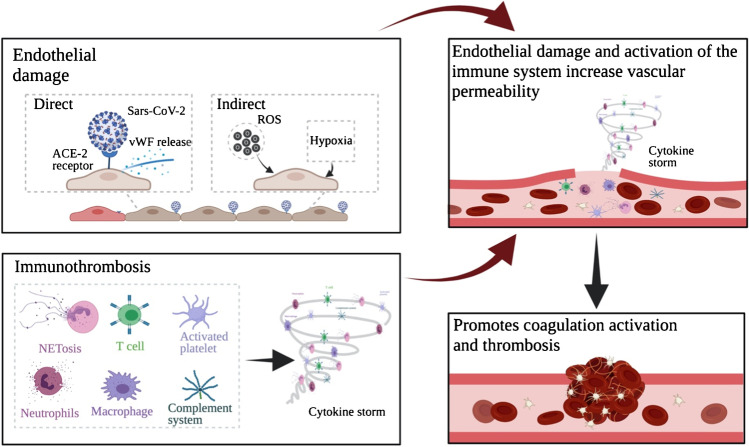
Recent findings: The endothelium plays a major role in the process due to direct and indirect injury. The immune system also contributes to a pro-thrombotic environment with immune cell dysregulation leading to excessive formation of cytokines, also called cytokine storm, and an eventual promotion of a hypercoagulable environment, known as immunothrombosis. Additionally, neutrophils play an important role by forming neutrophil extracellular traps, which are shown to be pro-thrombotic and further enhanced in COVID-19 patients. A disruption of the fibrinolysis system has also been observed.
Summary: Multiple pathways likely contribute synergistically to form a pro-thrombotic milieu. A better understanding of these factors and the complex interplay between them will lead to the improvement of diagnostic and therapeutic interventions.
Keywords: COVID-19; Coronavirus; Hypercoagulable; Immunothrombosis; Thrombosis; VTE.
© The Author(s), under exclusive licence to Springer Science+Business Media, LLC, part of Springer Nature 2021.
Conflict of interest statement
Conflict of InterestMDN has the following financial relationships to disclose: Consultant, External Scientific Advisor for Anticoagulation Science for Janssen Pharmaceuticals (Johnson & Johnson), research funding from Haemonetics and Instrument Laboratories, Scientific Advisory Board of Haima Therapeutics, Trauma Advisory Board, CSL Behring, and US Patent 9,072,760 TLR4 inhibitors for the treatment of human infectious and inflammatory disorders (issued to Neal, Wipf, Hackam, Sodhi). The additional authors declare that no significant conflicts of interest exist.
Figures
References
-
- Obi AT, Barnes GD, Napolitano LM, Henke PK, Wakefield TW. Venous thrombosis epidemiology, pathophysiology, and anticoagulant therapies and trials in severe acute respiratory syndrome coronavirus 2 infection. J Vasc Surg Venous Lymphat Disord. 2021;9(1):23–35. doi: 10.1016/j.jvsv.2020.08.030. - DOI - PMC - PubMed
Publication types
Grants and funding
LinkOut - more resources
Full Text Sources
Research Materials