Survival rates of adult and juvenile gyrfalcons in Iceland: estimates and drivers
- PMID: 34900413
- PMCID: PMC8621780
- DOI: 10.7717/peerj.12404
Survival rates of adult and juvenile gyrfalcons in Iceland: estimates and drivers
Abstract
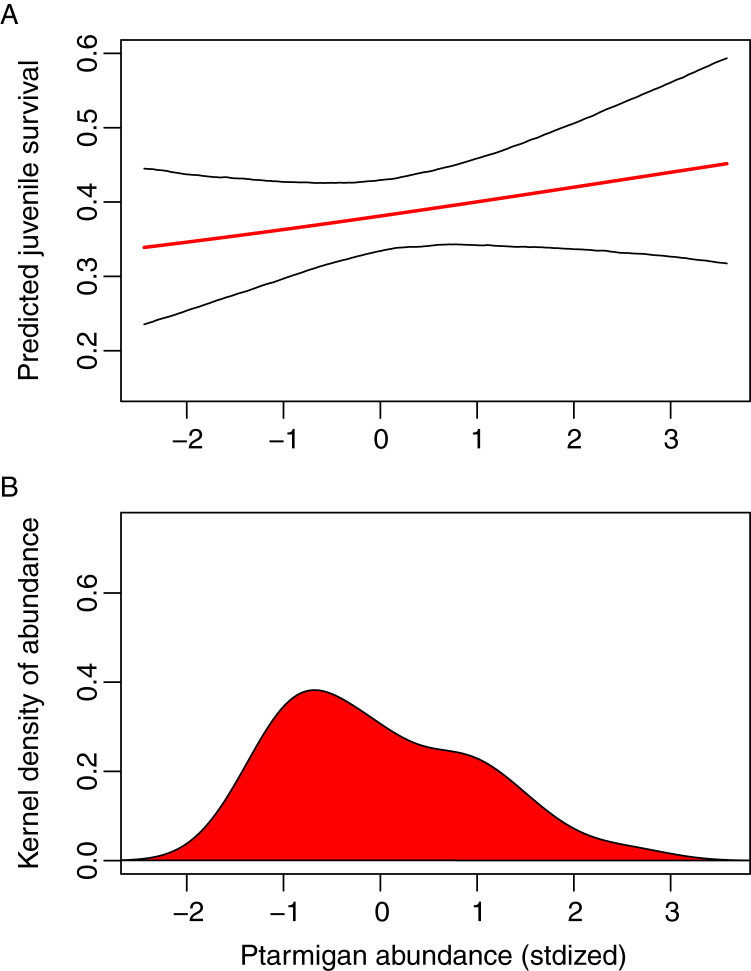
Knowledge of survival rates and their potential covariation with environmental drivers, for both adults and juveniles, is paramount to forecast the population dynamics of long-lived animals. Long-lived bird and mammal populations are indeed very sensitive to change in survival rates, especially that of adults. Here we report the first survival estimates for the Icelandic gyrfalcon (Falco rusticolus) obtained by capture-mark-recapture methods. We use a mark-recapture-recovery model combining live and dead encounters into a unified analysis, in a Bayesian framework. Annual survival was estimated at 0.83 for adults and 0.40 for juveniles. Positive effects of main prey density on juvenile survival (5% increase in survival from min to max density) were possible though not likely. Weather effects on juvenile survival were even less likely. The variability in observed lifespan suggests that adult birds could suffer from human-induced alteration of survival rates.
Keywords: Capture-recapture; Gyrfalcon; Iceland; Mark-recovery; Survival.
© 2021 Barraquand and Nielsen.
Conflict of interest statement
The authors declare that they have no competing interests.
Figures
References
-
- Barraquand F, Nielsen ÓK. Gyrfalcon survival estimation. Zenodo. 2021 doi: 10.5281/zenodo.5459150. - DOI
-
- Booms T, Cade T, Clum N. Gyrfalcon (Falco rusticolus), version 1.0. In: Billerman SM, editor. Birds of the World. Ithaca: Cornell Lab of Ornithology; 2020.
-
- Booms TL, Talbot SL, Sage GK, McCaffery BJ, McCracken KG, Schempf PF. Nest-site fidelity and dispersal of gyrfalcons estimated by noninvasive genetic sampling. Condor. 2011;113(4):768–778. doi: 10.1525/cond.2011.100178. - DOI
LinkOut - more resources
Full Text Sources