


Clustering of cardiometabolic risk factors and the continuous cardiometabolic risk score in children from Southern Brazil: a cross-sectional study
- PMID: 34900773
- PMCID: PMC8630131
- DOI: 10.1007/s40200-021-00845-9
Clustering of cardiometabolic risk factors and the continuous cardiometabolic risk score in children from Southern Brazil: a cross-sectional study
Abstract
Purpose: The present study aimed to verify the clustering of cardiometabolic risk factors for cardiovascular diseases (CVD) and its relationship with the continuous cardiometabolic risk score (cMetS).
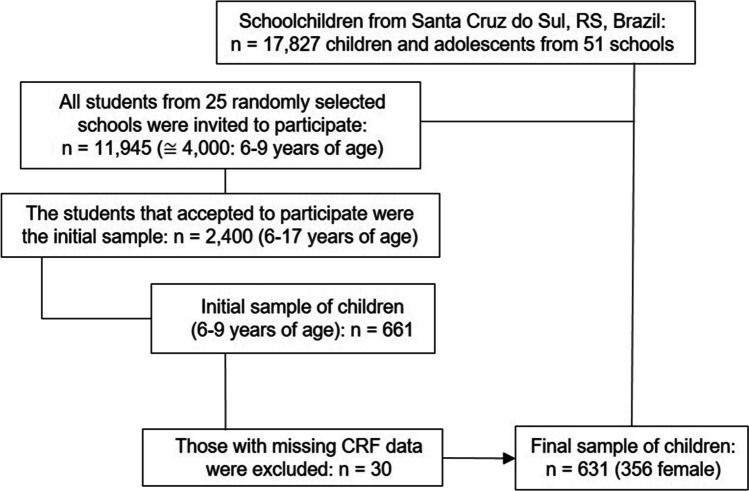
Methods: Cross-sectional study with 631 children aged 6 to 9 years. Cardiorespiratory fitness, glucose, systolic blood pressure, total cholesterol/high-density lipoprotein cholesterol ratio, triglycerides, and waist circumference were assessed. The number of children in whom the risk factors were not independently distributed was analyzed. Z-scores were computed for each risk factor to calculate the cMetS.
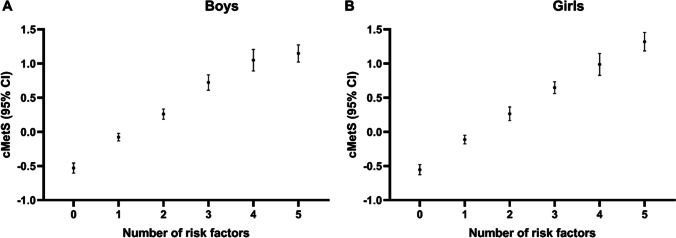
Results: There was a high proportion of children with clustering of risk factors for CVD. The clustering of risk factors was apparent in 11.3% of the children for four or more risk factors, and 21.9% had three or more risk factors. The cMetS showed a linear relationship with the increase in the number of risk factors. A cMetS value higher than 0.91 indicated clustering of cardiometabolic risk factors amongst children.
Conclusion: The use of clustering of cardiometabolic risk factors identified a high proportion of children with the presence of relevant cardiometabolic alterations. A cMetS value higher than 0.91 (relative to an international standard) indicated higher clustering of cardiometabolic risk factors amongst children.
Supplementary information: The online version contains supplementary material available at 10.1007/s40200-021-00845-9.
Keywords: Cardiovascular diseases; Child; Metabolic syndrome; Pediatric.
© Springer Nature Switzerland AG 2021.
Conflict of interest statement
Conflicts of interestThe authors state no conflict of interest.
Figures
References
-
- Reuter CP, Andersen LB, de Moura Valim AR, Reuter ÉM, Borfe L, Renner JDP, de Mello ED (2019) Cutoff points for continuous metabolic risk score in adolescents from southern Brazil. Am J Hum Biol. 10.1002/ajhb.23211 - PubMed
LinkOut - more resources
Full Text Sources
