


Vaccine Hesitancy Is a Barrier to Achieving Equitable Herd Immunity Among Racial Minorities
- PMID: 34901042
- PMCID: PMC8652048
- DOI: 10.3389/fmed.2021.668299
Vaccine Hesitancy Is a Barrier to Achieving Equitable Herd Immunity Among Racial Minorities
Abstract
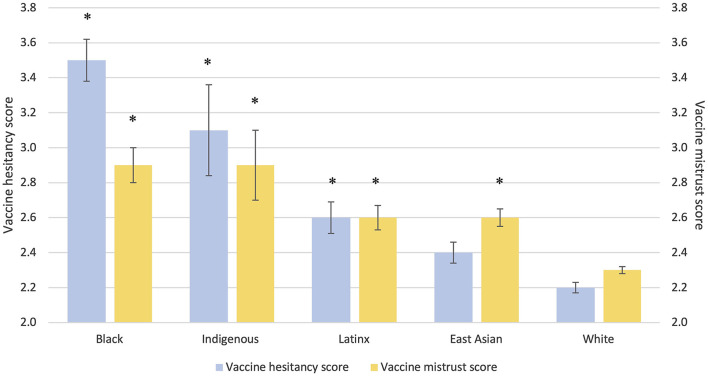
Introduction: Racial minority groups have been disproportionately affected by the 2019 novel coronavirus disease (COVID-19). Vaccine hesitancy may be a major barrier to achieving equitable herd immunity and must be addressed to reduce the excess morbidity and mortality of COVID-19 in disproportionately affected communities. This study aimed to determine if COVID-19 vaccine hesitancy, and its factors vaccine complacency and confidence, are more prominent among disproportionately affected racial minority groups. Methods:We collected data from participants aged 18 years or older from the four most populous U.S. states, including New York, California, Florida, and Texas, and Canada. Data were collected using a web-based survey platform. Data are available at http://www.covid19-database.com. Results:Data from 4,434 participants were included [mean (SD) age = 48.7 (17.2) and 50.4% women]. Vaccine hesitancy was higher in Black, Indigenous (Native American and Indigenous People of Canada, including First Nations, Inuit and Métis), and Latinx compared to White participants, while no difference was found between East Asian and White participants. The group differences in vaccine hesitancy for Indigenous and Black compared to White participants remained after controlling for sociodemographic factors. Determinants of vaccine complacency were equivalent between disproportionately affected racial groups and white participants. Vaccine confidence (i.e., trust in vaccine benefit) was generally lower in all racial groups compared to White participants. Differences in vaccine mistrust comparing Black and East Asian to White participants remained after controlling for sociodemographic factors. Discussion:Disproportionately affected racial minorities may have higher vaccine hesitancy and lower confidence in COVID-19 vaccines. Public health and other relevant government services should address vaccine hesitancy among racial minorities using a culturally sensitive, community-centered approach to attain equitable herd immunity.
Keywords: 3C model; COVID-19; herd immunity; racial minorities; vaccine acceptance; vaccine hesitancy.
Copyright © 2021 Gerretsen, Kim, Quilty, Wells, Brown, Agic, Pollock and Graff-Guerrero.
Conflict of interest statement
PG reports receiving research support from the Canadian Institute of Health Research (CIHR), Ontario Ministry of Health and Long-Term Care, Ontario Mental Health Foundation (OMHF), and the Centre for Addiction and Mental Health (CAMH). AG-G has received support from the United States National Institute of Health, CIHR, OMHF, Consejo Nacional de Ciencia y Tecnologia, the Instituto de Ciencia y Tecnologia del DF, the Brain & Behavior Research Foundation (Formerly NARSAD), the Ontario Ministry of Health and Long-Term Care, the Ontario Ministry of Research and Innovation Early Research Award, and Janssen. The remaining authors declare that the research was conducted in the absence of any commercial or financial relationships that could be construed as a potential conflict of interest.
Figures
References
-
- Schmidt H, Gostin LO, Williams MA. Is It Lawful and Ethical to Prioritize Racial Minorities for COVID-19 Vaccines?. (2020). Available online at: https://jamanetwork.com/journals/jama/fullarticle/2771874 (accessed November 19, 2020). - PubMed
-
- National Academies of Sciences E . Framework for Equitable Allocation of COVID-19 Vaccine (2020). Available online at: https://www.nap.edu/catalog/25917/framework-for-equitable-allocation-of-... (accessed November 19, 2020). - PubMed
-
- Government of Canada SC . COVID-19 Mortality Rates in Canada's Ethno-Cultural Neighbourhoods (2020). Available online at: https://www150.statcan.gc.ca/n1/pub/45-28-0001/2020001/article/00079-eng... (accessed January 15, 2021).
-
- Cheung J. Black People and Other People of Colour Make Up 83% of Reported COVID-19 Cases in Toronto. CBC News. (2020). Available online at: https://www.cbc.ca/news/canada/toronto/toronto-covid-19-data-1.5669091 (accessed January 15, 2021).
-
- City of Toronto . COVID-19: Status of Cases in Toronto. Toronto. City of Toronto. (2020). Available online at: https://www.toronto.ca/home/covid-19/covid-19-latest-city-of-toronto-new... (accessed January 15, 2021).
LinkOut - more resources
Full Text Sources
