


COVID-Related Stress and Work Intentions in a Sample of US Health Care Workers
- PMID: 34901752
- PMCID: PMC8651505
- DOI: 10.1016/j.mayocpiqo.2021.08.007
COVID-Related Stress and Work Intentions in a Sample of US Health Care Workers
Abstract
Objective: To evaluate relationships between coronavirus disease 2019 (COVID-19)-related stress and work intentions in a sample of US health care workers.
Patients and methods: Between July 1 and December 31, 2020, health care workers were surveyed for fear of viral exposure or transmission, COVID-19-related anxiety or depression, work overload, burnout, and intentions to reduce hours or leave their jobs.
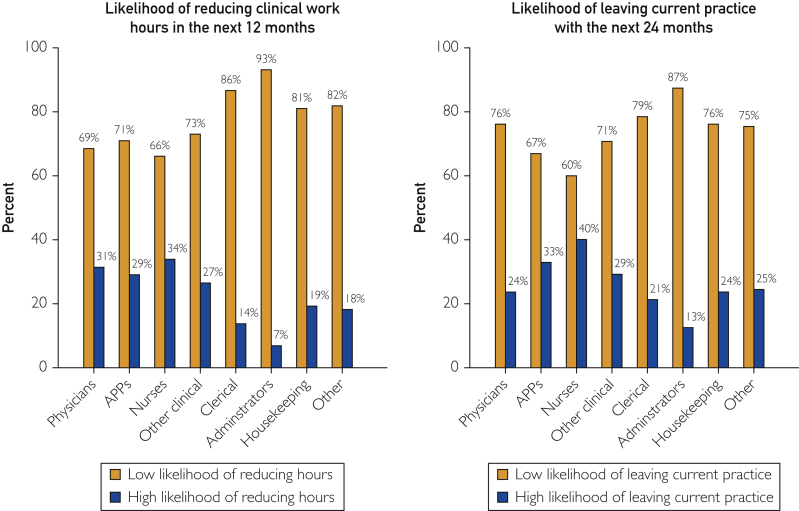
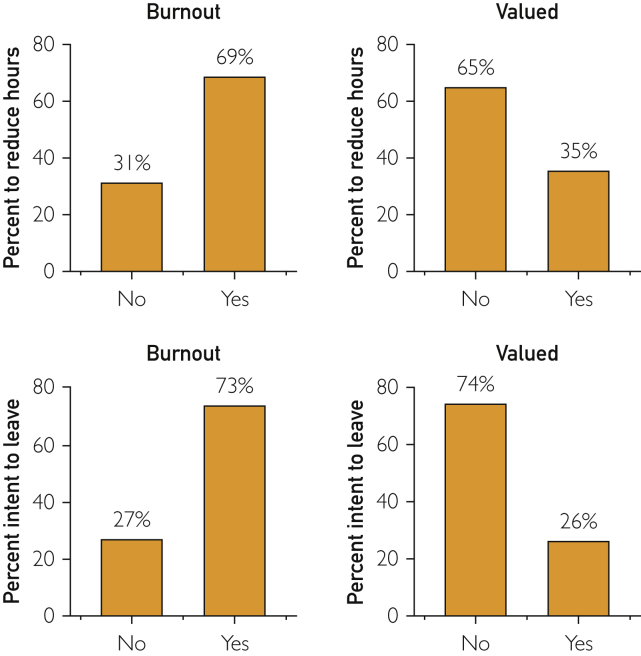
Results: Among 20,665 respondents at 124 institutions (median organizational response rate, 34%), intention to reduce hours was highest among nurses (33.7%; n=776), physicians (31.4%; n=2914), and advanced practice providers (APPs; 28.9%; n=608) while lowest among clerical staff (13.6%; n=242) and administrators (6.8%; n=50; all P<.001). Burnout (odds ratio [OR], 2.15; 95% CI, 1.93 to 2.38), fear of exposure, COVID-19-related anxiety/depression, and workload were independently related to intent to reduce work hours within 12 months (all P<.01). Intention to leave one's practice within 2 years was highest among nurses (40.0%; n=921), APPs (33.0%; n=694), other clinical staff (29.4%; n=718), and physicians (23.8%; n=2204) while lowest among administrators (12.6%; n=93; all P<.001). Burnout (OR, 2.57; 95% CI, 2.29 to 2.88), fear of exposure, COVID-19-related anxiety/depression, and workload were predictors of intent to leave. Feeling valued by one's organization was protective of reducing hours (OR, 0.65; 95% CI, 0.59 to 0.72) and intending to leave (OR, 0.40; 95% CI, 0.36 to 0.45; all P<.01).
Conclusion: Approximately 1 in 3 physicians, APPs, and nurses surveyed intend to reduce work hours. One in 5 physicians and 2 in 5 nurses intend to leave their practice altogether. Reducing burnout and improving a sense of feeling valued may allow health care organizations to better maintain their workforces postpandemic.
Keywords: AMA, American Medical Association; APP, advanced practice provider; IRB, Institutional Review Board; MAR/MCAR, missing at random vs missing completely at random; OR, odds ratio.
© 2021 THE AUTHORS.
Figures
References
-
- de Girolamo G., Cerveri G., Clerici M., et al. Mental health in the coronavirus disease 2019 emergency—the Italian response. JAMA Psychiatry. 2020;77(9):974–976. - PubMed
LinkOut - more resources
Full Text Sources
