Association of Systolic Blood Pressure With Dementia Risk and the Role of Age, U-Shaped Associations, and Mortality
- PMID: 34901993
- PMCID: PMC8669604
- DOI: 10.1001/jamainternmed.2021.7009
Association of Systolic Blood Pressure With Dementia Risk and the Role of Age, U-Shaped Associations, and Mortality
Abstract
Importance: The optimal systolic blood pressure (SBP) to minimize the risk of dementia in older age is unknown.
Objective: To investigate whether the association between SBP and dementia risk is U-shaped and whether age and comorbidity play a role in this association.
Design, setting, and participants: This cohort study used an individual participant data approach to analyze 7 prospective, observational, population-based cohort studies that were designed to evaluate incident dementia in older adults. These studies started between 1987 and 2006 in Europe and the US. Participants had no dementia diagnosis and had SBP and/or diastolic blood pressure (BP) data at baseline and incident dementia status during follow-up. Data analysis was conducted from November 7, 2019, to October 3, 2021.
Exposures: Baseline systolic BP.
Main outcomes and measures: All-cause dementia (defined using Diagnostic and Statistical Manual of Mental Disorders [Third Edition Revised] or Diagnostic and Statistical Manual of Mental Disorders [Fourth Edition] and established at follow-up measurements or in clinical practice), mortality, and combined dementia and mortality were the outcomes. Covariates included baseline antihypertensive medication use, sex, educational level, body mass index, smoking status, diabetes, stroke history, myocardial infarction history, and polypharmacy. Cox proportional hazards regression models were used, and nonlinear associations were explored using natural splines.
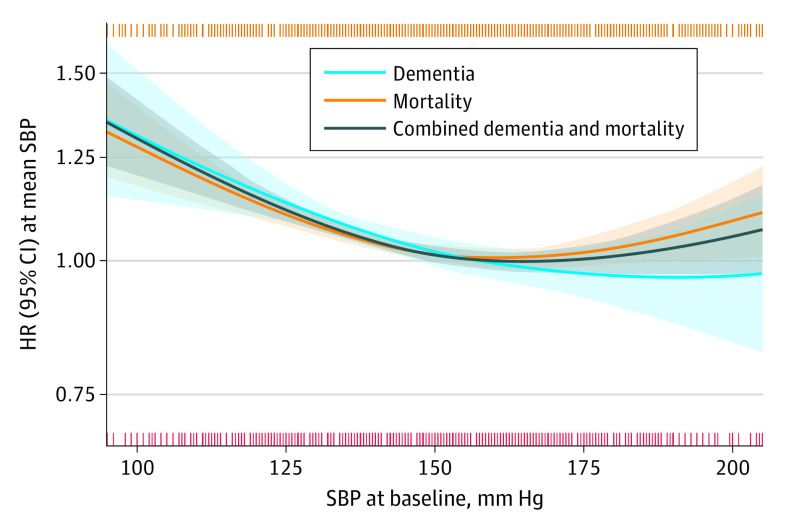
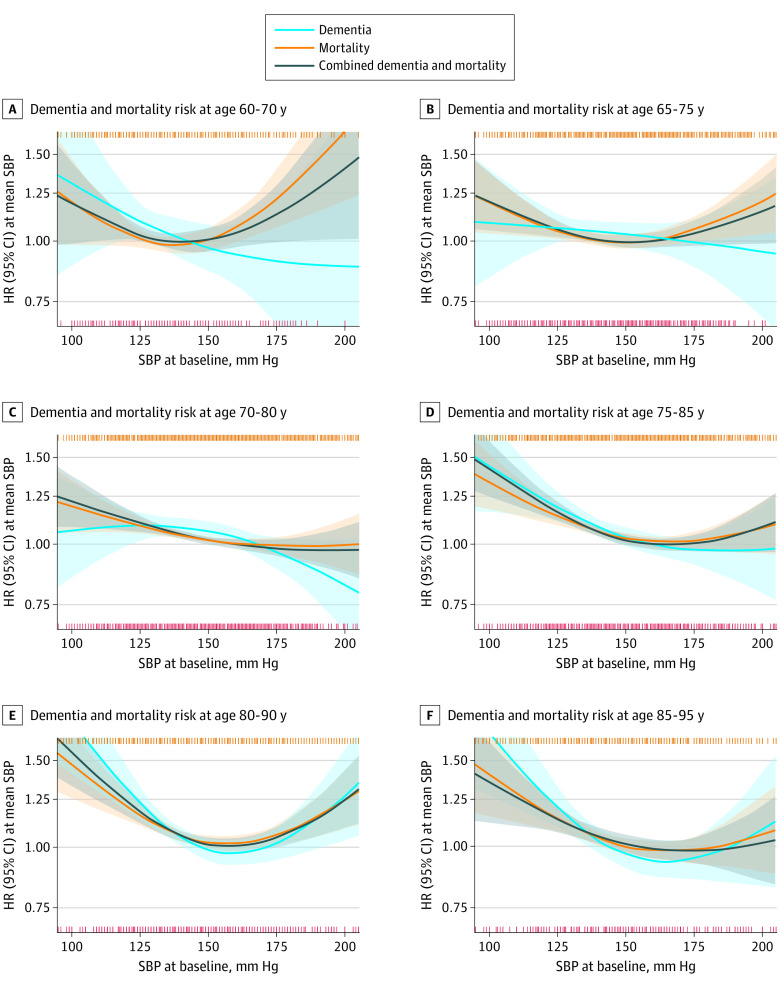
Results: The study analyzed 7 cohort studies with a total of 17 286 participants, among whom 10 393 were women (60.1%) and the mean (SD) baseline age was 74.5 (7.3) years. Overall, dementia risk was lower for individuals with higher SBP, with the lowest risk associated with an SBP of approximately 185 mm Hg (95% CI, 161-230 mm Hg; P = .001). Stratified by overlapping 10-year baseline age groups, the lowest dementia risk was observed at somewhat lower systolic BP levels in those older than 75 years (158 [95% CI, 152-178] mm Hg to 170 [95% CI, 160-260] mm Hg). For mortality, there was a clear U-shaped association, with the lowest risk at 160 mm Hg (95% CI, 154-181 mm Hg; P < .001). This U-shape occurred across all age groups, with the lowest dementia risk associated with an SBP of 134 mm Hg (95% CI, 102-149 mm Hg; P = .03) in those aged 60 to 70 years and increasing to between 155 mm Hg (95% CI, 150-166 mm Hg; P < .001) and 166 mm Hg (95% CI, 154-260 mm Hg; P = .02) for age groups between 70 and 95 years. Combined dementia and mortality risk curves closely resembled those for mortality. Associations of diastolic BP with dementia risk were generally similar but were less distinct.
Conclusions and relevance: This cohort study found that dementia risk was lower for older individuals with higher SBP levels and that more distinctly U-shaped associations appeared for those older than 75 years, but these associations cannot be explained by SBP-associated changes in mortality risk. The findings may warrant future trials on tailored BP management in older age groups that take life expectancy and health context into consideration.
Conflict of interest statement
Figures
References
Publication types
MeSH terms
Grants and funding
LinkOut - more resources
Full Text Sources
Medical