Randomized Controlled Trial
. 2022 Feb 22;145(8):575-585.
doi: 10.1161/CIRCULATIONAHA.121.055459. Epub 2021 Dec 14.

Effect of the Glucagon-Like Peptide-1 Receptor Agonists Semaglutide and Liraglutide on Kidney Outcomes in Patients With Type 2 Diabetes: Pooled Analysis of SUSTAIN 6 and LEADER

Affiliations
Randomized Controlled Trial

Effect of the Glucagon-Like Peptide-1 Receptor Agonists Semaglutide and Liraglutide on Kidney Outcomes in Patients With Type 2 Diabetes: Pooled Analysis of SUSTAIN 6 and LEADER

Ahmed M Shaman et al. Circulation. .

Abstract

Background: We assessed the effect of once-weekly semaglutide and once-daily liraglutide on kidney outcomes in type 2 diabetes.

Methods: Pooled (n=12 637) and by-trial data from SUSTAIN 6 (Trial to Evaluate Cardiovascular and Other Long-Term Outcomes With Semaglutide in Subjects With Type 2 Diabetes; n=3297) and LEADER (Liraglutide Effect and Action in Diabetes: Evaluation of Cardiovascular Outcome Results; n=9340) were assessed for albuminuria change, annual slope of estimated glomerular filtration rate (eGFR) change, and time to persistent eGFR reduction (30%, 40%, 50%, and 57%) from baseline.

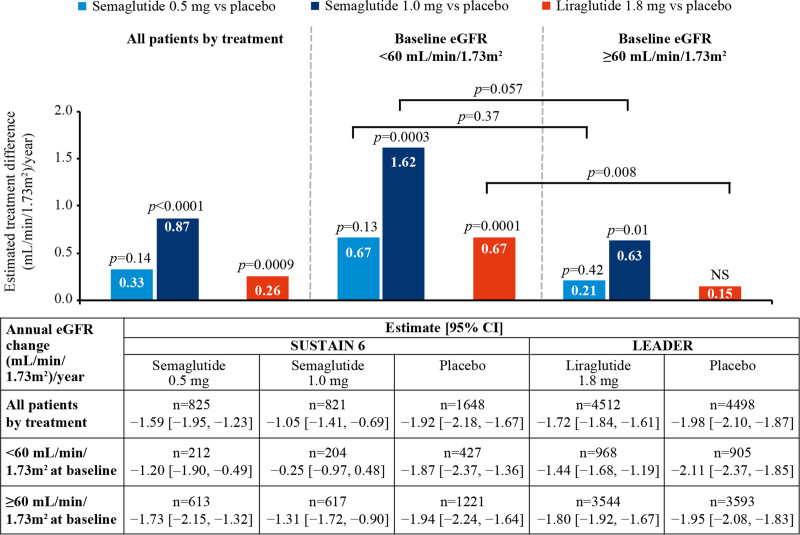
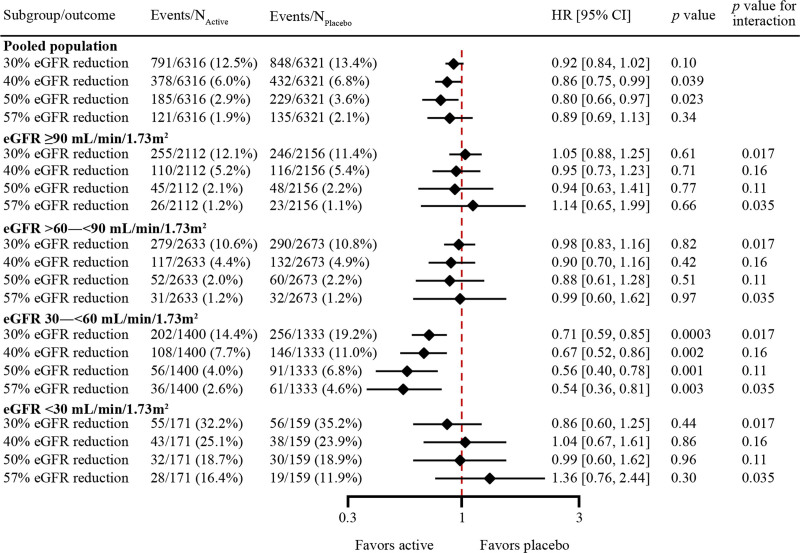
Results: The median follow-up durations were 2.1 years for SUSTAIN 6 and 3.8 years for LEADER. In the pooled analysis, semaglutide/liraglutide lowered albuminuria from baseline to 2 years after randomization by 24% versus placebo (95% CI, 20%-27%; P<0.001). Significant reductions were also observed in by-trial data analyses (P<0.001 for all), the largest being with semaglutide 1.0 mg (33% [95% CI, 24%-40%]; P<0.001) at 2 years. With semaglutide 1.0 mg and liraglutide, eGFR slope decline was significantly slowed by 0.87 and 0.26 mL/min/1.73 m2/y (P<0.0001 and P<0.001), respectively, versus placebo. Effects appeared larger in patients with baseline eGFR <60 versus ≥60 mL/min/1.73 m2 (Pinteraction=0.06 and 0.008 for semaglutide 1.0 mg and liraglutide, respectively). Semaglutide/liraglutide significantly lowered risk of persistent 40% and 50% eGFR reductions versus placebo (hazard ratio [HR], 0.86 [95% CI, 0.75-0.99]; P=0.039 and HR, 0.80 [95% CI, 0.66-0.97]; P=0.023, respectively). Similar, nonsignificant, directional results were observed for 30% and 57% eGFR reductions (HR, 0.92 [95% CI, 0.84-1.02]; P=0.10 and HR, 0.89 [95% CI, 0.69-1.13]; P=0.34). In patients with baseline eGFR 30 to <60 mL/min/1.73 m2, the likelihood of persistent reduction for all thresholds was increased, ranging from HR 0.71 for 30% reduction (95% CI, 0.59-0.85; P=0.0003, Pinteraction=0.017) to 0.54 for 57% reduction (95% CI, 0.36-0.81; P=0.003, Pinteraction=0.035).

Conclusions: In patients with type 2 diabetes, semaglutide/liraglutide offered kidney-protective effects, which appeared more pronounced in patients with preexisting chronic kidney disease.

Keywords: albuminuria; chronic kidney disease; eGFR; glucagon-like peptide-1 receptor agonists; liraglutide; semaglutide; type 2 diabetes.


Figures
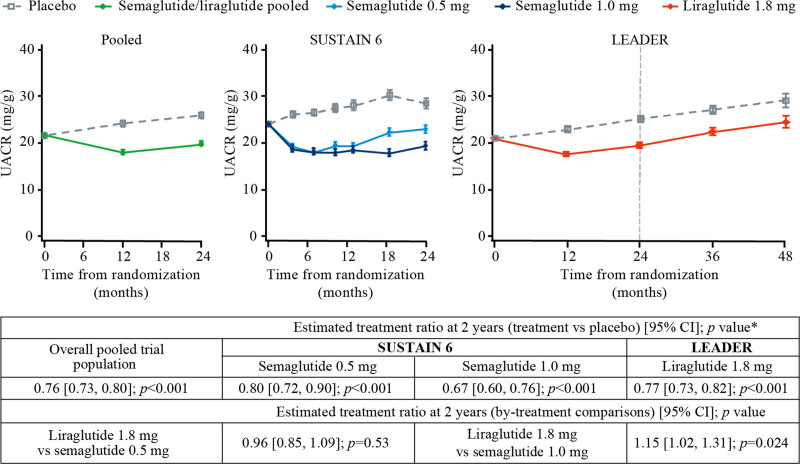
Figure 1.
Figure 1.
Effects of once-weekly semaglutide and once-daily liraglutide versus placebo on albuminuria over time. *Estimated geometric mean ratio calculated for each active treatment group versus the respective placebo group. Geometric mean values of albuminuria over time with semaglutide and liraglutide by trial as compared with placebo were estimated using a mixed model for repeated measures with an unstructured covariance matrix for repeated measures. Urinary albumin-to-creatinine ratio (UACR) was included as a dependent variable (which was log-transformed) with treatment and visits as fixed factors and baseline UACR as a covariate (log-transformed). Pooled analyses were done using the same model with trial also included as a fixed factor. LEADER indicates Liraglutide Effect and Action in Diabetes: Evaluation of Cardiovascular Outcome Results; and SUSTAIN 6, Trial to Evaluate Cardiovascular and Other Long-Term Outcomes With Semaglutide in Subjects With Type 2 Diabetes.
Figure 2.
Figure 2.
Effects of once-weekly semaglutide and once-daily liraglutide versus placebo on average annual eGFR decline. Effects of once-weekly semaglutide and once-daily liraglutide versus placebo on average annual estimated glomerular filtration rate (eGFR) decline (slope) in all patients and according to baseline eGFR. N is the number of patients whose samples/measures were available at the point of analysis. Slope analyses were performed on the intent-to-treat population. Slope analyses of eGFR were performed using a random-slope model by trial with change from baseline as dependent variable and baseline value and time (in years) as covariate and treatment as a fixed factor and the interaction between treatment and time. Patient-specific intercepts and time as random effects assuming a bivariate normal distribution for these effects were included in the model. Analyses by subgroups were performed by including the respective subgroups as a fixed factor and the interaction with treatment. Data shown were averaged over 2 years. LEADER indicates Liraglutide Effect and Action in Diabetes: Evaluation of Cardiovascular Outcome Results; and SUSTAIN 6, Trial to Evaluate Cardiovascular and Other Long-Term Outcomes With Semaglutide in Subjects With Type 2 Diabetes.
Figure 3.
Figure 3.
Effects of semaglutide and liraglutide versus placebo on time to the first persistent reduction in eGFR in the pooled population and subgroups according to eGFR at baseline. Effects of semaglutide and liraglutide versus placebo on time to the first persistent reduction in estimated glomerular filtration rate (eGFR) of 30%, 40%, 50%, and 57% from baseline in the pooled population and subgroups according to eGFR (mL/min/1.73 m2) at baseline. Time to persistent reduction of eGFR from baseline was analyzed independently from each other. Subgroup analyses were performed by including subgroup as a fixed factor and the interaction between subgroup and treatment. HR indicates hazard ratio.
Figure 4.
Figure 4.
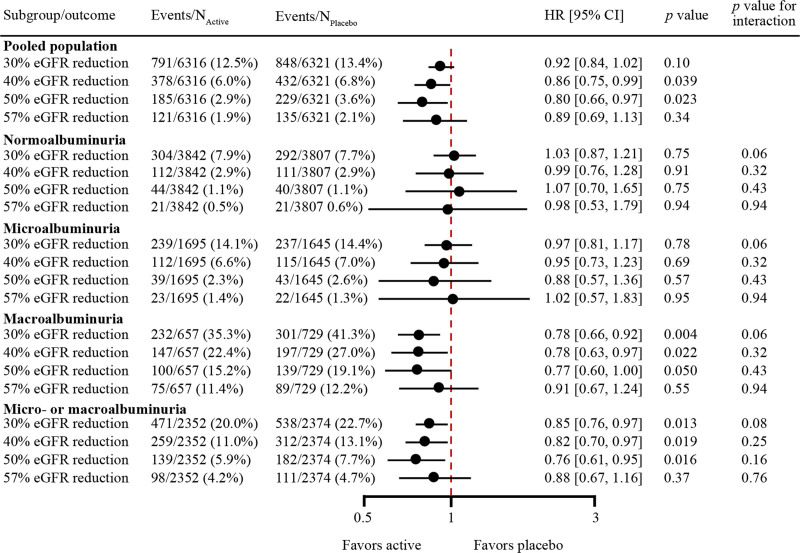
Effects of semaglutide and liraglutide versus placebo on time to the first persistent reduction in eGFR in the pooled population and subgroups defined by the level of albuminuria at baseline. Effects of semaglutide/liraglutide versus placebo on time to the first persistent reduction in estimated glomerular filtration rate (eGFR) of 30%, 40%, 50%, and 57% from baseline in the pooled population and subgroups defined by the level of albuminuria at baseline. Time to persistent reduction of eGFR from baseline was analyzed independently from each other. Subgroup analyses were performed by including subgroup as a fixed factor and the interaction between subgroup and treatment. HR indicates hazard ratio.

References

    1. Koye DN, Magliano DJ, Nelson RG, Pavkov ME. The global epidemiology of diabetes and kidney disease. Adv Chronic Kidney Dis. 2018;25:121–132. doi: 10.1053/j.ackd.2017.10.011 - PMC - PubMed
    1. Tuttle KR, Bakris GL, Bilous RW, Chiang JL, de Boer IH, Goldstein-Fuchs J, Hirsch IB, Kalantar-Zadeh K, Narva AS, Navaneethan SD, et al. . Diabetic kidney disease: a report from an ADA consensus conference. Diabetes Care. 2014;37:2864–2883. doi: 10.2337/dc14-1296 - PMC - PubMed
    1. Roglic G. WHO Global report on diabetes: a summary. Int J Noncommun Dis. 2016;1:3–8.
    1. Liyanage T, Ninomiya T, Jha V, Neal B, Patrice HM, Okpechi I, Zhao MH, Lv J, Garg AX, Knight J, et al. . Worldwide access to treatment for end-stage kidney disease: a systematic review. Lancet. 2015;385:1975–1982. doi: 10.1016/S0140-6736(14)61601-9 - PubMed
    1. United States Renal Data System. Annual data report: chapter 7: healthcare expenditures for persons with CKD. Published 2018. Accessed November 7, 2021. https://www.usrds.org/media/1718/v1_c07_ckd_costs_18_usrds.pdf

Publication types

MeSH terms