


Does virtual reality increase the efficacy of psychotherapy for young adults with mild-to-moderate depression? A study protocol for a multicenter randomized clinical trial
- PMID: 34903251
- PMCID: PMC8666832
- DOI: 10.1186/s13063-021-05809-1
Does virtual reality increase the efficacy of psychotherapy for young adults with mild-to-moderate depression? A study protocol for a multicenter randomized clinical trial
Abstract
Background: The improvement of psychological treatments for depression in young adults is a pressing issue highlighted in the literature. Its relevance is determined not only because young adults are underrepresented in research, but also to prevent chronic severe mental health disorders later in life. Engagement is considered a key factor for a good therapeutic outcome, especially among young patients. In this sense, virtual reality could be particularly suited to engage young adults in the therapy process. This project aims to improve the psychological treatment of mild-to-moderate depression in young adults by testing out the efficacy of virtual reality-enhanced personal construct therapy (PCT-VR), as compared to personal construct therapy alone (PCT) and to the reference standard cognitive behavioral therapy (CBT). In contrast to CBT, PCT neither educates patients about depression nor gives them directions on the changes to be made in their dysfunctional behaviors or cognitions. Rather, PCT explores the coherence (or conflicts) of thoughts and behaviors with respect to the person's sense of identity and focuses on meaning-making processes.
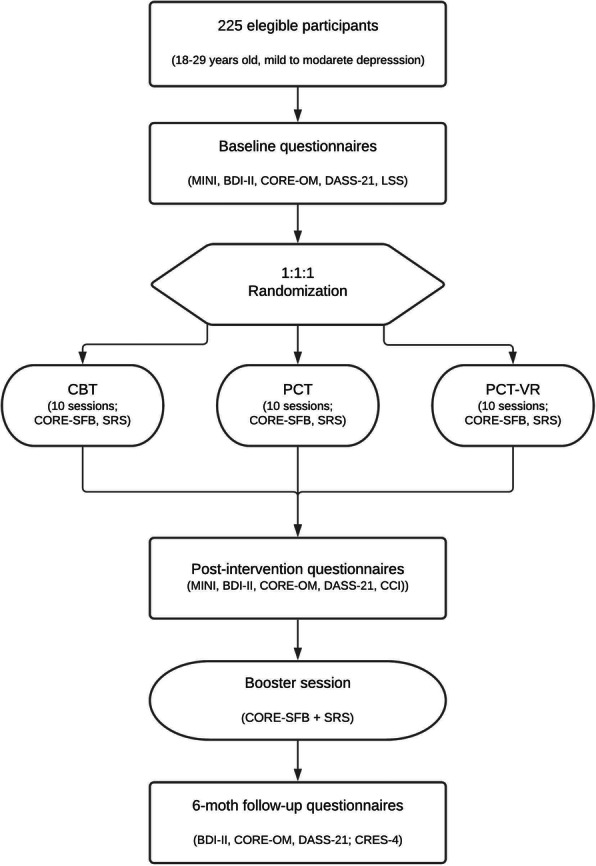
Methods: The efficacy of this innovative intervention (PCT-VR) will be compared to PCT and to CBT in a randomized clinical trial. The study includes an appraisal of therapists' adherence and independent assessments to preserve internal validity. The Beck Depression Inventory-II is the primary outcome measure for calculating both statistical and clinical significance, but other outcomes will also be assessed (e.g., functioning, well-being, anxiety, stress) at pre- and post-therapy and at 6-month follow-up. The trial will be conducted in a naturalistic context, mostly at the usual health care center of each patient. A sample of 225 participants is targeted to reach enough statistical power to accomplish the goals of the study.
Discussion: We expect that providing evidence for PCT-VR will widen the repertoire of evidence-based technology-based psychotherapeutic interventions for young adults and contribute to the prevention of deteriorating courses of the disorder.
Trial registration: ClinicalTrials.gov NCT04321525 . Registered on 18 February 2020.
Keywords: Cognitive behavioral therapy; Personal construct therapy; Prevention, Psychotherapy efficacy; Repertory grid technique; Self and identity; Therapeutic alliance; Therapy engagement; Virtual reality.
© 2021. The Author(s).
Conflict of interest statement
GF and MA have founded and have a small share of Mind and Identity SL, a spin-off company created to commercialize EYME.
The other authors declare that they have no competing interests.
Figures
References
-
- Boffin N, Bossuyt N, Declercq T, Vanthomme K, Van Casteren V. Incidence, patient characteristics and treatment initiated for GP-diagnosed depression in general practice: results of a 1-year nationwide surveillance study. Fam Pract. 2012;29(6):678–687. - PubMed
-
- Mitchell AJ, Rao S, Vaze A. Can general practitioners identify people with distress and mild depression? A meta-analysis of clinical accuracy. J Affect Disord. 2011;130(1–2):26–36. - PubMed
-
- Kessing LV. Severity of depressive episodes according to ICD-10: prediction of risk of relapse and suicide. Br J Psychiatry. 2004;184:153–156. - PubMed
-
- Birmaher B, Brent D. AACAP Work Group on Quality Issues, Bernet W, Bukstein O, Walter H, et al. Practice parameter for the assessment and treatment of children and adolescents with depressive disorders. J Am Acad Child Adolesc Psychiatry. 2007;46(11):1503–1526. - PubMed
Publication types
MeSH terms
Associated data
Grants and funding
LinkOut - more resources
Full Text Sources
Medical
